








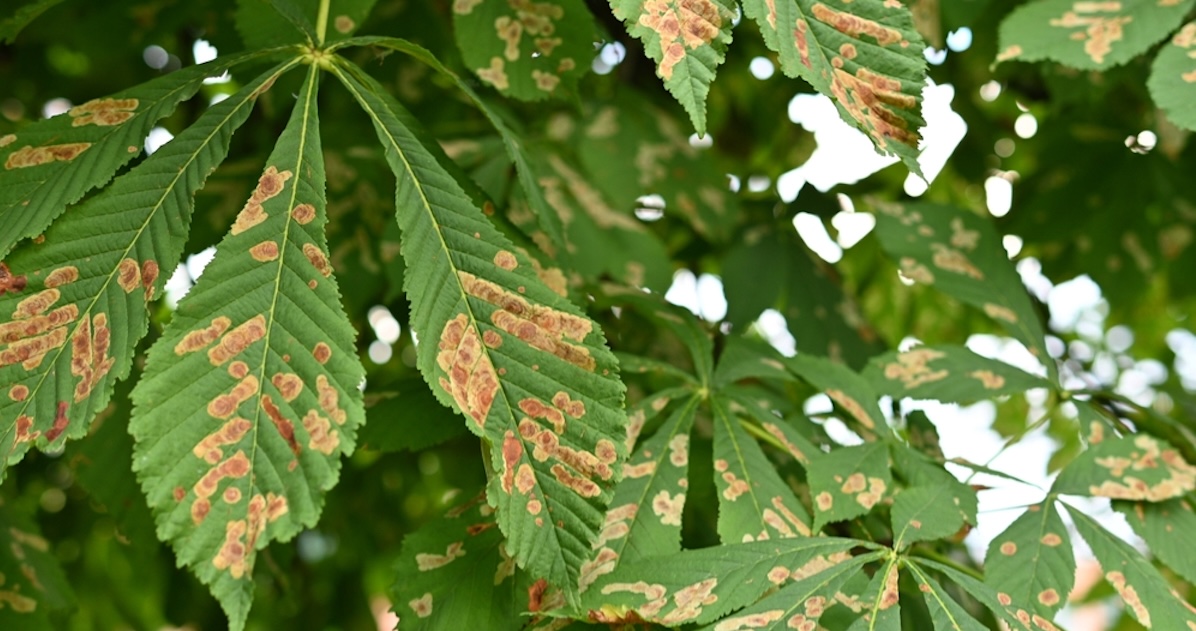
A GM American chestnut tree was promoted as a way to bring back an iconic species to North American forests – but the GM tree did not live up to expectations
Summary
The American chestnut tree is on the brink of extinction in the United States, due to widespread infection by an imported pathogenic fungus. Researchers at the State University of New York College of Environmental Science and Forestry (SUNY ESF) developed a genetically modified (GM) American chestnut, that was claimed to better resist the fungus, for forest restoration. They later enlisted the support and collaboration of The American Chestnut Foundation (TACF). However, in a shock announcement in 2023, TACF said they were withdrawing support for the GM tree due to “significant performance limitations” – the trees’ poor blight tolerance, substandard growth, and increased mortality. TACF also revealed that the SUNY ESF researchers had mistakenly given the wrong GM tree line to TACF for testing. However, efforts to genetically engineer American chestnut trees for resistance to the fungus continue. Meanwhile, organisations focusing on breeding blight-resistant American chestnuts report good progress in long-term programmes.
Facts at-a-glance
The American chestnut tree has been decimated in the United States and Canada by an imported pathogenic fungus that causes chestnut blight.
Claims
- Researchers at the State University of New York College of Environmental Science and Forestry (SUNY ESF) announced in 2013 that they had developed a genetically engineered (genetically modified, GM) blight-resistant American chestnut for forest restoration.[1]
- Their work was supported by The American Chestnut Foundation (TACF),[2] which called the GM tree a “revolutionary transgenic American chestnut tree with enhanced blight tolerance” for use in “restoration” of the species.[3]
- SUNY ESF researcher and GM tree developer William Powell claimed that “genetic engineering can revive” North America’s “once vast chestnut forests”.[4]
- From 2019, US media promoted the potential of the GM tree to restore the species in North America,[5]claiming the GM approach was superior to traditional breeding.[6]
Results
- In a shock announcement in December 2023, after participating in the project for over 11 years and providing over $2 million in funding, TACF said they were withdrawing support for the GM tree, as well as for petitions for regulatory authorisation for planting in the wild. TACF said the decision was due to “significant performance limitations” – the trees’ poor blight tolerance, substandard growth, and increased mortality.[7]
- TACF also revealed that from as early as 2016, the SUNY ESF researchers had mistakenly given the wrong GM tree line to TACF for testing – a variant called Darling 54 (D54). TACF said this GM variant had a large DNA deletion in a native gene, which could impede the trees’ performance.[8]
- TACF demanded that SUNY ESF withdraw its petition to the USDA to release the GM trees into the wild, but it has not done so[9] and is moving ahead with the project.[10] In this venture, SUNY ESF has support from other organisations, such as the New York Chapter of TACF and the New York State Department of Environmental Conservation.[11] TACF still hopes genetic engineering can succeed.[12]
- Meanwhile TACF’s cross-breeding programme is showing promising results[13] and a US-based biologist reports thousands of healthy, wild American chestnuts growing on his land.[14]
Companies
- According to TACF, SUNY ESF engaged with private investors who formed American Castanea to commercialise production of the GM tree now known to be D54.[15]
Patents
- A patent on American chestnut leaf compositions comprising oxalate oxidase (an enzyme that breaks down a toxin that the blight fungus produces), on which SUNY researcher William Powell was an inventor, was filed by the University of Florida Research Foundation Inc. and the Research Foundation for the State University of New York (RF SUNY). As of March 2026 it is pending.[16]
Background
The American chestnut tree has fallen victim to the pathogenic fungus Cryphonectria parasitica.[17] The fungus was introduced into the United States in the late 1800s on imported Japanese chestnut nursery trees, which tolerate the fungus.[18] In American chestnuts, the fungus causes a disease known as chestnut blight, which has caused the functional extinction of this iconic forest tree. “Functional extinction” means that isolated specimens continue to exist, but the species has undergone such a drastic decline that it no longer plays any significant ecological role.
The fungal infection makes the parent tree die back. Though new trees re-sprout from the base, the young trees often become infected and die before reaching sexual maturity and so do not reproduce. The ecologically and economically devastating loss of American chestnuts led to the enactment of plant quarantine laws in the US.[19]
Prior to the blight, the American chestnut was an important lumber and nut crop species.[20] The lumber was highly valued for its durability and rot resistance.[21]
Claims
Researchers at the State University of New York College of Environmental Science and Forestry (SUNY ESF) announced in 2013 that they had developed a genetically engineered (genetically modified, GM) blight-resistant American chestnut for forest restoration. They added that its blight resistance was comparable to the naturally resistant Chinese chestnut.[22]
In 2014 leading SUNY ESF researcher William Powell claimed that “genetic engineering can revive” North America’s “once vast chestnut forests”. He described GM as “a cutting-edge technology” that “promised a speedier and more precise way to create resistant American chestnuts”.[23] In parallel, the University of Georgia’s Warnell School of Forestry and Natural Resources worked on ways to genetically engineer chestnut trees.[24]
In 2018 the SUNY ESF researchers doubled down on their claims and said the transgenic American chestnut trees showed “significantly enhanced resistance to chestnut blight” and that they pass on the blight resistance to the next generation.[25]
From 2012 onwards, TAFC supported this work. In a joint announcement in 2020, TACF and SUNY ESF called the transgenic tree “revolutionary”.[26] In December 2022, in a Wall Street Journal article optimistically titled, “Technology puts American chestnut trees on the comeback trail”, Sara Fitzsimmons, TACF’s then-chief conservation officer, said, “The [genetically engineered] resistance of Darling 58 is superior to anything we’ve been able to do through traditional breeding.”[27]
The media were enthusiastic. In 2019 the Washington Post published an article about TACF’s breeding approach and SUNY ESF’s GM approach, with a headline suggesting that both methods were “close” to restoring the American chestnut.[28]
A 2023 article in National Geographic favoured the GM approach over traditional breeding. It noted the problem of the long timespan of tree breeding, with each generation taking many years, and contrasted this with the supposedly greater speed and efficiency offered by GM. The article claimed, “Genetic engineering offers a controversial shortcut to creating a truly American blight-resistant chestnut” – and blamed anti-GM activists and over-strict regulations for the delay in rollout. It quoted Allen Nichols, president of the New York chapter of the TACF, as saying, “Some people say, ‘You’re playing God.’… What I say is: We’ve been playing the devil for ages, so we need to start playing God, or we’re going to start losing a whole mess of stuff.”[29]
The US’s National Broadcasting Company (NBC), in 2023, described the impact of the SUNY ESF GM research on the American chestnut as blazing a trail for genetic engineering that had implications far beyond just the restoration of this tree, by showing “how other species can survive in our future”. NBC’s Noah Pransky told viewers that scientists were “nearing a breakthrough that could transform American agriculture” and that “scientists and tree lovers” were “banding together to save an American icon and the future of our food and forests”.[30]
Results
The SUNY ESF researchers began their transgenic research on American chestnuts in the early 1990s at the request of Stan Wirsig of TACF. SUNY ESF’s William Powell began working to identify potential genes for blight resistance.[31] The project benefited from the personal philanthropic support of former TACF board chair Herb Darling. The work became the focus of TACF’s New York Chapter.[32] Field trials with GM American chestnut trees started in 2006.[33]
Funding
Funding for Powell’s work came from TACF, the Forest Health Initiative, and the biotechnology companies ArborGen and Monsanto, among other entities.[34]
The Forest Health Initiative (FHI) was a collaboration between the US Endowment for Forestry and Communities, the US Forest Service, and Duke Energy (a large company with interests in biomass energy production[35]). The Forest Health Initiative (FHI) says it “works to plumb the potential role of biotechnology in addressing some of today’s most pressing forest health challenges”.[36] The FHI supported research into the GM American chestnut as a “test tree” for the US regulatory system and “societal” issues,[37] and over 2009–2010 provided grants of more than $1 million to Powell’s research,[38] as part of a multi-institutional grant totalling $5.2 million.[39]
According to one critical analysis, “The deep involvement of Duke Energy and other companies in the FHI raises troubling questions about the initiative’s purpose” – casting doubt on the notion that the GM American chestnut venture was ever just about conservation. The analysis continued, “Duke Energy is a founder and member organisation of the FHI Steering Committee; GE [genetically engineered] tree company ArborGen sits on the FHI Social and Environmental Committee; and the corporate-backed Institute for Forest Biosciences sits on the FHI Policy Committee. The US Endowment for Forestry and Communities, USDA Forest Service, and Duke Energy are listed as ‘primary financial sponsors’ of the Forest Health Initiative.”[40]
The analysis cites an FHI document that concludes, “Biotech trees will find their place in this world, providing fibre, fuel and even sustainable comfort food (e.g., biotech American chestnuts roasting on an open fire). This is an industry to watch, as it evolves toward ‘responsible use’ and takes its place in the pipeline of sustainable biotech products.”[41]
In 2012 Duke Energy confirmed its interest in the GM American chestnut as a tool for ‘greening’ its ecologically devastated mountaintop removal coal mine sites, as well as a source of revenue: “The tree is expected to thrive on former surface-mine sites in Central Appalachia, which has been a major coal-supply region for electric generation... In addition to its voracious appetite for carbon, the American chestnut can one day provide high-quality lumber, biomass fuel for electric generation, and a food source for people and wildlife — all potentially contributing to the region’s economic growth.”[42]
Gene of interest identified
During 2010–2018 the researchers at SUNY ESF’s American Chestnut Research and Restoration Project (ACRRP) collaborated on the GM American chestnut project with scientists at the University of Georgia’s Warnell School of Forestry & Natural Resources.[43]
The SUNY ESF team inserted a gene (called OxO) from wheat into a new line of American chestnut trees. The gene produces an enzyme, oxalate oxidase, that breaks down the toxin – oxalic acid – that the fungus produces. The buildup of oxalic acid is the primary cause of cell death in American chestnut.[44]
The SUNY ESF researchers published the results of their research in 2013, stating that their GM American chestnut had comparable blight resistance to the naturally resistant Chinese chestnut.[45] In 2018 they published results showing that the enhanced resistance was successfully transmitted to offspring.[46]However, these tests were laboratory and greenhouse experiments done on leaves and/or stems of young saplings, while the blight affects older trees (albeit before sexual maturity is reached), meaning that the conclusions that could be drawn were limited.
Support from The American Chestnut Foundation
SUNY ESF’s long-term collaborator in its venture to genetically engineer a blight-resistant American chestnut was The American Chestnut Foundation (TACF), which since 1989 has also run its own programme aimed at developing a blight-resistant tree through conventional breeding.[47]
By 2015 SUNY ESF had developed several lines of genetically engineered trees, one of which was called Darling 58 (D58). TACF said D58 showed “promise of superior blight resistance in greenhouse experiments”. Therefore TACF’s directors made the decision to support the work of SUNY ESF, as a complement to its own breeding programmes. D58 was selected for field trials, to be conducted by TACF.[48]
In TACF’s words, over 11 years the organisation provided “more than $2 million in funding to the ACRRP for their work on transgenic American chestnuts”. It gave “additional assistance, also valued at approximately $2 million, in the form of expert legal counsel, experimental design and testing, and general outreach” to provide “crucial support and guidance to ACRRP in its applications to deregulate D58.”[49]
Wider enthusiasm
In 2019, a report commissioned by the US Dept of Agriculture (USDA), the US Endowment for Forestry and Communities, and the US Environmental Protection Agency (EPA) supported claims that genetic rescue of the American chestnut was possible. However, it conceded that such an approach posed challenges due to “the complexity of tree genomes, the genetic diversity in tree populations, and the lack of knowledge about genetic mechanisms that underlie important traits.”[50]
In the same year the International Union for Conservation of Nature (IUCN) a report included the GM American chestnut as an example of genetic engineering in the service of nature conservation. The report stated that the GM trees, then thought to be D58, were “potentially ready for field trials”.[51]
Environmental studies
In 2018 SUNY ESF researchers published two studies[52] on the environmental impact of transgenic American chestnut trees, which ESF said “provide evidence that the trees have no harmful effects on germinating seeds, beneficial fungi, or larval frogs that are dependable indicators of environmental quality”.[53] However, these were greenhouse and laboratory studies on an extremely limited number of organisms and interactions. They do not reflect a natural ecosystem, which is made up of innumerable species and complex interactions, many of which are not understood.
Opposition and cautions
Opposition to the GM approach came from an alliance of environmental groups named The Campaign to STOP GE Trees, which said that the release of the GM tree into the wild would be “a massive and irreversible experiment” and would pave the way for other forest tree species to be genetically engineered and released.[54]
Biologist Dr Rachel Smolker of Biofuelwatch, co-author of a report critical of the plan,[55] said, “This would be the first one [GM tree] to be released into nature.” She told the Post that the restoration of the American chestnut is such an appealing idea that the proponents of genetic engineering are using it to win broad acceptance of the technology. “It’s about winning public support for genetically engineered trees, which has met with tremendous public resistance,” she said. “It’s a very deliberate strategy. A tree engineered for biofuels doesn’t win over the public in the same way.”[56]
Dr Smolker and Anne Petermann (of the Global Justice Ecology Project) warned that Cryphonectria was not the only pathogen that would threaten the restoration of the American chestnut. They argued that the OxO trait alone will not restore American chestnuts. This would require stacking of multiple traits, including those for resistance to Phytophthora.[57]
The voices of caution included the SUNY scientist who led the development of the GM chestnuts, William Powell. He acknowledged that long term stable resistance to Cryphonectria, based on the OxO trait alone, was unlikely to succeed. He said: “Eventually we hope to fortify American chestnuts with many different genes that confer resistance in distinct ways. Then, even if the fungus evolves new weapons against one of the engineered defences, the trees will not be helpless.”[58]
SUNY ESF seeks regulatory approval
SUNY ESF submitted a request to approve the release of its Darling 58 GM chestnut tree into the wild (a petition for non-regulated status) to the US Department of Agriculture (USDA-APHIS) in January 2020.[59]
In July 2022, USDA-APHIS issued a draft Environmental Impact Statement recommending approval of D58 for non-regulated status,[60] based on the narrow US regulatory criterion for GMOs that the tree was unlikely to pose a plant pest risk.
The Center for Food Safety opposed deregulation, stating in its comments to USDA-APHIS that the trials carried out in support of regulatory authorisation included tests on GM lines other than D58 and that no outdoor-grown D58 trees over a few years old were tested for blight resistance,[61] even though blight usually impacts trees as they get older (though before they reach sexual maturity) and the species can live for up to 600 years.[62]
Commenting to USDA-APHIS on a revised risk assessment by the USDA in 2025, TACF reiterated its concerns about the large deletion in the native gene SAL1 in the GM tree now known to be D54, on the basis that it could represent “a deleterious mutation that could be spread to the remaining wild population of American chestnuts if released in the wild”. TACF noted that its own “observations from field trials indicate an early growth and survival penalty” for GM trees that had only one copy of the OxO transgene, “though it is not clear whether this is related to SAL1 or the transgene construct itself”.
TACF added, “Some of our performance observations differ from those subsequently reported” by SUNY ESF. TACF said it “observed lower than expected inheritance of the oxalate oxidase (OxO) construct, growth and survival penalties associated with transgene inheritance, and a lack of long-term robust blight resistance among the Darling 54 progeny that inherited OxO”.[63]
In a separate comment to USDA-APHIS, biologist and molecular geneticist Dr Ricarda Steinbrecher criticised the SUNY ESF researchers’ use of the CaMV 35S promoter (a DNA sequence that controls when and where a gene is expressed) in D54. This promoter, she wrote, “may be useful as a short-term experimental promoter, but has been found unreliable and inappropriate for long-term final GMO products in the wild”. This is because plants have often been found to be able to silence this promoter, meaning that transgenes under its control (in this case, the gene for blight resistance) could be unpredictably de-activated. Dr Steinbrecher concluded, “this promoter should not be used for restoration purposes”.
Dr Steinbrecher also raised the question of whether the performance problems observed in D54 may be due to an inbuilt overactivity of the OxO gene, “which may deplete the energy of a growing or struggling tree”, or due to the disruption of its SAL1 gene. These questions remain unanswered. But whichever is the case, referring to USDA-APHIS’s remit to prevent the release of plants that may constitute a “plant pest risk”, Dr Steinbrecher wrote: “Darling 54 has the potential to be exactly such a plant pest.”[64]
Three regulatory reviews needed
Aside from the USDA, the US Food and Drug Administration (FDA) and Environmental Protection Agency (EPA) also need to review the GM tree for health and environmental risks before it can be planted outside of research plots.[65] This process “may take a few years”, according to a 2025 media article.[66]
TACF withdraws support
In a shock announcement in December 2023, after 11 years and over 2 million dollars invested in the project,[67] TACF announced that they were withdrawing support for the D58 GM American chestnut tree and for its regulatory authorisation for release into the wild. TACF cited “significant performance limitations that, from TACF’s perspective, make it unsuitable as a restoration tree”.[68] TACF cited “striking variability in Darling trees’ blight tolerance, significant losses in growth competitiveness, and increased mortality.”[69]
SUNY ESF and TACF researchers had first revealed these disappointing results to the public in a TACF webinar known as a “Chestnut Chat” in September 2023.[70] The TACF website explained the findings in detail. The Darling 58 trees had an unexpectedly high mortality rate and reduced growth, being 15% to 25% shorter than their non-GM siblings. They were also susceptible to the blight they were engineered to resist.[71]
In their December 2023 press release, TACF also revealed that the GM tree they had been propagating was not, in fact, D58 at all. Somehow, SUNY ESF had given TACF the wrong pollen and trees, as early as 2016.[72] TACF was given Darling 54 (D54) – a different GM tree variant. This meant that all field and other research on the trees done by TACF was on the wrong variant. William Pitt, TACF’s president and CEO, called it a “significant identity error”.[73]
TACF and the Canadian Chestnut Council, as well as the civil society group, the Canadian Biotechnology Action Network (CBAN) called on SUNY ESF to withdraw its petition to USDA-APHIS for deregulation of the GM American chestnut.[74]
SUNY ESF did not withdraw its petition but amended it to take account of its “labelling error”[75] – the mix-up between D58 and D54. In June 2025 USDA-APHIS opened a public comment period on its revised draft environmental impact assessment of D54. Based on the narrow remit of whether the GM tree posed a plant pest risk, USDA-APHIS – ignoring the research showing that D54 was defective and prone to blight and could therefore pose a risk to remaining naturally blight-resistant trees – concluded that it did not. It therefore recommended non-regulated status (removal from the regulatory requirements of testing, monitoring, and GMO labelling).
However, the agency stated that “commercial use of Darling 54 American chestnut is not anticipated currently” for several reasons, including that “Most growers consider Chinese chestnuts to be the best option currently available for establishing profitable orchards in eastern United States.” In contrast, the attributes of the GM tree “have yet to be established and it is susceptible to other diseases such as ink disease caused by Phytophthora cinnamomic”. Meanwhile “Chinese chestnut has resistance to ink disease in addition to blight... From the standpoint of performance characteristics, the risk of using Darling 54 American chestnut in a commercial venture is much higher than Chinese chestnut.” USDA-APHIS also noted the “risk to commercial growers from the standpoint of potential reduced public acceptance” of genetically engineered trees.[76]
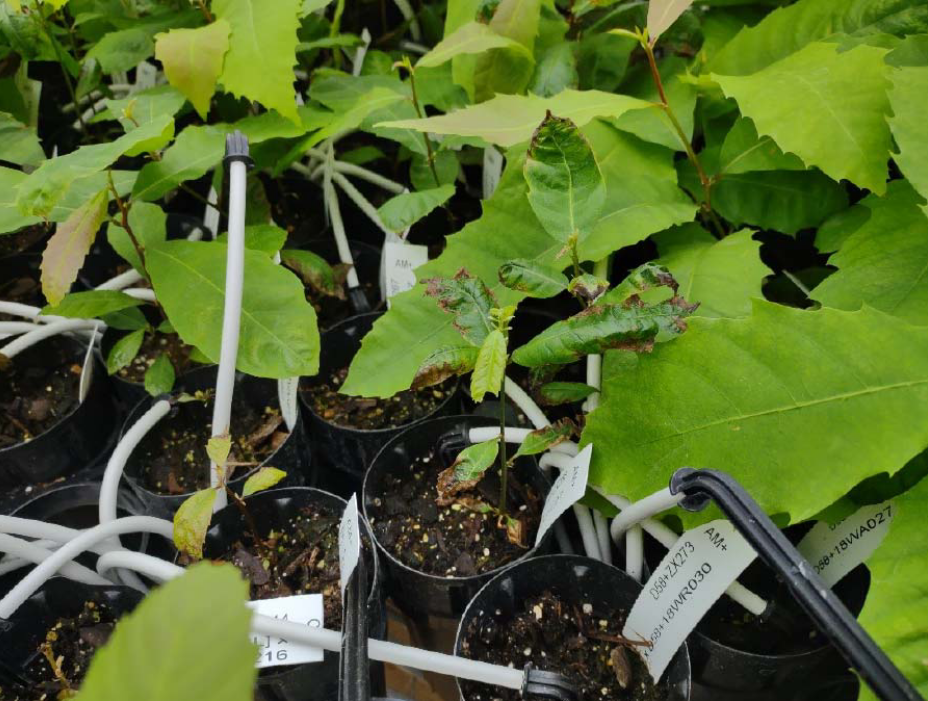
Engineered seedlings beginning to manifest characteristic leaf injury symptoms, May 2022. Image copyright: TACF
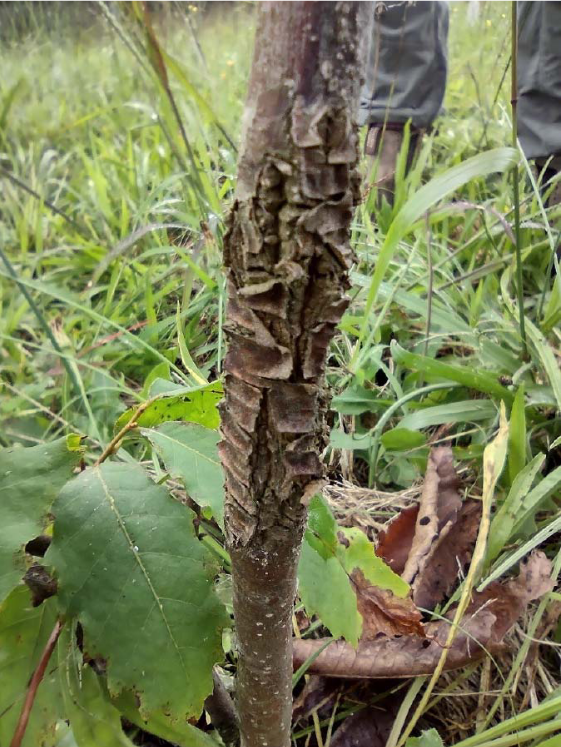
Blight cankering on surviving engineered trees at the VT Kentland BRAG plot Sept 2022. Image copyright: TACF
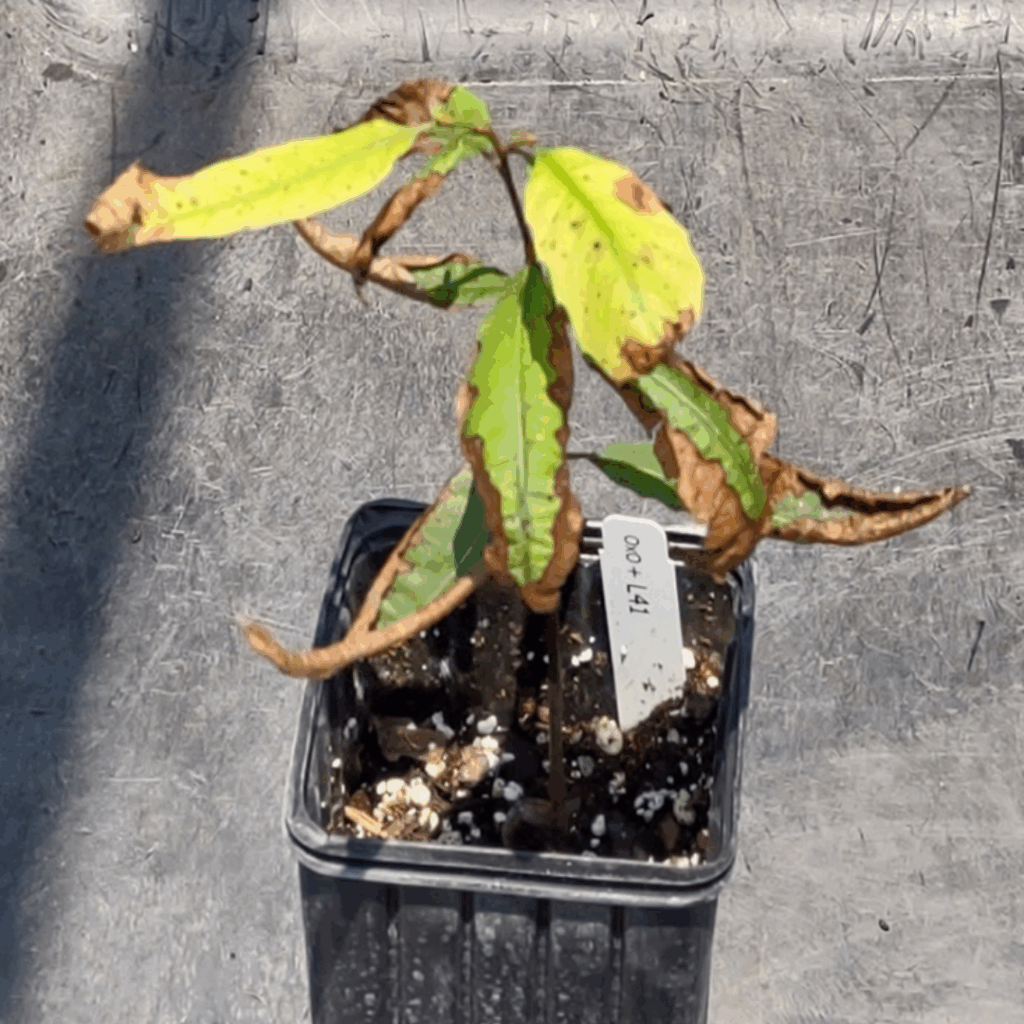
Blight symptoms on engineered seedling. Image copyright: TACF
TACF “surprised” by commercialisation plans
In another indication of the rift between TACF and the SUNY ESF researchers, in TACF’s December 2023 publicity about its withdrawal of support for the GM tree, the foundation said it was “surprised to learn in mid-2022 that directors of the SUNY ESF’s ACRRP had engaged with private investors who formed a company, American Castanea Inc, to commercialise production of the Darling tree (now known to be D54). Commercialising the transgenic American chestnut tree is contrary to statements made in regulatory filings and assurances given in public statements and to academic partners. The considerable support TACF provided to help ACRRP negotiate the regulatory process was based upon the understanding that a deregulated tree would be in the public commons.”
TACF added, “Most importantly for TACF, for-profit production of seedlings would significantly impede restoration of American chestnut – our very mission – because the profit premium placed upon the cost of seedlings would prohibitively increase the already high expense of planting trees.”[77]
In a strongly worded letter to members and supporters, TACF’s William Pitt explained that even after TACF shared its concerns with SUNY ESF about the latter’s proposal to commercialise the GM chestnut “through an exclusive partnership with American Castanea”, SUNY ESF “offered a variety of high-cost proposals to TACF, all of which continued to demonstrate their interests in using D54, a transgenic tree TACF considers unsuitable for restoration, as a means to fund their programs. SUNY ESF continued to request annual six-figure licensing fees and royalties, while requesting TACF’s continued financial support of SUNY ESF research. We believe that payment of these fees would divert critical funds from our core research and the development of an effective restoration tree.”[78]
For this reason and others relating to the tree’s “deficiencies”, TACF said it could no longer support the petition to the USDA for deregulation of the D54 GM American chestnut.[79]
TACF’s New York Chapter leaves the foundation
Despite TACF’s withdrawal of support for the D54 GM American chestnut tree, the New York Chapter of TACF (NY-TACF) continued to back it, causing the national office of TACF to formally terminate its links with the New York Chapter.[80] In a statement of 20 April 2025, Allen Nichols, president of the organisation that was the New York Chapter of TACF, wrote: “The national office of TACF gave us 30 days notice that they were severing our 35 year affiliation, and that we must discontinue the use of the name ‘New York Chapter of TACF’.”[81]
The reason, as the national office of TACF appeared to state, was the NY Chapter’s continuing support for D54: “NY-TACF’s leadership remain committed to working with SUNY-ESF and its for-profit commercial partner on the Darling 54 transgenic chestnut program. The two organisations agreed to terminate their association.”[82]
Subsequently, TACF has promoted recurrent genomic selection (RGS) – a form of marker assisted selection that uses knowledge of the genome to select naturally resistant varieties but does not result in a GMO – as its “main strategy” to achieve disease resistance, according to its Annual Report for 2023–4. Its conclusion on the GM experiment was: “Mother nature has truly shown us that ecology is hard.”[83]
The New York Chapter of TACF became American Chestnut Restoration, Inc. (ACR).[84] ACR’s sole purpose seems to be to continue the “focus on transgenic chestnut research”.[85] According to its website: “ACR is dedicated to ESF’s transgenic approach to rescuing the American chestnut as this appears to have the highest chance of success.”[86]
Genetic engineering venture continues
In spite of TACF’s withdrawal of support for the project, efforts to genetically engineer American chestnut trees for resistance to the pathogenic fungus continue at SUNY ESF.[87] The researchers are developing new lines of GM American chestnuts that combine the OxO gene with a promoter from the poplar tree. This wound-inducible promoter is intended to only drive strong expression of the OxO gene when it is needed, in response to pathogen infection or wounding of the tree. The change of promoter was an effort to conserve the tree’s energy resources and address the performance issues. In a 2021 publication reporting results of the research, the SUNY ESF scientists state that in greenhouse trials, comparable levels of blight resistance were achieved as are seen in the naturally resistant Chinese chestnut controls.[88] However, nothing has been reported since, suggesting that this venture has not thus far proven a success.
The University of Georgia Warnell School of Forestry and Natural Resources has a GM American chestnut research programme and collaborated with SUNY ESF in developing processes for generating GM seedlings.[89] SUNY ESF also has support from the New York State Department of Environmental Conservation.[90] In 2025 SUNY ESF announced that it had received new funding for its American chestnut programme.[91]
TACF still hopes that genetic engineering can succeed[92] and has retained a GM strategy in its work. It even seems to be supporting SUNY ESF’s work[93] to develop GM trees using an alternative wound-inducible promoter, stating: “TACF and other research partners are now exploring transgenic lines that use a variety of inducible promoters to express the OxO gene only under specific conditions, such as in the tissue surrounding a wound where the blight fungus is commonly introduced.”[94]
Options to restore the American chestnut
Some organisations are using conventional breeding to restore the American chestnut in North America. These include the Canadian Chestnut Council;[95] the American Chestnut Cooperators’ Foundation (ACCF);[96] and the TACF, which runs a breeding programme augmented by marker assisted selection (a technique that can speed up breeding and does not result in a GMO) in addition to its GMO programme.[97]
TACF has focused its breeding programme on crossing American chestnuts with naturally blight-resistant Chinese chestnuts and then backcrossing with American chestnuts to restore as many of the traits of the American chestnut as possible while retaining the blight resistance.[98]
In 2026 TACF scientists and collaborators published a paper reporting that crossing American chestnuts with Chinese chestnuts results in hybrids with substantial blight resistance, as well as resistance to another problematic disease called root rot. The hybrids have around 70% American chestnut ancestry. In addition, the scientists used genomic selection to predict pathogen resistance before planting and hybridization, thereby enhancing breeding efficiency. They concluded: “Recurrent selection within hybrid populations remains a key approach to enhance disease resistance and forest competitiveness while representing genetic diversity from remnant C. dentata [American chestnut] populations.”
Ongoing disappointing results from the GM approach are reported in the new paper: blight canker severity ratings among the GM trees varied widely, and cankers on 13% of trees with the highest year-1 resistance ratings continued to expand in subsequent years. Also, the GM trees grew 22% slower compared with non-GM siblings, which the scientists concluded “may be a pleiotropic effect” of the inserted transgene (a pleiotropic effect is when a single gene influences multiple traits or biological processes).[99]
Not all groups involved in breeding programmes favour importing Chinese chestnut genes into the American chestnut. The Canadian Chestnut Council is choosing instead to focus on existing native genes. It has been working for many years to identify and breed on healthy American chestnuts. They state that their work “is clearly demonstrating that there is a native resistance to the blight in the population”.[100]
The ACCF confirms this view, reporting in a 2024 newsletter that based on reports submitted by people who planted nuts bred and supplied by the organisation: “Thousands of surviving, durably resistant and maturing ACCF chestnuts are the result of our founding members’ commitment to their theory that American chestnuts have inherent resistance and will survive as a pure species.”[101] In 2025 the renowned US-based biologist and author, Dr Bernd Heinrich, reported thousands of healthy, wild American chestnuts growing on his land in Maine.[102]
The Virginia Dept of Forestry commented on the mature chestnut trees that survive in the wild in the US: “DNA analysis can determine if these trees are 100 percent American. If so, they probably carry some natural resistance to the blight. These trees may eventually help to re-establish chestnut on the landscape.”[103]
It is likely that any solution to the blight problem will not happen overnight. In a report on the GM American chestnut project, Dr Ricarda Steinbrecher stated, “Plants have developed many forms and layers of defence that engage various networks of genes and feedback loops. Given time, they are well equipped to adapt and to form new ways to counter challenges, change responses, work with evolution. This capacity needs to be utilised in restoration efforts… this work may span across the careers and lives of breeders, foresters, scientists, possibly for many generations.”
She added that the failure to date of the GM American chestnut “illustrates some of the many significant challenges with using genetic engineering [GE] and should be instructive as to the inability of GE to provide a quick solution to conservation or restoration needs”.[104]
Companies
TACF noted that directors of the ACRRP at SUNY ESF had engaged with private investors who formed the company American Castanea to commercialise production of the GM tree now known to be D54.[105] As of May 2025, the American Castanea website address (americancastanea.com) leads to a website under the name SilvaBio,[106] a trademark owned by American Castanea.[107] American Castanea holds the only commercial licence for the Darling line of GM American chestnut trees.[108]
ArborGen provided funding to both SUNY ESF and the Warnell School of Forestry and Natural Resources for their work on the GM chestnut tree.[109]
Patents
A patent on American chestnut leaf compositions comprising oxalate oxidase, on which SUNY researcher William Powell is an inventor, has been filed by the University of Florida Research Foundation Incorporated and the Research Foundation for the State University of New York (RF SUNY). As of March 2026 it has pending status.[110]
Author: Claire Robinson. Reviewers: Jonathan Matthews, Lucy Sharratt, Franziska Achterberg. Scientific reviewers: Dr Rachel Smolker, Dr Ricarda A. Steinbrecher. Article last updated: 17 Mar 2026. A version of this article was first published on the GMO Promises site. Banner image: Shutterstock (licensed purchase)
References
[1] Zhang B et al (2013). A threshold level of oxalate oxidase transgene expression reduces Cryphonectria parasitica-induced necrosis in a transgenic American chestnut (Castanea dentata) leaf bioassay. Transgenic Research 22(5):973–982. https://doi.org/10.1007/s11248-013-9708-5
[2] TACF (2024). Darling 58/54. https://tacf.org/darling-58/ Accessed 4 Jul 2024.
[3] TACF (2023). Darling 58: About the American chestnut tree. Version of 25 Aug 2023 archived in Wayback Machine. https://web.archive.org/web/20230825203949/https:/tacf.org/darling-58/
[4] Powell W (2014). The American chestnut's genetic rebirth. Scientific American, 1 Mar. https://www.scientificamerican.com/article/the-american-chestnut-genetic-rebirth/
[5] Higgins A (2019). Blight wiped out the American chestnut. Parallel efforts are close to bringing it back. The Washington Post, 18 Dec. https://www.washingtonpost.com/lifestyle/home/two-plans-to-bring-back-the-american-chestnut--one-by-hybridization-one-by-genetic-engineering/2019/12/17/8fc28ff4-16c7-11ea-a659-7d69641c6ff7_story.html
[6] Peterson K (2022). Technology puts American chestnut trees on the comeback trail. Wall Street Journal, 29 Dec. https://www.wsj.com/articles/technology-puts-american-chestnut-trees-on-the-comeback-trail-11672273224 Archived version: https://archive.ph/HBYkQ#selection-629.0-629.214 ; Gibbens S (2023). To save chestnut trees, we may have to ‘play God’. National Geographic, 28 Apr. https://www.nationalgeographic.com/environment/article/genetically-modified-american-chestnut-trees-conservation
[7] TACF (2023). TACF discontinues development of Darling 58. 8 Dec. https://tacf.org/tacf-discontinues-development-of-darling-58/ ; TACF (2023). See also: Chestnut chat: Darling 58 update. 15 Sept. https://www.youtube.com/watch?v=9w_ehgYyxGY
[8] TACF (2024). Darling 58/54. https://tacf.org/darling-58/ Accessed 1 Aug 2024.
[9] Global Justice Ecology Project (2024). Press release: USDA reportedly “pauses work” on GE American chestnut. 24 Dec. https://globaljusticeecology.org/usda-pause-work-on-ge-american-chestnut/ ; Canadian Chestnut Council and CBAN ; Canadian Chestnut Council and CBAN (2024). RE: Request for SUNY ESF to withdraw its petition for deregulation of Darling 58. 20 Feb. https://cban.ca/wp-content/uploads/Request-to-SUNY-ESF-to-withdraw-Darling-58-petition-for-deregulation-Feb-20-2024.pdf
[10] SUNY ESF (2024). Progress Report 2024. https://www.esf.edu/chestnut/progress-report/index.php
[11] TACF New York Chapter (2025). About us. https://tacf.org/ny/about-us/ Accessed 22 May 2025.
[12] TACF (2025). Darling 58/54. https://tacf.org/darling-58/ Accessed 22 May 2025.
[13] Westbrook JW et al (2026). Genomic approaches to accelerate American chestnut restoration. Science 391, no 6786. https://www.science.org/doi/10.1126/science.adw3225
[14] GMWatch (2025). Holiday revelation: Wild American chestnuts thriving on biologist’s land in Maine. 21 Dec. https://www.gmwatch.org/en/106-news/latest-news/20625
[15] TACF (2023). Darling 58/54. https://tacf.org/darling-58/ Accessed 5 Jul 2024.
[16] Lens.org (2024). Patent no. US 2023/0321202 A1. American chestnut leaf compositions comprising oxalate oxidase and methods for treatment of oxalate-related disorders. https://www.lens.org/lens/patent/146-041-610-197-935/frontpage?l=en
[17] Mlinarec J et al (2018). Molecular evolution and invasion pattern of Cryphonectria hypovirus 1 in Europe: Mutation rate, and selection pressure differ between genome domains. Virology 514: 156-164. https://www.sciencedirect.com/science/article/pii/S0042682217303902?via%3Dihub
[18] Anagnostakis SL (2024). Chestnuts and the introduction of chestnut blight. Connecticut State: The Connecticut Agricultural Experiment Station. https://portal.ct.gov/caes/fact-sheets/plant-pathology/chestnuts-and-the-introduction-of-chestnut-blight Accessed 4 July 2024.
[19] Anagnostakis SL (2024). Chestnuts and the introduction of chestnut blight. Connecticut State: The Connecticut Agricultural Experiment Station. https://portal.ct.gov/caes/fact-sheets/plant-pathology/chestnuts-and-the-introduction-of-chestnut-blight Accessed 4 July 2024.
[20] TACF (2025). History of the American chestnut tree. https://tacf.org/history-american-chestnut/
[21] SUNY ESF (2025). History. https://www.esf.edu/chestnut/background.php
[22] Zhang B et al (2013). A threshold level of oxalate oxidase transgene expression reduces Cryphonectria parasitica-induced necrosis in a transgenic American chestnut (Castanea dentata) leaf bioassay. Transgenic Research 22(5):973–982. https://doi.org/10.1007/s11248-013-9708-5
[23] Powell W (2014). The American chestnut's genetic rebirth. Scientific American, 1 Mar. https://www.scientificamerican.com/article/the-american-chestnut-genetic-rebirth/
[24] Warnell School of Forestry & Natural Resources (2025). The Merkle Lab. https://warnell.uga.edu/about/centers-labs/merkle-lab ; Morales K (2023). Call it a comeback: Warnell lab pioneers process that gives chestnuts a fighting chance. 6 June. https://research.uga.edu/news/call-it-a-comeback-warnell-lab-pioneers-process-that-gives-chestnuts-a-fighting-chance/
[25] Newhouse AE et al (2018). Transgenic American chestnuts show enhanced blight resistance and transmit the trait to T1 progeny. Plant Science 228: 88–97. https://www.sciencedirect.com/science/article/abs/pii/S016894521400079X
[26] SUNY ESF and TACF (2020). The transgenic American chestnut tree. 20 Aug. https://tacf.org/wp-content/uploads/2020/08/web3-transgenic-tree.pdf
[27] Peterson K (2022). Technology puts American chestnut trees on the comeback trail. Wall Street Journal, 29 Dec. https://www.wsj.com/articles/technology-puts-american-chestnut-trees-on-the-comeback-trail-11672273224 Archived version: https://archive.ph/HBYkQ#selection-629.0-629.214
[28] Higgins A (2019). Blight wiped out the American chestnut. Parallel efforts are close to bringing it back. The Washington Post, 18 Dec. https://www.washingtonpost.com/lifestyle/home/two-plans-to-bring-back-the-american-chestnut--one-by-hybridization-one-by-genetic-engineering/2019/12/17/8fc28ff4-16c7-11ea-a659-7d69641c6ff7_story.html
[29] Gibbens S (2023). To save chestnut trees, we may have to ‘play God’. National Geographic, 28 Apr. https://www.nationalgeographic.com/environment/article/genetically-modified-american-chestnut-trees-conservation
[30] NBC News (2023). The rebirth of the American chestnut. 29 Jul. https://www.youtube.com/watch?v=IsR9sC8Rghs
[31] Powell W (2014). The American chestnut’s genetic rebirth. Scientific American, 1 Mar. https://www.scientificamerican.com/article/the-american-chestnut-genetic-rebirth/
[32] TACF (2024). Darling 58/54. https://tacf.org/darling-58/ Accessed 4 Jul 2024.
[33] George D et al (2025). Opening up “containment”. Arizona State University, Mar. https://www.authorea.com/users/907718/articles/1284708-opening-up-containment-technological-and-social-dimensions-of-biocontainment-for-genetically-engineered-organisms-designed-for-deliberate-release
[34] SUNY ESF (2015). Annual Report: June 1, 2013–May 31, 2014. William A. Powell. https://web.archive.org/web/20150920034335/https://www.esf.edu/efb/annualreports/1314/Powell1314_000.pdf
[35] Duke Energy (2025). Biopower. https://www.duke-energy.com/energy-education/how-energy-works/biopower
[36] US Endowment (2025). Forest Health Initiative. https://2017-2019.archive.usendowment.org/what-we-do/forest-health/forest-health-initiative/
[37] Forest Health Initiative (2019). Exploring biotechnology to protect forest health. https://web.archive.org/web/20191112194505/http://foresthealthinitiative.org/ Version of 12 Nov 2019, accessed in web archive 5 Jun 2025.
[38] SUNY ESF (2015). Annual Report: June 1, 2010–May 31, 2011. William A. Powell. https://web.archive.org/web/20150920034442/https://www.esf.edu/efb/annualreports/1011/PowellAnnualReport1011.pdf Version of 20 Sept 2015, accessed in web archive 5 Jun 2025.
[39] SUNY ESF. Annual Report for June 1, 2009–May 31, 2010. William Powell.
https://web.archive.org/web/20150920030839/https://www.esf.edu/efb/annualreports/0910/PowellAR0910.pdf Version of 20 Sept 2015, accessed in web archive 5 Jun 2025.
[40] The Campaign to Stop GE Trees (2019). Biotechnology for Forest Health? April. https://stopgetrees.org/wp-content/uploads/2019/04/biotechnology-for-forest-health-test-case-american-chestnut-report-WEB-1.pdf
[41] Cited in: The Campaign to Stop GE Trees (2019). Biotechnology for Forest Health? April. https://stopgetrees.org/wp-content/uploads/2019/04/biotechnology-for-forest-health-test-case-american-chestnut-report-WEB-1.pdf The FHI document is no longer available online.
[42] Duke Energy (2013). Bringing back the American chestnut.
https://web.archive.org/web/20150918190842/https://sustainabilityreport.duke-energy.com/2012/environmental-footprint/bringing-back-the-american-chestnut/ Version of 18 Sept 2015, accessed in Web Archive 5 Jun 2025.
[43] University of Georgia’s Warnell School of Forestry & Natural Resources (2025). The Merkle Lab. https://warnell.uga.edu/about/centers-labs/merkle-lab ; Morales K (2023). Call it a comeback: Warnell lab pioneers process that gives chestnuts a fighting chance. 6 June. University of Georgia, Warnell School of Forestry & Natural Resources. https://research.uga.edu/news/call-it-a-comeback-warnell-lab-pioneers-process-that-gives-chestnuts-a-fighting-chance/
[44] Zhang B et al (2013). A threshold level of oxalate oxidase transgene expression reduces Cryphonectria parasitica-induced necrosis in a transgenic American chestnut (Castanea dentata) leaf bioassay. Transgenic Research 22(5):973–982. https://doi.org/10.1007/s11248-013-9708-5
[45] Zhang B et al (2013). A threshold level of oxalate oxidase transgene expression reduces Cryphonectria parasitica-induced necrosis in a transgenic American chestnut (Castanea dentata) leaf bioassay. Transgenic Research 22(5):973–982. https://doi.org/10.1007/s11248-013-9708-5
[46] Newhouse AE et al (2014). Transgenic American chestnuts show enhanced blight resistance and transmit the trait to T1 progeny. Plant Science 228: 88–97. https://www.sciencedirect.com/science/article/abs/pii/S016894521400079X A fuller list of publications is here: https://www.esf.edu/chestnut/about.php
[47] TACF (2016). The American Chestnut Foundation Backcross Breeding Program. https://tacf.org/wp-content/uploads/2016/09/Backcross-Breeding-Program.pdf
[48] TACF (2024). Darling 58/54. https://tacf.org/darling-58/ Accessed 4 Jul 2024.
[49] TACF (2024). Darling 58/54. https://tacf.org/darling-58/ Accessed 4 Jul 2024.
[50] US National Academies (2019). Forest health and biotechnology: Possibilities and considerations. http://nap.nationalacademies.org/25221
[51] IUCN (2019). Genetic frontiers for conservation: An assessment of synthetic biology and biodiversity conservation.https://portals.iucn.org/library/sites/library/files/documents/2019-012-En.pdf A critique of this report in relation to synthetic biology is offered in: Wells M, Steinbrecher R (2021). Genetically engineered gene drives: IUCN report on synthetic biology lacks balance. Critical Scientists Switzerland (CSS), European Network of Scientists for Social and Environmental Responsibility (ENSSER), & Vereinigung Deutscher Wissenschaftler (VDW/FGS). May. https://www.econexus.info/publication/genetically-engineered-gene-drives-iucn-report-synthetic-biology-lacks-balance
[52] Newhouse AE et al (2018). Transgenic American chestnuts do not inhibit germination of native seeds or colonization of mycorrhizal fungi. Front Plant Sci 19:9:1046. doi: 10.3389/fpls.2018.01046. eCollection 2018. https://pubmed.ncbi.nlm.nih.gov/30073011/ ; Goldspiel HB et al (2018). Effects of transgenic American chestnut leaf litter on growth and survival of wood frog larvae. 24 Aug. https://onlinelibrary.wiley.com/doi/abs/10.1111/rec.12879
[53] SUNY ESF (2018). Studies: Transgenic American chestnut trees show no ill effects on seeds, fungi or larval frogs. 10 Dec. https://www.esf.edu/news/2018/transgenic-trees-no-ill-effect-environment-12102018.php
[54] Higgins A (2019). Blight wiped out the American chestnut. Parallel efforts are close to bringing it back. The Washington Post, 18 Dec. https://www.washingtonpost.com/lifestyle/home/two-plans-to-bring-back-the-american-chestnut--one-by-hybridization-one-by-genetic-engineering/2019/12/17/8fc28ff4-16c7-11ea-a659-7d69641c6ff7_story.html
[55] Smolker R, Petermann A (2019). Biotechnology for forest health? The test case of the genetically engineered American chestnut. Campaign to STOP Genetically Engineered Trees, Global Justice Ecology Project (GJEP) and Biofuelwatch. https://www.biofuelwatch.org.uk/2019/chestnut-report/
[56] Higgins A (2019). Blight wiped out the American chestnut. Parallel efforts are close to bringing it back. The Washington Post, 18 Dec. https://www.washingtonpost.com/lifestyle/home/two-plans-to-bring-back-the-american-chestnut--one-by-hybridization-one-by-genetic-engineering/2019/12/17/8fc28ff4-16c7-11ea-a659-7d69641c6ff7_story.html
[57] Smolker R, Petermann A (2019). The GE American chestnut – restoration of a beloved species or Trojan horse for tree biotechnology? Independent Science News, 11 Jun. https://www.independentsciencenews.org/environment/the-ge-american-chestnut-restoration-of-a-beloved-species-or-trojan-horse-for-tree-biotechnology/
[58] Powell W (2014). The American chestnut’s genetic rebirth. Scientific American, Mar. https://faculty.mtsac.edu/cbriggs/American%20Chestnut%20Genetic%20Rebirth%202014.pdf
[59] SUNY ESF (2020). Petition of determination of nonregulated status for blight-tolerant Darling 58 American chestnut (Castanea dentata). 17 Jan. https://www.aphis.usda.gov/sites/default/files/19-309-01p.pdf
[60] USDA-APHIS (2022). The State University of New York College of Environmental Science and Forestry Petition (19-309-01p) for determination of nonregulated status for blight-tolerant Darling 58 American chestnut (Castanea dentata). OECD Unique Identifier: ESF-DAR58-3. Draft Environmental Impact Statement. https://www.aphis.usda.gov/sites/default/files/19-30901p-deis.pdf
[61] Center for Food Safety & International Center for Technology Assessment (2023). RE: Comments on draft Environmental Impact Statement and draft Plant Pest Risk Assessment
for Determination of Nonregulated Status for blight-tolerant Darling 58 American chestnut (Castanea dentata) developed using genetic engineering. Docket No.: APHIS-2020-0030. 26 Jan. https://www.centerforfoodsafety.org/files/cfs-ge-chestnut-eis-ppra-comments--1-26-23_54485.pdf
[62] Wang GG, Hu H (2015). The replacements of American chestnut: a range-wide assessment based on data from forest inventory and published studies. USDA Forest Service Southern Research Station. https://research.fs.usda.gov/treesearch/47670
[63] USDA-APHIS (2025). Comment from the American Chestnut Foundation. 22 Jul. https://www.regulations.gov/comment/APHIS-2020-0030-19911
[64] USDA-APHIS (2025). Comment from Steinbrecher, Ricarda. 22 Jul. https://www.regulations.gov/comment/APHIS-2020-0030-20158
[65] Redford KH et al (2019). Genetic Frontiers for Conservation. IUCN. p.88. https://portals.iucn.org/library/sites/library/files/documents/2019-012-En.pdf
[66] Featherstone S (2025). Genetically engineered chestnut tree, grown in Syracuse, moves one step closer to release. Syracuse.com, 1 Jul. https://www.syracuse.com/outdoors/2025/07/experimental-chestnut-tree-grown-in-syracuse-one-step-closer-to-release.html
[67] This figure is given in: TACF (2023). Darling 58/54. https://tacf.org/darling-58/ Accessed 5 Jul 2024
[68] TACF (2023). TACF discontinues development of Darling 58. 8 Dec. https://tacf.org/tacf-discontinues-development-of-darling-58/
[69] TACF (2023). TACF discontinues development of Darling 58. 8 Dec. https://tacf.org/tacf-discontinues-development-of-darling-58/
[70] TACF (2023). Chestnut chat: Darling 58 update. 15 Sept. https://www.youtube.com/watch?v=9w_ehgYyxGY
[71] TACF (2023). Darling performance results: Evidence of poor performance of Darling progeny. Dec. https://tacf.org/darling-58-performance/ Accessed 5 Jul 2024.
[72] TACF (2024). Darling 58/54. https://tacf.org/darling-58/ Accessed 1 Aug 2024.
[73] TACF (2023). TACF discontinues development of Darling 58. 8 Dec. https://tacf.org/tacf-discontinues-development-of-darling-58/
[74] Global Justice Ecology Project (2024). Press release: USDA reportedly “pauses work” on GE American chestnut. 24 Dec. https://globaljusticeecology.org/usda-pause-work-on-ge-american-chestnut/ ; Canadian Chestnut Council and CBAN ; Canadian Chestnut Council and CBAN (2024). RE: Request for SUNY ESF to withdraw its petition for deregulation of Darling 58. 20 Feb. https://cban.ca/wp-content/uploads/Request-to-SUNY-ESF-to-withdraw-Darling-58-petition-for-deregulation-Feb-20-2024.pdf
[75] SUNY ESF (2024). Progress Report 2024. https://www.esf.edu/chestnut/progress-report/index.php
[76] USDA-APHIS (2025). Draft Environmental Impact Statement: The State University of New York College of Environmental Science and Forestry Petition (19-309-01p) for Determination of Nonregulated Status for Blight-Tolerant Darling 54 American Chestnut (Castanea dentata). 6 Jun. https://www.regulations.gov/document/APHIS-2020-0030-17583 Other materials related to the application are here: https://www.regulations.gov/search?filter=APHIS-2020-0030
[77] TACF (2023). Darling 58/54. https://tacf.org/darling-58/ Accessed 5 Jul 2024.
[78] Pitt W (2024). Letter to members, supporters and colleagues. 24 May. https://gmwatch.org/en/20448-letter-from-william-pitt-of-tacf-to-members-and-supporters-24-may-2024
[79] Pitt W (2024). Letter from William Pitt of TACF to members, supporters and colleagues. 24 May. https://gmwatch.org/en/20448-letter-from-william-pitt-of-tacf-to-members-and-supporters-24-may-2024
[80] TACF (2025). Changes to TACF’s New York Chapter. 16 Apr. https://tacf.org/changes-to-tacfs-ny-chapter/ Accessed 28 Sept 2025.
[81] American Chestnut Research and Restoration Project (2025). Facebook post of 20 Apr. [see under “See more” above the photo of trees.] https://www.facebook.com/groups/esfchestnut/posts/8807383416030774/
[82] TACF (2025). Changes to TACF’s NY Chapter. 16 Apr. https://tacf.org/changes-to-tacfs-ny-chapter/
[83] TACF (2025). Annual Report July 1, 2023 – June 30, 2024. https://tacf.org/wp-content/uploads/2025/03/2024_TACF_AnnualReport.pdf
[84] American Chestnut Restoration (2025). Home page. https://www.americanchestnut.org/ Accessed 29 Sept 2025.
[85] American Chestnut Restoration (2025). Our history. https://www.americanchestnut.org/history Accessed 29 Sept 2025.
[86] American Chestnut Restoration (2025). Transgenic vs hybrid. https://www.americanchestnut.org/transgenic-versus-hybrid Accessed 29 Sept 2025.
[87] SUNY ESF (2024). Progress Report 2024. https://www.esf.edu/chestnut/progress-report/index.php
[88] Carlson E et al (2021). Pathogen‐induced expression of a blight tolerance transgene in American chestnut. Mol Plant Pathol. 28;23(3):370–382. doi: 10.1111/mpp.13165. https://pmc.ncbi.nlm.nih.gov/articles/PMC8828690/#mpp13165-sec-0009
[89] TACF (2025). Darling 58/54. See section, “Inducible OxO transgenic lines”. https://tacf.org/darling-58/ Accessed 22 May 2025; Morales K (2023). Call it a comeback: Warnell lab pioneers process that gives chestnuts a fighting chance. 6 June. University of Georgia, Warnell School of Forestry & Natural Resources. https://research.uga.edu/news/call-it-a-comeback-warnell-lab-pioneers-process-that-gives-chestnuts-a-fighting-chance/
[90] TACF New York Chapter (2025). About us. https://tacf.org/ny/about-us/ Accessed 22 May 2025.
[91] SUNY ESF (2025). ESF’s American Chestnut Restoration Project receives $1.5 million grant. 15 Sept. https://www.esf.edu/news/2025/american_chesntut_receives_grant.php
[92] TACF (2025). Darling 58/54. See “Inducible OxO transgenic lines”. https://tacf.org/darling-58/ Accessed 28 Sept 2025.
[93] Carlson E et al (2021). Pathogen‐induced expression of a blight tolerance transgene in American chestnut. Mol Plant Pathol. 28;23(3):370–382. doi: 10.1111/mpp.13165. https://pmc.ncbi.nlm.nih.gov/articles/PMC8828690/#mpp13165-sec-0009
[94] TACF (2025). TACF Strategic Science Plan 2023-2033. https://tacf.org/science-strategies/
[95] Canadian Chestnut Council (2023). Home page. https://canadianchestnutcouncil.ca/ Accessed 8 Jul 2024.
[96] American Chestnut Cooperators’ Foundation (2024). Home page. https://accf-online.org Accessed 16 Jul 2024.
[97] TACF (2023). Darling 58/54. https://tacf.org/darling-58/ Accessed 8 Jul 2024.
[98] TACF (2016). The American Chestnut Foundation backcross breeding program. https://tacf.org/wp-content/uploads/2016/09/Backcross-Breeding-Program.pdf
[99] Westbrook JW et al (2026). Genomic approaches to accelerate American chestnut restoration. Science 391, no 6786. https://www.science.org/doi/10.1126/science.adw3225
[100] Canadian Chestnut Council (2022). Letter of opposition to the release of the Darling 58 as a restoration tree in the North America. 20 Dec. https://cban.ca/wp-content/uploads/Canadian-Chestnut-Council-response-APHIS-D58.pdf
[101] ACCF (2024) February 2024 Newsletter. https://accf-online.org/News2024Feb.pdf
[102] GMWatch (2025). Holiday revelation: Wild American chestnuts thriving on biologist’s land in Maine. 21 Dec. https://www.gmwatch.org/en/106-news/latest-news/20625
[103] Virginia Dept of Forestry (2022). A prickly problem. 5 Oct. https://dof.virginia.gov/a-prickly-problem/
[104] Steinbrecher RA (2024). Genetically engineered American chestnut: Discussion of the performance limitations of Darling 58/54. Econexus, Aug. https://www.econexus.info/files/ge-american-chestnut-darling-54_econexus-august-2024.pdf
[105] TACF (2023). Darling 58/54. https://tacf.org/darling-58/ Accessed 5 Jul 2024.
[106] americancastanea.com ; https://www.silvabio.com
[107] Trademarkia (2025). American Castanea Pbc. https://www.trademarkia.com/owners/american-castanea-pbc Accessed 13 May 2025 ; LinkedIn (2025). SilvaBio. See “overview”. https://www.linkedin.com/company/silva-bio/
[108] SilvaBio (2025). A breakthrough. https://www.silvabio.com/ Accessed 23 May 2025.
[109] Morales K (2023). Call it a comeback: Warnell lab pioneers process that gives chestnuts a fighting chance. 6 June. https://research.uga.edu/news/call-it-a-comeback-warnell-lab-pioneers-process-that-gives-chestnuts-a-fighting-chance/ Note: It is possible to license out a technology and claim royalties on it even though the patent is pending and not granted. This is confirmed by this: https://www.investopedia.com/terms/p/patent-pending.asp and this https://founderslegal.com/can-i-license-my-patent-pending-invention/#:~:text=The%20inventor%20and%20his%20or,the%20point%20of%20patent%20grant
[110] Lens.org (2024). Patent no. US 2023/0321202 A1. American chestnut leaf compositions comprising oxalate oxidase and methods for treatment of oxalate-related disorders. https://www.lens.org/lens/patent/146-041-610-197-935/frontpage?l=en