



Award presented to GM wheat genetic engineer Raquel Chan in Paris has reignited doubts about the crop and the technology. Report: Claire Robinson
An article for the highly regarded Argentine publication Economía Sustentable reveals the extent of the failure of the GM wheat HB4. HB4 was marketed as drought-tolerant but is also tolerant to glufosinate, a herbicide that is so toxic to reproduction that it is banned outright in the European Union and the United Kingdom, and heavily discouraged or restricted in several other regions.
The author, Karina Ocampo, begins her article by noting that on 11 June, Professor Raquel Lia Chan received the 2026 L’Oréal-UNESCO International Award for Women in Science in Paris “for transforming fundamental plant biology into agricultural innovation through her discovery of genes and biological mechanisms that enhance plants’ tolerance to environmental changes”.
Chan is a researcher and lecturer at the National University of the Littoral (UNL) and director of the Littoral Institute of Agrobiotechnology (CONICET-UNL), in Argentina. Her research has focused on the development of supposedly drought-resistant varieties of GM wheat, maize, rice and soy, of which the soy and wheat have been commercialised by the company Bioceres. The award has reignited debate over one of her flagship developments, to which she has devoted years of her work: HB4 wheat, which has been criticised both in academic circles and by environmental and agricultural groups not only for its tolerance to glufosinate, but also for putting conventional wheat at risk through cross-contamination.
The publicity about the award highlights Chan as “a visionary leader and a devoted mentor who has trained a future generation of plant scientists”. It also claims that her work on “drought-tolerant” GMOs is “contributing to global food security”. But Ocampo writes that six years on from the commercial approval of HB4 wheat, the reality is “difficult to assess in markets and across regions. The environmental sector has highlighted a lack of data on its production and marketing in Argentina.”
And what evidence there is, as Ocampo’s article makes clear, is decidedly at odds with the hype surrounding HB4 wheat. This is, of course, a familiar story. It is unwise to rely on the unevidenced promises of the GMO industry, yet stories about GMO “breakthroughs” are not only regularly reported uncritically by the media but can even, as in this case, lead to an award for “contributing to global food security”. It is even more foolhardy to rely on such claims when it comes to policy and law making. Yet EU and UK lawmakers have recently deregulated new GMOs based on such promises. Farmers, breeders, consumers and the environment are the ones who will pay the price – just as they already are in Argentina.
Ocampo begins her account of the HB4 wheat saga with the December 2018 publication of an article in Página12 by journalist Darío Aranda, entitled Danger on Argentine dinner tables. The article warned of the recent (non-commercial) approval of genetically modified potatoes and wheat, two staple foods in the country.
Chan was given the opportunity to respond in January 2019, in an article entitled “Why ‘GM’ shouldn’t be a dirty word”, in which she said she had improved the properties of the wheat by adding a sunflower gene to make it more drought-tolerant, and that a GM crop was not necessarily associated with increased use of pesticides. She also pointed out that it had not yet been released commercially, as it had to undergo numerous safety tests to ensure that it did not harm the environment.
Herbicide-tolerant GMOs: “exorbitant source of profit for those who sell poisons”
In response to that article, Fernando Frank, an agricultural engineer from the University of La Pampa, wrote in the same publication that Chan’s claims were far removed from reality and that there were conflicts of interest in the regulatory oversight and control mechanisms – of the National Advisory Commission on Agricultural Biotechnology (Conabia) and the National Service for Agrifood Health and Quality (Senasa) – in favour of transnational corporations, and that, furthermore, consumers had not been consulted. In the countryside, the reality was quite different, Frank believed: “The approach of reducing pesticide use by releasing herbicide-resistant GM crops has been going on for more than 20 years, and it is an environmental and health disaster, yet at the same time an exorbitant source of profit for those who sell poisons.”
Pointing to increasing soil degradation, Fernando Frank denounced GM herbicide-tolerant technology: “Science that is beholden to transnational agribusinesses repeatedly peddles false solutions that ignore the wealth of evidence and experience surrounding agroecological practices that could help us emerge from the serious ecological, social and health crisis currently afflicting agriculture – and, by extension, humanity.”
Don’t mess with our bread!
In an interview with Economía Sustentable, Fernando Frank recalled the impact of the wheat’s first commercial approval – subject to its approval for import by Brazil, the purchaser of roughly 45% of Argentina’s wheat exports – in 2020, in the midst of the pandemic and under the government of Alberto Fernández of the Frente de Todos.
GMWatch recalls that in protest, hundreds of socio-environmental organisations, as well as thousands of individuals and more than 1,400 researchers from 35 universities and institutes across the country took part in the campaign “No to genetically modified wheat. Don’t mess with our bread!”, with demonstrations taking place in several cities across the country. Even before its approval, in 2016 a shipment of Argentine wheat had been rejected in South Korea for containing illegal genetically modified wheat, which showed that it was already being grown and was affecting the environment.
Frank said: “At one point, we had identified 10 reasons to say NO to genetically modified wheat. In my role as an agricultural engineer, I have on several occasions had to explain the issue of cross-pollination. Wheat is self-pollinating, but there is always a certain percentage of cross-pollination, which is a mechanism plants use to increase genetic variability. There are some scientific studies that reported cross-pollination rates of up to 15 per cent – ironically, in drought conditions – meaning that it could genetically contaminate non-GM wheat varieties through cross-pollination... There are now new findings regarding a drop in productivity [with GM wheat], which is nowhere near the productivity of other wheat varieties.”
Around that time, a group of scientists and environmental campaigners called Trigo Limpio was formed, of which Fernando Frank was a member. He took part in the protests outside the Havanna company’s premises when it announced that it would be using HB4 wheat flour in its alfajores [traditional South American sandwich cookies]; this decision was subsequently reversed following the #ChauHavanna (Goodbye Havanna) boycott campaign. In 2023, Bioceres revealed that at least 25 Argentine flour mills were using this wheat without any restrictions – as they were under no obligation to inform consumers of this – and this led to a backlash and legal action.
In June 2025, Bioceres S.A. declared itself in default, meaning it had failed to meet its legal financial obligations. In January of this year, it decided to file for protective insolvency proceedings, but ultimately chose to continue with Bioceres Semillas as a technology developer. Management of the seed business was transferred to Horus, whilst sales of HB4 wheat were taken over by Natal Seeds.
Frank commented: “What we’re saying is that, in reality, what they did was a technological and commercial failure, resulting from the production failure caused by the fact that HB4 wheat, as we suspected, is not drought-resistant.”
In an article written for a Brazilian agroecology journal, and also in Agencia Tierra Viva, Frank set out the reasons why he believes the benefits of drought tolerance are not real. Even in studies presented by Bioceres on field trials with ‘control’ varieties, the data contradict the conclusions, because “non-GM varieties, on average, produced more than the GM variety under water-stress conditions”, which is why he considers the claims of drought tolerance a strategic lie.
With regard to tolerance to glufosinate, Frank refers to a debate on the subject: whilst Raquel Chan claimed that it was not a technological objective and that it was merely a byproduct of the technological development process, opposing scientists refuted this, citing statements from Bioceres itself.
GMWatch notes that Bioceres and its product managers explicitly list glufosinate tolerance as a key agronomic feature of HB4 wheat. This is evident on Bioceres’s website, as well as in its presentations targeted at investors, its interviews, and its regulatory submissions to the Argentine and US governments. The dual traits of drought tolerance plus glufosinate tolerance are consistently emphasised in articles about the wheat appearing in trade publications.
“We cannot know where it is being planted”
On the question of how widely HB4 wheat is being planted, Frank said: “We cannot know whether it is being used; we know that it is not being planted on such a massive scale as they intended, but we cannot know where it is being planted. In Argentina, there is no register of which GM crops are being grown, where, or in what quantities of seed. There is no will – there has never been any will – to create such a register, which does exist, for example, in Uruguay and in a whole host of other countries.”
The engineer added that even within the agribusiness sector there were voices critical of HB4 wheat, for commercial reasons. A few weeks ago in Europe, a shipment of soy meal was stopped from entering the country because the HB4 gene was detected and this GMO is not approved in the EU.
He explained that the situation with Chan is complex, because she speaks out in favour of national science and is involved in defending public universities, scientific research and public technological development, “but in reality the patent was developed by the public research sector and was then acquired by Bioceres, a private transnational company of Argentine origin, with capital from Siemens, Biogenesis Bagó, Grobocopatel and other individuals; the company is listed on the New York Stock Exchange and has funding from other sources.”
Unanswered questions and the path of agroecology
The philosopher and biologist Guillermo Folguera, who is a member of socio-environmental groups and regularly shares his views in the mainstream media and on social media, raises questions about the consequences that have arisen from the lack of data on the health, social and environmental impacts of GM wheat.
Folguera said: “The first [question] concerns how we assess HB4 technology, a technology that promotes deforestation and land clearing. It is a technology that drives the expansion of agriculture, particularly in the north-west of our country. What has happened with this HB4 technology (and previously with HB4 soya too), and what were the consequences of the widespread cultivation of soya in areas suffering from water stress, which, within two or three generations, ended up destroying the soil?”
The next question concerns the increase in the use of one of the herbicides promoted by the same company: glufosinate.
Folguera said: “The lack of data is a very serious matter, and makes it very difficult to make projections, but of course, this lack of data is no coincidence, is it? It is deliberate. Thirdly… what changes did the consumption of this wheat – which has sparked a great deal of controversy in other parts of the world – bring about in the Argentine population’s diet?”
The fourth question concerns public-private partnerships in the field of science – involving CONICET, the National University of the Littoral and Bioceres – which, as Folguera points out, represent a project that leads to the privatisation of knowledge, the erosion of the public sphere and the expansion of corporate interests.
Folguera’s final question concerns the implications of discussing this issue whilst Bioceres was on the brink of bankruptcy and had to hand over its operations to other companies: “What sort of assessment can be made of something that involves the health of the Argentine people, the land, the environment and food, in relation to a company that has already made its profits in a sector undergoing structural change... but which has not been planned in the slightest; rather, it seems much closer to what might be understood as short-term speculation than to a genuine revolution aimed at improving the health, the environment and the diet of the Argentine people?”
In 2020, the creation of the Secretariat for Agroecology, within the Ministry of Agriculture, Livestock and Fisheries, was welcomed by farmers who were committed to moving away from the use of genetically modified crops dependent on agrochemicals or who were seeking to develop their farms within a natural framework. Its president, Eduardo Cerdá, served in public office until the current government led by Javier Milei closed it down in 2024. In his role as director, he tried, together with his team, to do something to prevent the approval of HB4 wheat, but they found it impossible due to pressure from the pro-GM lobby, despite explaining that this technology would not provide solutions for the agricultural sector.
Now, having returned to his work as a private consultant and president of the National Network of Municipalities and Communities Promoting Agroecology (RENAMA), the agricultural engineer says he does not know of anyone who has sown HB4 wheat, because it was distributed covertly. The farmers he knows did not get involved in the debate or share the concerns about contamination, although he acknowledges that there was indeed cause for concern.
Cerdá said: “Within agroecology groups, they try to grow their own seeds – seeds that are specific to the local area, which they are familiar with – and so they don’t rely heavily on seeds from nurseries; they are much more independent and don’t fall for these flashy gimmicks so easily.”
Agroecology works where GM fails
Cerdá believes that although the company Bioceres tried to streamline its logistics, even during periods of drought it was unable to demonstrate good results, because it did not achieve them. Meanwhile, although it receives less attention, agroecology continues to grow in the fields of Argentina and across the continent.
Cerdá concluded: “The farmers we work with haven’t turned their backs on agroecology; they feel that making progress with it has enabled them to become debt-free. There were areas that experienced droughts and very severe weather events, yet somehow they managed to get through it because they were in good shape. When it has rained, the fields have recovered quickly because they were more fertile than if they had been under conventional farming systems, which rely so heavily on chemicals.”
HB4 wheat demonstrates the problems with GM technology
The failure of HB4 GM wheat demonstrates several fundamental problems with GM technology, which GMWatch has been emphasising for years:
• GM technology, which involves manipulating one or a few genes, cannot reliably confer complex genetic traits such as drought tolerance or high yield. “Complex” traits are those depending on many gene families working together. In contrast, conventional breeding is perfectly designed to deliver genetically complex traits and continues to be spectacularly successful in doing so.
• Genetic engineering techniques have what are known as pleiotropic effects. Pleiotropic effects can be of different types. First, a single gene alteration can produce multiple unintended changes in this and/or other genes. Second, the GM transformation process as a whole (plant tissue culture, cell transformation procedure, and transgene insertional mutagenesis) is known to cause large-scale genome-wide DNA damage, much of which can carry through to the final marketed product. This will alter many gene functions, which can include compromised crop performance, thereby negating the intended benefit. Most of the effects of the GM transformation process (plant tissue culture and cell transformation procedure, and insertional mutagenesis caused by gene editing tool-encoding plasmid insertions) also apply to gene-edited plants. This is why all GMOs made with older-style and new techniques should be subjected to comprehensive testing and risk assessment.
• Those who listen to the promises of the GMO industry should demand independent evidence.
Main source: Economía Sustentable
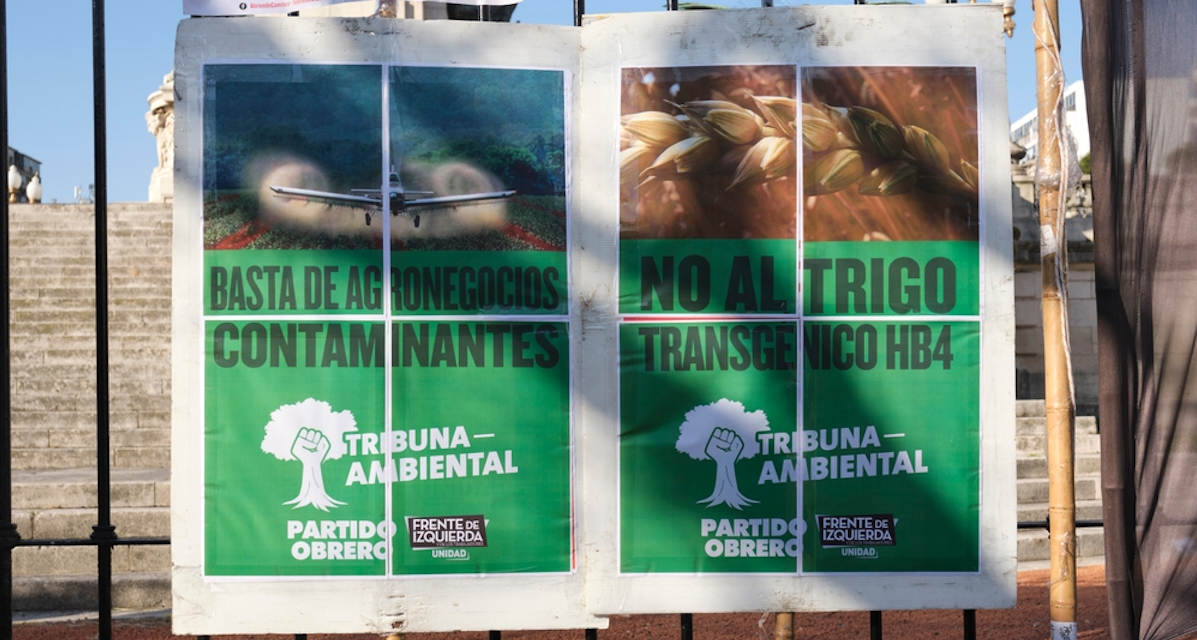
Image: Buenos Aires, Argentina. Poster opposing GM wheat. Carolina Jaramillo / Shutterstock.com (licensed purchase)