



Uncategorised
- Details
Scientific critique of the Genetic Technology (Precision Breeding) Act 2023, the Genetic Technology (Precision Breeding) Regulations 2025, and the corresponding ACRE and FSA guidance documents
By Claire Robinson, GMWatch, and Prof Michael Antoniou. March 2026
- Details
Letter from Copa-Cogeca on NGTs and patent protection May 2025
https://www.gmwatch.org/images/CEO_documents/14_Letter_from_Copa-Cogeca_on_new_genomic_techniques_NGTs_and_patent__protection.pdf
Letter from Copa-Cogeca on NGTs September 2025
https://www.gmwatch.org/images/CEO_documents/24_LETTER2502378-Vrhelyi_-_Attachment_to_doc_23.pdf
CropLife Europe (2025). Email: CLE letter on IP protection in the context of the legislative proposal for a regulation for plants obtained by certain New Genomic Techniques. 29 Oct.
https://www.gmwatch.org/images/CEO_documents/16_CLE_letter_on_IP_protection_in_the_context_of_the_legislative_proposal_for_a__regulation_for_plants_obtained_by_certain_New_Genomic_Techniques.pdf
Letter from CropLife Europe on intellectual property protection October 2025
https://www.gmwatch.org/images//CEO_documents/17_39140_Intellectual_property_protection_in_the_context_of_the_legislative__proposal_for_a_regulation_for_plants_obtained_by_certain_New_Genomic__Techniques_-_Attachment_to_doc_16.pdf
Minutes of meeting between European Commission and Copa-Cogeca, 3 Nov 2025
https://www.gmwatch.org/images/CEO_documents/MeetingMinutes-2.pdf
Minutes of meeting between European Commission and Limagrain et al, 9 Oct 2025
https://www.gmwatch.org/images/CEO_documents/MeetingMinutes-3.pdf
Minutes of meeting between European Commission and Copa-Cogeca, 3 Jul 2025
https://www.gmwatch.org/images/CEO_documents/MeetingMinutes-5.pdf
Minutes of meeting between European Commission and Euroseeds, 7 Jul 2025
https://www.gmwatch.org/images/CEO_documents/MeetingMinutes-6.pdf
- Details
By Claire Robinson, Co-Director, GMWatch, and Michael Antoniou, Professor of Molecular Genetics and Toxicology, King’s College London.
Correction and clarification regarding comments on soy leghemoglobin (21 Aug 2025)
- Details
- Details
GENERAL PRINCIPLES
We take privacy and data protection very seriously. We collect your personal data in order to send our email newsletters to you as a result of your subscribing to them. We never collect more data than is necessary, nor do we hold it for longer than is required to fulfil our purposes. If you no longer wish to receive our newsletters, it is easy and quick to unsubscribe by clicking the "unsubscribe" link at the foot of one of our emails.
We will never sell or pass on your data to third parties for marketing purposes, or make it public. You may make a data access request to us, and ask us to disclose all data that we hold on you, or that you have provided to us. We do not use cookies on our website.
DETAILED INFORMATION
1. Your data
“Your data” means any information about you from which you may be personally identified, including your name, email address, and/or any other information from which you can be identified and which you may disclose to us.
We may collect and use the following information about you:
1.1 information that you provide by filling in forms on our site. This includes information provided to subscribe to our email newsletters.
1.2 information submitted when you report a problem with our site;
1.3 information about yourself provided by you to us for specific purposes.
1.4 To help us improve our services, if you send us personal information which identifies you via email, we may keep your email and your email address.
2. When do we collect your data?
2.1 We collect your data when you subscribe to our email newsletters;
2.1.2 make a complaint or enquiry or provide other feedback to us.
3. How do we use your data?
3.1 We use your data to:
3.1.1 send you information by email;
3.1.2 process and deal with any complaints or enquiries made by you;
3.1.3 campaign on issues related to genetically modified foods and crops and associated pesticides, where you have expressed a clear interest in such activity (e.g. sending a letter to a representative via our website).
4. Will we pass on your data to third parties?
4.1 We will never sell or pass on your data to third parties for marketing purposes without your consent. We only pass on your data to third parties as follows:
4.1.1 We may pass your data to our employees, agents, subcontractors, and partner organisations to help administer our email services and provide relevant information to you;
4.1.2 Your data may be transferred to a successor company or other organisation in the event of a sale or insolvency administration; (but you will be notified and offered the chance to unsubscribe if this occurs);
4.1.3 in some cases we may use subcontractors or partner organisations to conduct some processing of your data on our behalf, but this is always subject to strict contractual control and in compliance with UK data protection legislation; this may include using a third party to identify individuals from our database who may be in a position to support our work further or take part in market research activities;
4.1.4 only if you have given your explicit consent for such purpose, we pass your data to third parties so that they can send you information about GM foods and crops and associated pesticides and information which may be of interest to you; and
4.1.5 in exceptional circumstances we may need to disclose your data to the police, regulatory bodies or legal advisers in connection with any alleged criminal offence or suspected breach relating to you of this privacy policy or any terms and conditions or pursuant to a court order.
4.2 If you are using a social media site, any information about you that you choose to post will be available for others to see and we cannot control how they may use it. Please therefore exercise caution and think carefully before posting any personal information. Likewise, we require that you don’t post any personal information about other people without first obtaining their explicit consent to do so.
4.3 We do not knowingly collect, store or use any personal information about children under the age of 16.
5. Data security, links and international transfers
5.1 We will take all reasonable steps to protect your data. All your data collected by us is stored on a secure server.
5.2 Please be aware that our website may link to other websites which may be accessed by you. We are not responsible for the privacy policies, content or security of those linked websites.
6. Mailing lists
6.1 We use MailChimp to collect, process and store data on those who subscribe to our mailing list. Subscribers must actively sign up to these lists, (e.g. via electronic or manual forms) and must complete the double opt-in to be added to the list. MailChimp stores such personal data as we collect in order to create our subscriber mailing lists. As part of its processing, MailChimp may transfer personal data to certain of its sub-processors, who perform some critical services, such as helping MailChimp prevent abuse and providing customer support.
6.2 Email communications sent to our supporters/subscribers via MailChimp include obvious links which allow subscribers to access, correct, amend or delete information held about them, and also to unsubscribe from the mailing list.
6.3 You may be removed from our newsletter mailing lists at any time by clicking the link at the bottom of all our emails.
7. Donations
7.1 Our websites use Paypal to collect online donations. Paypal shares data with a range of third parties, a list of which is available here. Sharing this information with payment processors and credit reference and fraud agencies and group companies is necessary in order for Paypal to fulfil obligations to its customers. The regulatory agencies with which Paypal shares its data are carrying out their purpose in accordance with their regulatory objectives and requirements.
8. Cookies
8.1 Our website does not use cookies. A cookie is a small element of data that a website can send to your browser, which may then be stored on your hard drive.
8.2 Any changes we may make to our privacy and cookies policy in the future will be posted on this page.
9. Your rights
9.1 Data protection laws provides the following rights for individuals:
* The right to be informed about the collection and use of their personal data.
* The right to access their personal data and supplementary information.
* The right to have inaccurate personal data rectified, or completed if it is incomplete.
* The right for individuals to have personal data erased.
* The right to request the restriction or suppression of their personal data.
* The right to obtain and reuse their personal data for their own purposes across different services.
* The right to object to processing based on legitimate interests or the performance of a task in the public interest/exercise of official authority (including profiling); direct marketing (including profiling); and processing for purposes of scientific/historical research and statistics.
* Rights in relation to automated individual decision-making (making a decision solely by automated means without any human involvement); and profiling (automated processing of personal data to evaluate certain things about an individual).
9.2 These rights apply in some, but not all circumstances. You can find more information about data protection and your rights of privacy from the Information Commissioner’s Office at www.ico.gov.uk. You can also find general information about data protection within the EU here.
10. Information about us
10.1 GMWatch Ltd is a company limited by guarantee, registered in England and Wales under registration number 13348994. Our registered address and administrative office is GMWatch Ltd, 99 Brentwood Road, Brighton, East Sussex BN1 7ET.
11. Contact us about privacy
11.1 If you have any comments or queries or complaints in connection with our privacy policy, would like to access your data or need to send us updated or corrected information, please contact us by email at editor [AT] gmwatch.org or write to us at: 99 Brentwood Road, Brighton, East Sussex BN1 7ET.
- Details
 Invitation to take part in new research project examining relationship between world views and perceptions of gene-edited food
Have you ever wondered what drives agricultural GMO enthusiasts to want to genetically alter our food supply? Our experience is that the simplistic answers offered by some – money and power – don't always give the whole picture and sometimes don't apply at all. What is clear, however, is that those who oppose GM foods and crops often have very different world views to those who advocate them. But what are those world views?
If you live in the UK and are 18 or over, you can contribute to research that hopes to answer these questions and more. The research is taking place in the context of the passage of the Genetic Technology Act last year, which removes a whole class of GMOs from safety checks and labelling.
In charge of the research is Maison McDermott-Reid, who is currently carrying out an MSc thesis with the Centre of Agroecology, Water and Resilience at Coventry University. In light of the increasing possibility of covert gene-edited produce entering our supermarkets in upcoming years, his research project examines the relationship between consumer world views and perceptions of gene-edited food. He said, "Given this often-polarising topic, I want to understand what causes people to possess such contrasting perceptions and investigate whether these differences can be explained by the alternate values and paradigms that people subscribe to."
If you would like to take part, please do so by filling in an interesting 15-20 minute questionnaire, which will first help distinguish your world view and then collect your perspectives on gene editing, genetic modification in general, and the Genetic Technology Act specifically. The link to the survey and the participant information sheet containing important additional information can be found here: https://forms.gle/1ZXdAUcPqsf599ba6.
We encourage people to take part whatever position they take on these topics.
- Details
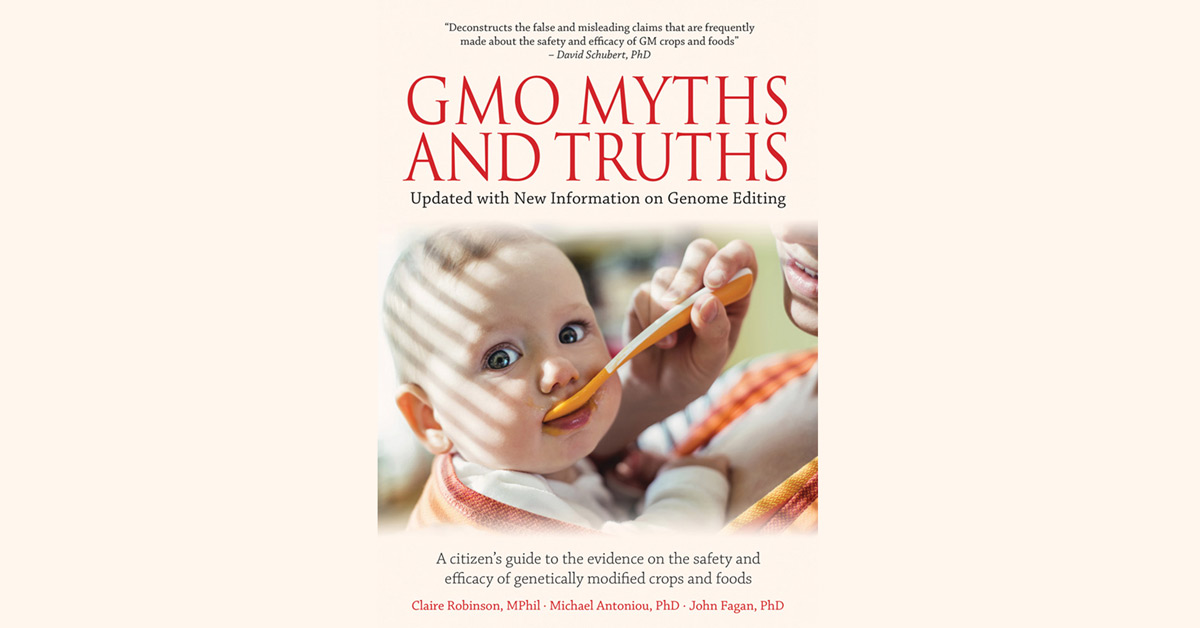
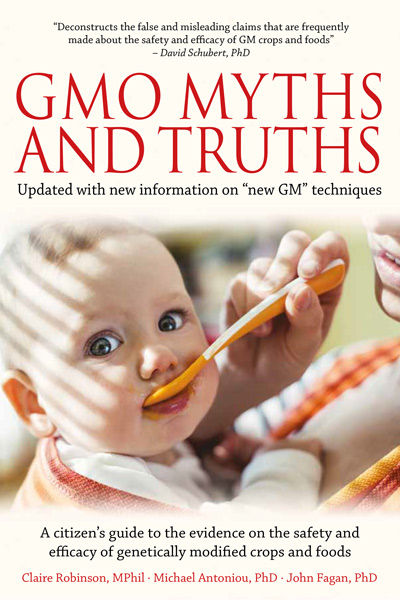
“GMO Myths and Truths is a very important contribution to the GMO debate. Written in a clear and concise style, it is an invaluable reference” – Dr Jane Goodall DBE, UN Messenger of Peace
“Essential reading for all involved, anywhere, with GM and agrichemicals risk and policy issues” – Professor Brian Wynne
“Scientifically correct, honest, and accessible … demonstrates why corporate claims about the inherent safety of GMOs and their centrality in reducing world hunger are utter nonsense” – Professor Sheldon Krimsky
“Excellent and urgently needed scientific critique of GM crops” – Professor Carlo Leifert
“GMO Myths and Truths is unquestionably the go-to source for up-to-date, scientifically rigorous evidence bearing on genetic modification … makes technical information accessible to the non-specialist.” – Dr Ann Clark
For more about the book and full reviews, see below.
To buy a new copy or copies of GMO Myths and Truths direct from the authors* at a very reasonable cost (15 GBP per copy plus postage, as opposed to the often hugely inflated prices for now rare second hand copies on Amazon), please use the payment options below to order. Alternatively you can email



About the book
It is often claimed that the case against genetically modified (GM) crops and foods is based on emotion, not science, and that to oppose GM crop and food technology is to be anti-science. It is also claimed that GM crops offer higher yields and better nutrition, that they are safe for health and the environment, that they reduce agrochemical use, and that they are needed to feed the world’s growing population. This book, co-authored by two genetic engineers and GMWatch co-director Claire Robinson, exposes these claims as false, using scientific and other documented evidence. GMO Myths and Truths summarises the facts on the safety and efficacy of genetically modified (GM) crops and foods in terms that are accessible to the non-scientist but still relevant to scientists, policymakers and educators. The evidence presented points to many hazards, risks, and limitations of genetic engineering technology. These include harms found in animal feeding and ecological studies, which in turn indicate risks to health and the environment posed by GM crops and foods.
The layout of the book enables those readers with limited time to read the chapter summaries, while providing more detail and full references for those who require them.
The book shows that conventional breeding continues to outstrip GM in developing crops that deliver high yields, better nutrition, and tolerance to extreme weather conditions and poor soils. In agreement with over 400 international experts who co-authored a UN and World Bank-sponsored report on the future of farming, the authors conclude that modern agroecology, rather than GM, is the best path for feeding the world’s current and future populations in a safe and sustainable way.
Editorial reviews
“Many who defend the use of GMO crops and foods claim that there is no evidence that any GMO is harmful to health or the environment. But this is wrong. There is plenty of sound empirical evidence of such harm, presented by qualified scientists in peer-reviewed literature. This book is a succinct summary and documentation of that evidence.” – Richard Jennings, PhD, Department of History and Philosophy of Science, University of Cambridge, UK
“GMO Myths and Truths is a very important contribution to the GMO debate. Written in a clear and concise style, it is an invaluable reference for those wanting to learn more about the arguments of proponents and those critical of the technology. I found it of great value in my own efforts to better understand the issue. I hope this information will be widely available to students and to the general public.” – Jane Goodall, PhD, DBE, and UN Messenger of Peace
“Using peer-reviewed studies and other documented evidence, GMO Myths and Truths deconstructs the false and misleading claims that are frequently made about the safety and efficacy of GM crops and foods. The book shows that far from being necessary to feed the world, GM crops are a risky distraction from the real causes of hunger. What is more, there is no reason to take this risk, since GM crops do not consistently raise yields, reduce pesticide use, or provide more nutritious food. GM crops and foods have not been shown to be safe to eat – and both animal feeding studies and non-animal laboratory experiments indicate that some GM foods, as well as most of the chemicals required to produce them, are toxic. Fortunately, the book shows that there are effective and sustainable alternatives to GM that can ensure a safe and plentiful food supply for current and future populations. GMO Myths and Truths is an invaluable and easy-to-read resource for everyone, including students, scientists, and members of the general public.” – David Schubert, PhD, Professor and Director, Cellular Neurobiology, Salk Institute for Biological Studies, La Jolla, California, USA
“Genetic engineering and its applications in agriculture are complex topics, even for scientists that are engaged with them. The range of techniques is large, as is the range of their implications for different groups in society, from the farmer, through to the citizen, to the corporation. It is difficult sometimes to have the latest information at the end of the fingertips and to understand the difference in how the same evidence is framed depending on the interests behind the science. GMO Myths and Truths is a great resource for me. It is written in a form that makes it readable to non-experts without losing value for the expert looking for the latest references. It has become one of my standard ‘go-to’ reviews when I need to refresh myself on the history, practice, or technical details in this fast moving, demanding and important area.” – Jack Heinemann, PhD, Professor, School of Biological Sciences, University of Canterbury, New Zealand
“GMO Myths and Truths is a much needed objective evaluation to separate propaganda and failed promises from the science of this critical topic.” – Don M. Huber, PhD, Professor Emeritus, Purdue University
“The role of provider of children’s health care has become an onerous job in this modern era. The rapid demise of children’s health where more children are chronically sick than well is statistically demonstrated in the US. The common denominator to all children’s health is their food. We, as pediatricians, have had to become geneticists and toxicologists to understand the impact of our changing food system in our modern agroenvironment and its effect on our children’s well-being without support from our traditional medical literary sources. Drs Antoniou and Fagan and Claire Robinson have provided a concise reference on the topic of GM foods and their impact that will educate the physician, farmer, citizen and policymaker. From this easily-readable third edition, a busy practitioner is able to extract the necessary information on the state of GM science to be utilized in their medical practice. Thoroughly sourced, this book is a must-read to understand the effects of GM food, Bt toxin, and pesticides, including their impacts on health. Its value is undeniable. It has simplified a very complex science without losing its scientific profundity.” – Michelle Perro, MD, Institute for Health and Healing, California, USA
“To all those concerned citizens, policymakers, journalists, researchers and students who have missed a reliable, unbiased, comprehensive and readable account of plant genetic engineering and its unpredictable consequences: Here it is, and it is a splendid piece of work!” – Terje Traavik, PhD, Professor of Virology and Professor Emeritus of Gene Ecology, Faculty of Health Sciences, UiT – The Arctic University of Norway; and Scientific Director Emeritus, Gen.k – Centre for Biosafety, Norway
“The global GM commercial and political juggernaut has already corrupted science by promoting a propaganda campaign to misinform the world that ‘science’ has revealed the unqualified safety of GM crops and foods, with no further question. This vitally important book documents the wide-ranging and well-grounded science that demolishes this political deception – a deception that has traduced the good name of science. The book also shows the systematic double standards exercised by those promoting GM, whereby studies claiming to show GM is safe are accepted with lower standards of scientific rigour than those showing evidence of harm and the need for further research. This book is essential reading for all involved, anywhere, with GM and agrichemicals risk and policy issues.” – Brian Wynne, PhD, Professor Emeritus of Science Studies and founding Research Director of the Centre for the Study of Environmental Change (CSEC); and former Associate Director of the UK ESRC Centre for Economic and Social Aspects of Genomics, Cesagen, Lancaster University, UK
“GMO Myths and Truths is unquestionably the go-to source for up-to-date, scientifically rigorous evidence bearing on genetic modification. As a scientist, I applaud not simply the heavy reliance on refereed literature, but also the attention to organization and interpretation, which makes technical information accessible to the non-specialist.” – E. Ann Clark, PhD, Associate Professor (retired), Plant Agriculture, University of Guelph, Canada
“GMO Myths and Truths is a scientifically correct, honest, and accessible discussion of molecular biotechnology that demonstrates why corporate claims about the inherent safety of GMOs and their centrality in reducing world hunger are utter nonsense.” – Sheldon Krimsky, PhD, Professor, Tufts University, USA; co-editor, The GMO Deception
“The condensed and updated GMO Myths and Truths is a thoroughly researched, evidence-based synthesis of the latest information regarding the environmental and health consequences of genetically modified crops. Updated and adapted from the well-received GMO Myths and Truths, it refutes common myths surrounding the alleged safety and effectiveness of GMOs and explains, in highly readable fashion, the scientific truths regarding this risky technology. I have found it valuable in my teaching and policy work, and highly recommend it for scientists, policymakers, educators, students, and indeed all individuals concerned about the corporate commodification of the world’s food supply.” – Martin Donohoe, MD, FACP, Adjunct Associate Professor, School of Community Health, Portland State University; Member, Social Justice Committee, Physicians for Social Responsibility; Member, Board of Advisors, Oregon Physicians for Social Responsibility; Senior Physician, Internal Medicine, Kaiser Sunnyside Medical Center, USA
“This is an excellent and urgently needed scientific critique of GM crops.” – Carlo Leifert, Professor for Ecological Agriculture, Newcastle University, Newcastle-upon-Tyne, UK
“GMO Myths and Truths provides an unprecedented overview of the current situation regarding genetically modified food production and consumption. Topics covered include the genetic engineering process, the safety questions around GM foods, and agronomic and environmental problems during GM crop cultivation, including weed and pest resistance and the consequences of contamination. This book will prove extremely useful for scientists, policymakers and students. In addition, it will inform members of the public, activists, farmers, and consumers.” – Mohamed Habib, PhD, Full Professor, UNICAMP, Brazil
“GMO Myths and Truths is a comprehensive study of the myths and facts surrounding genetically modified foods and crops. It illuminates aspects of the topic that are commonly misunderstood. The issues are systematically explained and analyzed in simple language, which is nonetheless precise. I would recommend this book to postgraduate students of genetics as well as interested members of the public. I am confident that it will prove a success worldwide and within Brazil.”– Nagib Nassar, PhD (Genetics); Professor Emeritus, University of Brasilia, Brazil
“An opt-out clause used by the members of many governments is that they ‘will make no decisions unless backed by sound scientific evidence’. This blind faith in the honesty and integrity of all scientists has proved, repeatedly, to be based on false assumptions. Politicians often fail to recognize that scientists and manufacturers are, like the rest of us, human. They can fall prey to the same ambitions, to financial greed, to a hunger for prestige, and to manipulating their findings in order to satisfy these cravings, just like some in other walks of life. Politicians like black-and-white – there can be no shades of grey or room for doubt, and they leave little scope for scientists to admit that they don’t know, so those with integrity are caught in a cleft stick. Do they speak out and risk being pilloried by those in power, or do they quietly keep their heads down?
“Nowhere is the controversy greater than in the scientific research upon which the reputed safety of genetically modified organisms is founded. We should be extremely grateful to the authors of GMO Myths and Truths for having the courage to review the research and to tell the world of their findings.” – Margaret, Countess of Mar, former independent cross-bench member of the House of Lords of the UK Parliament and elected hereditary peer
About the Authors
Claire Robinson, MPhil is co-director of GMWatch, a public news and information service on genetically modified (GM) foods and crops and their associated pesticides.
Michael Antoniou, PhD is a Reader in Molecular Genetics and Head of the Gene Expression and Therapy Group, Department of Medical and Molecular Genetics, King’s College London School of Medicine, UK. He has 40 years’ experience of using genetic engineering technology, including genome-editing tools, in the investigation of gene organisation and control, with over 150 peer-reviewed publications. He holds inventor status on gene expression biotechnology patents. His discoveries in gene control mechanisms are being used for research as well as the development of diagnostic and therapeutic products for genetic disorders. Dr Antoniou has taken an active interest in the safety of GM crops and their associated pesticides. In recent years he has published papers demonstrating the non-equivalence of glyphosate-tolerant GM corn and non-GM corn and severe kidney and liver toxicity from chronic exposure to an ultra-low dose of Roundup.
Dr John Fagan is a leading authority on sustainability in the food and agricultural system, biosafety, and food safety and authenticity. He is a successful entrepreneur in the field of biotechnology, having founded, built and sold Global ID Group, a company that pioneered the development of innovative molecular biological tools to verify and advance food purity, safety, and sustainability. Dr Fagan is CEO and chief scientist of Health Research Institute, a non-profit research and service institution dedicated to understanding the links between food quality, diet, and health. HRI Labs applies cutting-edge analytical methods to understand the relationships between agricultural practices a nd the levels of micronutrients and synthetic residues present in crops.
* Please note that monies from sales of the book do not go to GMWatch but to the authors of the book.
- Details
Lobbyists seeking to minimise regulation of gene editing technologies like CRISPR claim it can be used safely because of its incredible precision. But the famous American geneticist and molecular engineer George Church says that, contrary to all the hype, CRISPR is far from precise, calling it a "blunt ax" and saying, "It's called editing, I think it's really genome vandalism".
Below you can find a series of briefings, reports, podcasts, and other resources, that cut through the hype, explaining gene editing in simple straighforward terms and showing that the process as a whole is far from precise, predictable and safe. They also expose other misleading claims, such as it's not involving foreign DNA, or it's merely creating changes like those in nature, or those resulting from traditional plant and animal breeding. It is bogus claims like these that are being used by some governments to justify not requiring products of gene editing to undergo safety assessments or be labelled as genetically modified, even though such products have no history of safe use.
What is gene editing and how is it different from older-style GM and conventional breeding?
In this briefing, Prof Michael Antoniou and GMWatch's Claire Robinson show that gene editing is different from natural breeding in ways that mean its products (plants and animals) pose risks to health and the environment that need to be assessed on a case-by-case basis in a robust regulatory regime.
New GMOs: Sorting spin from facts – media briefing
In this short, simple, and clear briefing, Greenpeace debunks five of the main misleading claims used by the biotech industry and politicians who want the EU to deregulate new GMOs. It draws on the warnings of the French National Agency for Food, Environmental and Occupational Health and Safety (ANSES), the German Federal Agency for Nature Conservation (BfN), and the Austrian Environment Agency (UBA), as well as the rulings of the European Court of Justice.
Let’s cut the crap on gene technology
Prof Jack Heinemann deconstructs some of the myths and spin about gene editing, including the false notion that it is lower risk than other forms of genetic engineering and therefore can be exempted from biosafety regulations.
The language of gene editing is highly misleading
Metaphors like gene editing, which suggest precision, actually hide messy cellular dynamics. They also fail to convey the sense of risk or the need for caution that is required with tools as powerful and imprecise as CRISPR. In this extract from his book, The Mutant Project, the scholar Eben Kirksey says an armed drone attack gives a more accurate comparison than the cutting and pasting of text on a computer. That's because CRISPR can persist in cells for weeks, bouncing around the chromosomes, producing damage to DNA over and over again, every time it finds a near match to the intended target.
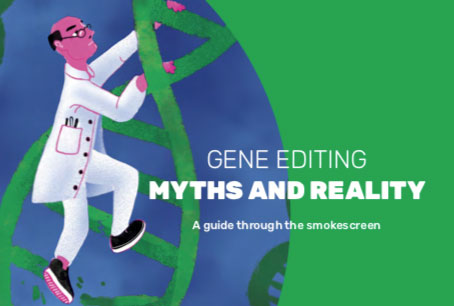
Gene editing myths and reality: A guide through the smokescreen
A detailed report written by GMWatch's Claire Robinson and published by the Greens/EFA in the European Parliament, deconstructing the myths about gene editing that are promoted by the pro-GMO lobby.
Science supports need to subject gene-edited plants and animals to strict safety assessments
GMWatch's annotated collection of peer-reviewed scientific papers explaining what can go wrong with gene editing and why gene-edited products must be robustly regulated, in order to protect health and the environment.
Gene editing: Unexpected outcomes and risks
An abbreviated version of our resource (above), "Science supports need to subject gene-edited plants and animals to strict safety assessments", for those who want a shorter document with less detailed explanation.
On-target effects of genome editing techniques: (Un)repaired DNA damage, a hindrance to safety and development?
This report by GeneWatch UK shows that claims of safety and efficacy of gene editing often hinge on their "precision" in targeting DNA sequences of interest, while ignoring unintended DNA damage not only at "off-target" sites of the genome (those not targeted by the intended genetic modification), but also at "on-target" sites (at the intended edit site).
Behind the smokescreen: Vested interests of EU scientists lobbying for GMO deregulation
This report, written by GMWatch's Claire Robinson and published by the Greens/EFA in the European Parliament, looks at the vested interests of those lobbying for the removal of regulatory safeguards around new GMOs in the EU. Alongside the seed industry, three scientist organisations also lobbied for legislative change. What are these groups? Why would they promote a weakening of the EU's GMO legislation? This report answers these questions by investigating the members of these groups and the national organisations with which they are affiliated. It shows that many have material interests in the commercial use of GM technology in agriculture.
PODCASTS
Prof Michael Antoniou on GMO myths and truths and why deregulation is not the way ahead
Prof Jack Heinemann on why we should not deregulate GMOs
Prof Jack Heinemann on GMO deregulation and media smothering of doubt on GMO safety
People pay premium prices for GMO-free food. But the AU/NZ regulator proposes to declare a vast range of new GMO foods non-GMO
This podcast comes from Physicians and Scientists for Global Responsibility New Zealand. You can hear it here and also on Spotify, where we found the audio quality a little better.
New GMOs deregulated: The wet dream of the biotech industry coming true
Nina Holland of Corporate Europe Observatory talks about the intense lobby battle that the biotech industry has been waging to get its new generation of genetic modification techniques excluded from European GMO regulations.
- Details
These interviews with Dr Arpad Pusztai, who carried out the first safety research on a GM food plant, were conducted in March 2002 by the journalist Andy Rowell, as part of his research for his book, Don't Worry, It's Safe to Eat. Andy kindly gifted this interview archive to GMWatch and wishes them to be made public.
In these interviews Dr Pusztai describes the results of his landmark 1999 study that found that GM insecticidal potatoes had toxic effects on rats and the political fallout from his public announcement of these findings in a brief 150-second appearance in an episode of the documentary series World in Action. Pusztai said that based on his findings, he would not eat these potatoes and that it was unfair to use our fellow citizens as guinea pigs by putting GM foods into the food supply.
The GM potatoes were engineered to express an insecticidal lectin (type of protein) called GNA, derived from a snowdrop gene. GNA lectin was chosen specifically because Dr Pusztai and his collaborators had, over a period of eight years of research, established that it was non-toxic to mammals in its natural form.
The GM GNA lectin-expressing potatoes were found to cause a proliferative (pre-cancerous growth-inducing) effect on the gut, as described in a peer-reviewed publication in The Lancet.
Another finding was that the GM-fed rats had a reduced brain size – a finding that Pusztai felt was so controversial that he did not publish it.
Mechanism of toxicity unknown
The mechanism of the GM potatoes' unexpected toxicity is not clear from these experiments. Pusztai was not able to follow up on his research to find out, because after he went public with his findings on British TV, he was fired from his job and barred from access to his lab. His research team was disbanded and a gagging order was imposed on him while his institute, the Rowett, carried out a hostile "audit" of his work. You can read more about these events here.
The GM potatoes used in the experiment were destroyed. This was regrettable, as well as anti-scientific. If they'd been put into deep frozen storage, today's molecular analysis techniques could easily have established the source of the toxicity of the GM potatoes – something that now we won't ever know.
However, in the recordings, Pusztai puts forward the hypothesis (for which he states that there was at that time no evidence) that given the toxicological findings related to the gut, which resembled a viral infection, a potential culprit was the cauliflower mosaic virus (CaMV) 35S promoter, engineered into the GM potatoes to drive expression of the transgene. Research shows that the CaMV 35S promoter can drive expression of genes (including transgenes) in mammalian cells – albeit not as strongly as in plants – with unknown effects. But it's equally possible that some other mechanism of toxicity is responsible.
GNA lectins have continued to be genetically engineered into plants to kill insects.
The Bt toxin protein in GM Bt crops is also an insecticidal lectin. GM Bt crops have been found to have harmful effects on laboratory animals.
Lessons on GMO regulation
In the current climate of lobbying for deregulation of a new generation of GMOs, we would do well to bear in mind Dr Pusztai's reply to CSIRO scientist and GMO enthusiast Dr Roger Morton, which we published in 2001. Dr Morton had claimed that GM foods are well tested and that there is a significant body of scientific literature supporting the safety of these foods. That was – and still is – far from the truth, as Arpad knew.
Prophetically, Arpad wrote: “The only thing the GM biotech industry needs to do in future is not do any testing as then the myth of the safety of GM food will be maintained for eternity. I am sure, to judge by present standards, that they are well on their way to achieving this.”
Those who are interested in the body of peer-reviewed research showing toxic and allergenic effects of GM foods (including commercialised ones) are recommended to read the book GMO Myths and Truths, in its 4th edition.
- Details
Repeated amendments by MEPs to NGT proposal, Nov 2023. Document obtained by Corporate Europe Observatory.
- Details
Combined presentation by Blanche Magarinos-Rey, Claire Robinson, and Prof Michael Antoniou at the Let’s Liberate Diversity! Conference, Dublin 27 October 2023
- Details
- Details
Open Response to Genetic Technology (Precision Breeding) Bill – Committee stage follow up Lord Benyon’s Letter to All Peers, 13 January 2023. Prepared by Beyond GM/A Bigger Conversation and GMWatch.
- Details
Contact Organics Weed Terminator Performance Validation at Harvard University: Harvard-University-Case-Study-Sm.pdf
- Details
- Details
- Details
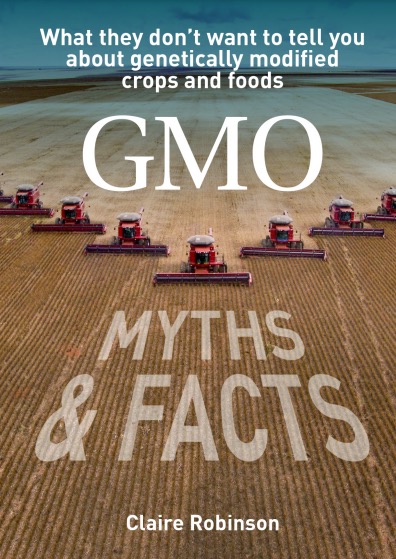
GMO Myths and Facts: What they don’t want to tell you about genetically modified crops and foods
Download the booklet by Claire Robinson of GMWatch for an easy-to-read introduction to this topic
Sponsored by the Sheepdrove Trust
References for this booklet can be viewed here.
- Details
Response of GMWatch to European Commission’s Inception Impact Assessment on “Legislation for plants produced by certain new genomic techniques”:
https://www.gmwatch.org/files/Sustainability-Commission-relies-on-promises-not-evidence.pdf
- Details
{source}
<script src="https://widget.proca.app/d/nogmo_consultation/gmwatch"></script>
{/source}
Keep GM food out of our fields and off our plates
Big agricultural corporations are using new genetic engineering techniques to force GM food onto our fields and plates without us knowing. They claim these new techniques do not produce genetically modified organisms (GMOs) and should be left out of the EU’s GMO regulations. They want to be able to flood the EU market with the GM food that Europeans have so far refused.
In reality, seeds produced with new GM techniques like CRISPR/Cas are fundamentally different from non-GM seeds. They are potentially unsafe for the environment and our health and have no place in nature-friendly farming. Armed with strong intellectual property rights and patents, multinationals like Bayer/Monsanto and Corteva will only use them to further entrench their control on our food production.
The EU’s highest court has ruled that the EU’s GMO regulations must be applied to organisms engineered with new GM techniques, for the sake of our environment and our health. Under EU regulations, GM organisms must undergo a strict safety evaluation, be labelled as GM, and be traceable throughout the supply chain.
Now the European Commission wants to change the law to exclude some GMOs from the EU’s GMO regulations. Echoing the corporations, it even claims that these new GMOs are needed to make EU food production “more sustainable”.
In reality, this would mean that farmers, food producers, retailers and consumers can no longer reject GM products and opt for GM-free choices, and that GM seed producers would bear no responsibility for any damage caused by their products.
Tell the European Commission it must apply the EU’s GMO regulations to all GMOs, and stop trying to sneak GM food onto our fields and plates untested and unlabelled.
Instead of weakening the EU’s GMO law, the European Commission must fix its weaknesses in the areas of risk assessment and labelling of GM food.
Join us and write your own submission to the Commission’s consultation. We have a draft ready for you.