



Colossal’s George Church needs to be held to account – just as much as his spinmeister partner, Ben Lamm. Report by Jonathan Matthews
“Colossal Biosciences is one big flashy scam. They have not and will not be resurrecting the woolly mammoth, they have not brought dire wolves back from extinction, their whole pious schtick of working to prevent extinction is a lie. Now they have a new scam, one that will find favor with the department of (defense) war: they want to genetically engineer WARHOUNDS.” So wrote the evolutionary biologist PZ Myers in response to Colossal co-founder Ben Lamm’s latest money-making scheme: a start-up aiming to create genetically engineered and cloned “superdogs” for the US military.
As we explored in an earlier article, Lamm had a track record of successfully raising money with heavily hyped futuristic ventures even prior to Colossal Biosciences – a company he built around “a con, full of gloss, bullshit and ghoulish greed”, to quote the British geneticist Adam Rutherford.
Lamm’s latest venture is already valued at $1.2 billion after securing a $200 million seed round from high-profile venture capital, such as the CIA’s In-Q-Tel, and 8VC – the firm founded by Joe Lonsdale, who famously co-founded the spy-tech firm Palantir alongside Peter Thiel, the tech billionaire said to be driving Silicon Valley’s fascist turn.
In harm’s way
Warhound – or the “Captain America dog program”, as Lamm describes it – has already drawn intense ethical, scientific, and political backlash. Although conventional dog breeding is known for its undesirable impacts on animal welfare – something Lamm claims the new start-up will help address, the genetic engineering and cloning combo that Warhound will be undertaking has a staggering failure rate: 95%+.
Quite apart from all the invasive egg harvesting and embryo implantation across many female dogs that Warhound’s “dog program” will require, the 95%+ failure rate also translates into high numbers of deliberately engineered miscarriages, severely deformed fetuses, or offspring born with agonizing, un-rectifiable developmental defects, in order to achieve each successful birth. And even with a “successful” birth, severe developmental, physiological, and other problems may emerge later in the dog’s life due to epigenetic flaws, unpredictable gene expressions, and premature mortality. In Warhound’s case, of course, this extraordinary level of animal suffering is all for the sake of engineering dogs that will then be put in harm’s way.
Ethical alarm bells
Lamm’s partner in this latest Colossal venture is Palmer Luckey of Anduril – the autonomous weapons firm originally seeded and heavily funded by Peter Thiel’s Founders Fund and christened “tech’s most controversial startup” by Bloomberg Businessweek. And Warhound’s CEO, David Spirk, is a former senior advisor at Palantir, a company accused of complicity in human rights abuses and genocide.
If that rings ethical alarm bells, it would be a mistake to think that Lamm’s fellow Colossal co-founder, the renowned Harvard geneticist George Church, for all his scientific gravitas and undoubted technical brilliance, is any more likely than Spirk or Luckey to provide Lamm with firm ethical guardrails.
Controversies galore
One obvious indication that such guardrails are not high on the list of priorities of the godfather of synthetic biology is the way so many of the outfits Church is involved with have been caught in serious ethical controversies and violations. These include:
• the anti-aging biotech firm BioViva which administers unapproved gene therapies carrying significant health risks;
• the polygenic embryo screening firm Orchid that critics say is engaging in a modern form of eugenics;
• the similarly accused DNA-based dating app DigiD8 that Church co-founded;
• the anti-aging SENS Research Foundation where, according to the victims, sexual harassment and its cover-up were normal, and there was pressure to be sexually available to funders;
• the George Church Institute of Regenesis – a research collaboration between Church’s lab and the Chinese genomics firm BGI Group, which stands accused of having a “eugenics-like” corporate culture that is invasive, ableist, and dystopian, and which has been sanctioned by the US for its involvement in the mass biometric surveillance and repression of Uyghurs and other ethnic minorities.
In this last case, it’s worth noting that Church’s involvement with a company accused of facilitating human rights abuses, including forced labour, has been far from peripheral. BGI provided the funds and much of the staffing for the institute which bears his name and where he’s designated Chief Scientist. He’s an advisor to BGI, whose chairman described him in a company press release as “our longtime friend and supporter”. He has also been a prominent speaker at BGI flagship events. And Church’s personal genomics company, Nebula Genomics, is in a commercial partnership with BGI.
The company he keeps
These aren’t the only indicators of a serious lack of scruple when it comes to collaborators. Ben Lamm, for instance, was not the first dubious tech entrepreneur Church got backing from for his woolly mammoth project. The groundwork for Church and Lamm launching Colossal Biosciences came from seed money provided by Peter Thiel. It was Thiel’s $100,000 donation in 2015 that funded the foundational work on de-extinction that was then spun out in 2021 into Colossal.
As a key mainstreamer of fringe far-right ideas, including techno-eugenics and scientific racism, Thiel shared an ideological bond with Jeffrey Epstein. And the two were in regular communication and entered a multi-million-dollar business relationship in the five years leading up to Epstein’s 2019 arrest for sex trafficking minors.
If that seems unsavoury, then what should we make of George Church’s 14-year relationship with the wealthy child-rapist and avid eugenicist – or their plans to form a joint business venture?
The 14-year relationship
Their relationship kicked off with Church’s Harvard lab receiving $686,000 in direct donations from the Epstein Virgin Islands Foundation between 2005 and 2007. In 2007, Church is also known to have attended a science meeting on Epstein’s private island in the Virgin Islands, later nicknamed “paedophile island” because of the sexual abuse that went on there.
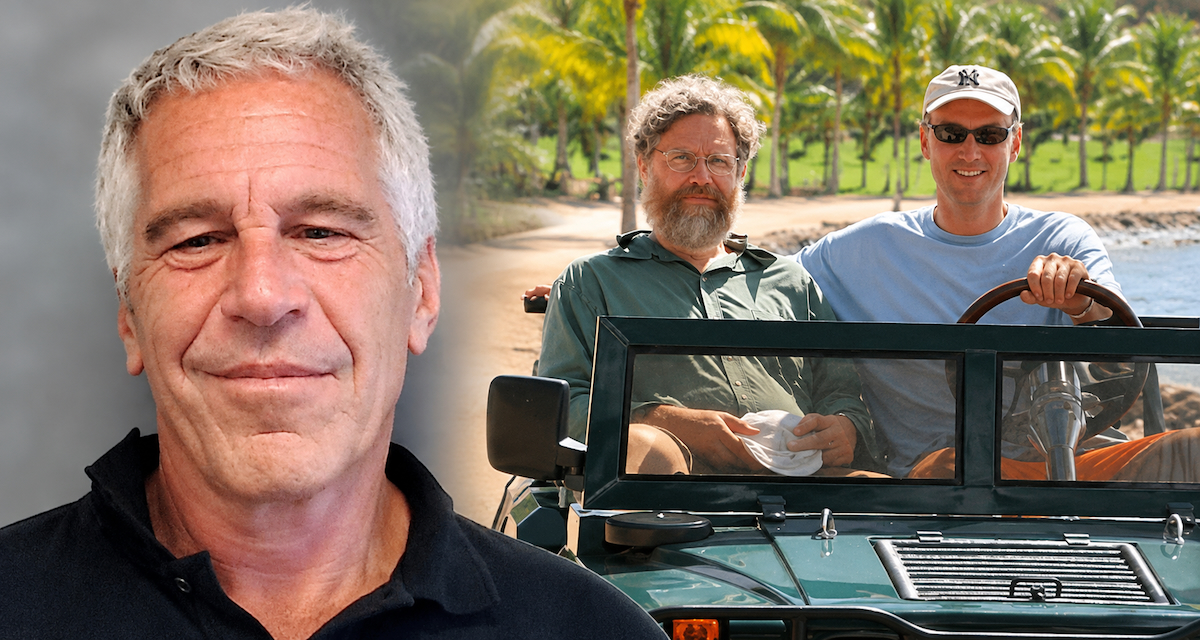
(The beach photo accompanying this article, which was released by the Department of Justice (DOJ), is purported to show George Church on Epstein’s island with his Harvard colleague, the mathematical biologist Martin Nowak. Nowak was placed on leave for the second time following the 2026 release by the DOJ of further Epstein files and images, including the one of Nowak and Church on Epstein’s island. Nowak has published influential papers with Church on CRISPR gene drives.)
Epstein was first publicly accused of engaging in sex with underage girls in 2006. In 2008, Harvard banned its staff from accepting any further funding from the disgraced financier, following Epstein’s guilty plea, 13-month prison sentence, and sex offender registration.
But despite his conviction for soliciting minors for prostitution, Church continued to email frequently with Epstein, as well as to meet and have phone conversations with him several times a year. And their contact was still ongoing eleven years later in 2019 – the year of Epstein’s final arrest.
The blacklist workaround
This wasn’t just a personal relationship but a financial one. As Harvard had blacklisted his donations, the sex trafficker introduced Church to the billionaire Leon Black, a close Epstein associate with whom he was financially deeply intertwined. Epstein then coordinated, through his own accountant and staff, a $2 million donation by Black to a genomics and synthetic biology research fund under Church’s direction.
Black has subsequently faced scrutiny over massive financial payments to Epstein, that are said to have almost singlehandedly bankrolled Epstein’s sex trafficking operations. He has also faced allegations of sexual assaults facilitated by Epstein, and suggestions that Epstein was his “fixer” regarding women “paid tens of millions of dollars in exchange for their silence”. Black has denied these allegations.
The misleading apology
In 2019 – amidst a welter of adverse publicity about Epstein’s deep ties to a number of academics, including Church, following his arrest on federal sex trafficking charges – Church apologised for his continuing contact with the convicted paedophile. While stressing his concern for the victims, Church denied having previously known the severity of Epstein’s crimes. “I did read a couple of news articles (a decade back)”, Church told STAT News, “but they weren’t clear enough for me to know there was a serious problem”.
He made the same point in another 2019 interview – this time with CBS’s 60 Minutes: “It’s only recently that we’ve found out that it was something serious, or become aware how serious it was”. He also told the CBS interviewer, Scott Pelley, that he regretted “not knowing more about the donor”.
Church told STAT that he put his lack of knowledge down to “nerd tunnel vision”. Yet, as the investigative journalist Robert Evans has noted, Church is an “incredibly skilled” communicator who’s “very good with people”, and Evans mocks the idea of Church as a socially unaware nerd.
The fact that Church has managed to co-found around 50 companies, some of which have raised tens or even hundreds of millions of dollars from top-tier venture capital firms – even though very few have ever brought an actual, proven product to market – also suggests he’s hardly the clueless geek.
Church knew exactly who he was dealing with
It was STAT News’s February 2026 investigation (also republished by The Boston Globe) that finally exposed just how much Church really knew about who he was dealing with.
STAT discovered that back in 2013, researchers in Church’s Harvard lab spelt out to him in detail exactly why they were so unhappy about Epstein being involved in the lab’s research, as an atypical participant in Church’s flagship Personal Genome Project. According to STAT, the furore among the project’s staff ignited after they discovered that Epstein was “a man whom dozens of girls had accused of sexually assaulting them, a man for whom Florida prosecutors had made the unusual decision to drop local law enforcement’s recommendations of charging multiple accounts of unlawful sex with minors in favor of a single solicitation of prostitution charge”.
Such explicit warnings from researchers so stunned by what they’d discovered that they walked out of his lab in disgust, triggering the crisis meeting with Church, make clear that he knew far more about Epstein’s criminal background than he acknowledged six years later when he repeatedly claimed to have been unaware “there was a serious problem” and to have “only recently” discovered otherwise.
Forming a firm together
What was also unknown at the time of Church’s 2019 apology was the full extent of his involvement with Epstein. This was something else that Church was dismissive about in a 2019 interview, saying, “just because [Epstein] hung out with me briefly, doesn’t mean I bought into [his] malarkey”. If “briefly” hardly seems to capture their 14-year relationship, during which they met and phoned each other repeatedly and emailed frequently, what is more disturbing is that we now know Church’s involvement with the child sex offender actually deepened, rather than ending, after he was told those unambiguous details by his troubled lab staff in 2013.
It was already known from Church’s online calendar that the following year, in 2014, he had at least six meetings or calls with Epstein, and that their relationship continued up until the year of Epstein’s arrest. According to CNN, the two even planned a lunch together in December 2018, “just weeks after a Miami Herald investigation brought the extent of Epstein’s crimes to light”.
But Department of Justice records released in early 2026 show Church didn’t just continue to meet with Epstein after the 2013 crisis meeting, and to seek funding through Epstein’s network (including the $2 million donation Epstein coordinated via Leon Black), he also began to discuss biotech investment collaborations. In particular, according to the New York Times, “Epstein and Dr. Church, who did not respond to a request for comment, explored forming a biotech firm together in 2014”.
The shell company: Georgarage LLC
Emails and public records suggest this primarily involved Georgarage LLC, a shell company Epstein helped Church set up as an investment vehicle to channel Epstein-derived funding into emerging biotech startups. Beyond encouraging Church to establish the venture, Epstein had his personal lawyer, Darren Indyke, formally register the entity in Delaware.
Under the plan, Church would ostensibly run Georgarage while Epstein controlled the money, routing investments into different companies. Their discussions centred on three in particular with which Church had formal financial, advisory, or founder ties:
• eGenesis – a xenotransplantation company co-founded by Church that develops gene-edited pig organs for human transplant;
• Androcyte – a cryonics-linked life-extension startup whose assets were later transferred to BetterHumans, a nonprofit that bills itself as “the world’s first specifically-transhumanist bio-medical research organization”; and
• Genapsys – a California-based DNA sequencing firm.
These biotech ventures directly intersected with Epstein’s broader, well-documented fascination, like Thiel’s, with transhumanism, eugenics, and life-extension technologies. In fact, Epstein, who reportedly wanted to have his head and penis cryonically frozen, and who gave $20,000 to the World Transhumanist Association, was so taken with Androcyte that he is said to have proposed being made its chairman of the board.
In Church’s initial pitch to Epstein for $10 million of investment, there was also mention of money going into creating “cold-resistant elephants”, a reference presumably to Church’s mammoth de-extinction project. In the end though, despite all the discussions, no monies seem to have actually gone into Georgarage other than the $300 paid by Epstein’s lawyer to register the firm.
A place of greed
Confronted with these latest revelations, STAT News reports Church as saying “that upon reflection, the decision to continue to accept funds from Epstein and his associates came more from a place of greed than need”. It’s a disarmingly frank admission – unlike Church’s 2019 apology, which now looks like a calculated PR move designed to cast him as an unworldly boffin caught in a web he didn’t comprehend.
But it would be a mistake to see Church as only in it for the money. With no equity in Colossal, his wealth, unlike Ben Lamm’s, is thought to be in the millions rather than the billions. What truly drives him is a Promethean crusade to “reinvent nature and ourselves” – the telling subtitle of his 2012 book Regenesis. Through synthetic biology, Church holds out the prospect of resurrecting extinct species (including Neanderthals), rendering humans immune to all disease, and brewing endless supplies of synthetic fuel. These techno-utopian fantasies have proved irresistible to a rogues’ gallery of wealthy patrons: biotech hucksters like Lamm, dark-enlightenment plutocrats like Thiel, and eugenics-obsessed predators like Epstein. Far from keeping them at arm’s length, Church has welcomed them all under his banner – as long as they seem ready to bankroll his dubious schemes.
This is the third in our series of articles about Colossal Biosciences and its founders. Others in the series are:
Dark PR attacks on critics of 10-billion-dollar biotech Goliath
Faking it without making it: The de-extinction disinfo campaign manager’s history of hype
Images:
Left: Jeffrey Epstein – State of Florida, via Wikimedia Commons.
Right: This photo, released by the US Department of Justice, purports to show George Church, left, and Martin Nowak on Jeffrey Epstein’s private island.