



Statement of the European Network of Scientists for Social and Environmental Responsibility (ENSSER)
Microorganisms are an essential and fundamental part of all spheres of life. Unknown to most, they play a pivotal role in human health, animal health, as well as plant health. They are essential for nutrient cycling, including nitrogen, CO2 and oxygen, and the recycling of organic matter, they are vital for functional immune systems, and for essential economic sectors such as farming, forestry, and fishery and, as well as for biodiversity as a whole.
Microorganisms live in water, inside organisms, in soil, in plant root systems, they live on skin, on plants and in plants, between cells and in cells – basically everywhere.
They are organisms too small to see with the naked eye and include bacteria, protozoa, fungi, microalgae, archaea and viruses.
They are carried and dispersed by wind and air, water, soil, insects, animals, pollen, anything.
What is at risk? What are the concerns about?
If genetically modified microorganisms (GMMs) are released into the environment without very strong safety precautions, food safety and security, public health and wellbeing, antibiotic resistance, agricultural production, the cycling of nutrients, the functioning and balance of ecological systems are all at risk.
Concern has also been expressed for malicious uses, inadvertent misuse, toxic, virulent or persistent traits, and potentially irreversible dynamics.
What makes GMMs for environmental release such a special case for risk assessment, risk management and regulation?
Experience in the EU with GMO releases has largely been limited to GM plants, mostly crop plants. There is no proper experience with the release of GMMs and no history of safe use. Importantly, microorganisms and their modifications differ from crop plants in major ways, resulting in a very different risk profile. This is due to:
• very short generation times; under ideal conditions some bacteria can for example divide every 10-15 minutes, doubling the population each time round;
• vast population sizes combined with high evolutionary and adaptive capacity, including through sharing of genetic information via ‘horizontal gene transfer’ across species boundaries, e.g. antibiotic resistance genes; this would also potentially include the transfer of the modified genes to other taxa;
• highly unpredictable dispersal and capacity to spread that is hard to contain; for example one single wind event can transport viable bacterial and fungal propagules hundreds of kilometres [1];
• GMMs being hard to detect and likely impossible to recall;
• the fact that microorganisms and their interactions cannot be directly seen or observed;
• high levels of complexity, as microorganisms don’t exist or act on their own but as part of interactive and interdependent microbiomes (communities of microorganisms of many taxa in a given habitat and location);
• microorganisms commonly engaging in symbiotic cooperations.
It cannot be predicted – neither from the specifics of the modification nor from the laboratory experiments and observations – how a GMM will behave and interact within natural settings and what the impacts may be on different microbiomes and their functions and services. Nor can it be predicted what the consequences would be of the modifications being passed on to other taxa of microorganisms.
[The working groups of the GFÖ (Ecological Society of Germany, Austria, and Switzerland) and the EEF (European Ecological Federation) warn:] “For most of history, monitoring microbes was impossible, as their microscopic size defies direct observational approaches common to plant or animal ecology. Studying most microbes in isolation is not possible, as they exist in metabolically interconnected communities that do not survive alone.”[1]
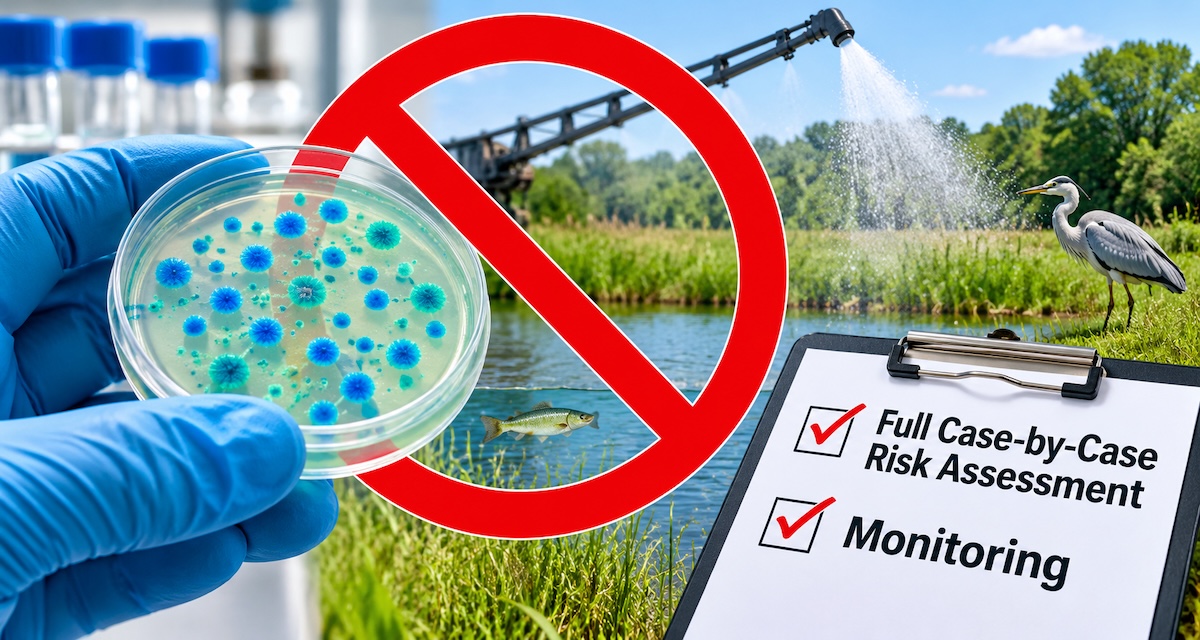
Risk assessment under these conditions is nothing like we have ever dealt with before. This requires (pre)caution and responsible action and upholding regulatory requirements, including a full case-by-case risk assessment and monitoring of any GMM, irrespective of whether its parental organism belongs to a taxon listed in the QPS (Qualified Presumption of Safety) list and suggested to be ‘low risk’. This list was primarily designed for food and feed purposes and in particular for unmodified microorganisms. Such a list of unmodified parental organisms has no predictive power for environmental interactions of novel GMMs and their modified traits – for example with microbiomes of the potential receiving environments – and the resulting consequences. Safety can only be determined by actual testing and assessment of the GMM in question and not by assumption. The use of this QPS list to lower testing requirements for safety in the context of this regulation is irresponsible.
Organ processing for transplantation does not belong in this proposal
The current EU proposal for GMMs is principally about the release of GMMs into the open environment. However, it also contains provisions for the processing of human organs for transplantation. These two topics – including risks, ethics and purpose – are too different to be combined in one directive. Organ transplantation is a specialised medical topic, whereas GMMs have a range of widely differing applications and consequences. The considerations, risks and concerns of organ processing for transplantation require their own dedicated legal treatment.
Concerning the new GMM regulation: We urge the EU to:
• Allow for the use of the best available current scientific knowledge
• Ensure mandatory rigorous case-by-case risk assessment for every GMM intended for environmental release and for this to include the interactions with and impact on the potential receiving environment(s) and their microbial communities. This has to also include assessing the in-situ capacity of the organisms to multiply, persist, spread, recover, evolve and pass on their modifications and the respective consequences. This is also to include inter alia: direct, indirect, cumulative and synergistic effects on other organisms (including microbes), metabolic processes, nutrient cycling, ecosystem function and services.
• Require that GMM samples are deposited and detection and identification methodologies are in place and working prior to any authorisation, and that the use of these are not covered by intellectual property rights (IPRs).
• Restrict the permit granting period to 2 years, due to the fast generation cycle and the extreme capacity to spread, and require re-evaluation.
• Require the development of robust risk assessment methodology and protocols for case-by-case risk assessment for the respective organism for real life conditions and as stipulated for the case-by-case risk assessment above.
• Require the development of appropriate monitoring methodology and schemes in line with the categories of the risk assessment.
• Require full mandatory and long-term monitoring for all GMMs and informed by the specifics of the case-by-case risk assessment. Also require general surveillance.
• Ensure liability and redress regimes are in place, including for cases of contamination and for cleanup and emergencies.
• Ensure the right for national decision making, that is for member states to have the right to reject or restrict the release of a GMM, or categories thereof.
• Ensure full transparency, with a public register of local GMM releases, as well as clear co-existence measures.
• Remove the provisions for the processing of human organs for transplantation from the GMM proposal. Instead, place them in a separate legal proposal and regulation.
________
[1] Ecologists' view on COM (2025) 1031 – Environmental release of genetically modified microorganisms (GMM) – Statement by the working groups of the GFÖ (Ecological Society of Germany, Austria, and Switzerland) and the EEF (European Ecological Federation) – September 2026.
Also see: Eckerstorfer MF et al. (2025). Environmental applications of GM microorganisms: Tiny critters posing huge challenges for risk assessment and governance. International Journal of Molecular Sciences, 26(7), 3174. https://doi.org/10.3390/ijms26073174