



Bayer to supply Pentagon with “critical military material” linked to humanitarian atrocities. Report: Jonathan Matthews
Bayer has been described as “the most consequential foreign-owned company in the US defense industrial base that almost no defense analyst tracks”. Bayer, of course, doesn’t present as a weapons contractor, let alone one solely responsible for the supply of arms that the US and its close military partner Israel have repeatedly used to commit what many consider breaches of international humanitarian law, and which have also led to calls for a “complete ban on production, transfer, and use of these weapons”.
Bayer has probably also stayed off defence analysts’ radars not only by presenting as primarily a pharmaceutical and agricultural-supplies company but by deliberately obscuring its arms production role behind supply chain intermediaries. Chief among these has been ICL Group (formerly Israel Chemical Limited). With a US base in St Louis, Missouri – home to Monsanto, which Bayer acquired in 2018 – this Israeli firm has long operated as a convenient cut-out between the military and Bayer-Monsanto.
But that dodge has been blown out of the water by a recent federal Indefinite Delivery Contract, executing an operational directive that flows directly down from the Pentagon and the White House. That contract explicitly identifies Bayer CropScience as the Pentagon’s prime contractor. It states unambiguously that it is a “sole source, firm-fixed-price contract to Bayer for the procurement of White Phosphorus”.
This multi-million-dollar arms deal commits Bayer to supplying as much white phosphorus as is required by Pine Bluff Arsenal – the US army’s key production centre for its Chemical Corps – where Bayer’s highly reactive and toxic chemical gets loaded into artillery shells and other munitions. All of which makes crystal clear that Bayer CropScience is not, as it claims, just Bayer’s agricultural division but a dual-use chemical juggernaut that sits at the very top of the US military’s white phosphorus supply chain.
By directly securing federal contracts to support weapon lines – like the M156, M1121, and M929 white phosphorus munition programmes specified in the recent contract – the company bridges the gap between commercial agriculture and active arms manufacturing.
Devastating weapons
Bayer portrays its heavily polluting operations at the facility where it extracts and refines raw phosphate ore in Soda Springs, Idaho, as focused on bulk production of elemental phosphorus as the foundational material for glyphosate, the active ingredient in the company’s Roundup herbicide. But in reality, Soda Springs is a dual-use facility. That’s because elemental phosphorus is nothing other than molten white phosphorus (or Willie Pete), which requires no further processing to be turned into military munitions.
Those munitions are allowable under international law for use as battlefield smokescreens, illumination and signalling. But their actual use by the US and Israel in operations in Iraq, Syria, Gaza and, most recently, southern Lebanon, has contributed to experts like Bonnie Docherty at the International Human Rights Clinic at Harvard Law School calling for countries to “condemn ongoing use of white phosphorus munitions” because of “the weapons’ unacceptable human costs”.
Those unacceptable costs include some of the most severe and horrific injuries known in warfare. Burning at temperatures up to 800°C and clinging aggressively to skin and clothing, white phosphorus can burn deep through tissue, muscle, and down to the bone. And unlike a standard heat burn, it is also highly toxic. Once absorbed by the body through the burned skin, it can target cells throughout the body, frequently causing fatal liver, heart, and kidney failure. This means even relatively small white phosphorus burns can be fatal due to internal organ poisoning.
Glyphosate also a weapon of war
The human rights organisation Medico International and the German network Coordination against Bayer Dangers (CBG) have documented how the Israeli occupation forces in southern Lebanon haven’t used only white phosphorus as a chemical weapon. Highly concentrated glyphosate has also been aerially sprayed over villages, damaging local agricultural ecosystems, some of which had earlier also been ravaged by white phosphorus. Both of these chemical weapons have also been deployed by the Israelis at different times in Gaza. Such incidents have led CBG to call on the German multinational to “stop marketing glyphosate and elemental phosphorus as dual-use goods”.
Trump uses wartime powers to protect Bayer
Bayer’s dual-use production at Soda Springs seems to have been a key element in galvanising Trump’s support in Bayer’s battle for federal preemption of lawsuits from those alleging their cancer was caused by using Roundup. Just a week before Bayer’s Supreme Court brief was due, Donald Trump issued an Executive Order (EO 14387) under the Defense Production Act, protecting the domestic production of elemental phosphorus and glyphosate-based herbicides as a national security priority. Bayer then weaponised the order as a core piece of its legal arsenal.
Given the pay-to-play character of the Trump presidency, it would be easy to attribute this unprecedented use of wartime powers to bail out a foreign conglomerate to Bayer’s $1 million payout to Trump’s inauguration – an event that no other German corporation felt it necessary to contribute to. There are also the 16 key administration officials with ties to Bayer’s lobbying or legal network.
But an analysis we published by Dr Michael Hansen, which was then followed by others along the same lines in the New York Times and TIME magazine, contended that Bayer had also exploited a different point of leverage – the monopoly arising from Soda Springs being the only elemental phosphorus mine and smelter in the Western Hemisphere, making the company the only US-based producer not just of glyphosate but of white phosphorus.
Obviously, once the Trump administration wrapped the company in the cloak of national security by emphasising that it was the only domestic producer of a chemical “critical to national defense”, there was little point in continuing to hide its prime role as a weapons contractor. This is undoubtedly why the recent contract is not with ICL Group, or any other intermediary, but openly with “Bayer CropScience… the sole source for this critical military material”.
In other words, the price of gaining wartime powers protection has been breaking cover.
Calls for a Bayer boycott
Even before we could publish Michael Hansen’s incisive analysis, Trump and Israel launched major military strikes on Iran. And Israel, as we’ve noted, was committing ecocide with glyphosate and making repeated use of white phosphorus over civilian areas in Lebanon, leading Human Rights Watch to accuse it of a war crime.
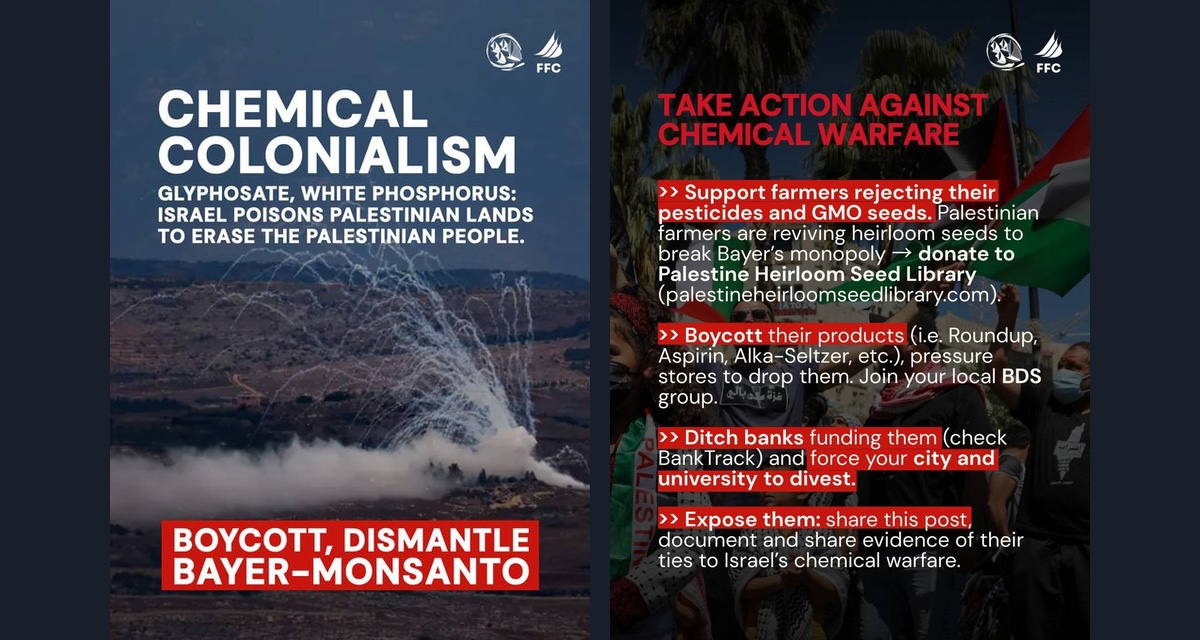
These developments also triggered anti-Bayer protests, including calls for a total boycott of all Bayer’s products, and even an Iranian missile attack on the Israeli chemical complex of ICL Group – Bayer’s some-time partner in white phosphorus production.
Bayer’s disastrous tradition
Of course, beneath the veneer of Bayer “the aspirin maker” has always lurked a far darker history – one that makes Monsanto’s own terrible record pale by comparison. It includes some of the most appalling war crimes imaginable.
This is what led to CBG’s Brigitte Hincha-Weisel commenting, after Bayer’s lucrative arms deal came to light: “Bayer produced chemical weapons in the First World War, supplied the Nazis’ arsenals in the Second World War, and continued its murderous business practices even after that. It’s high time the corporation finally broke with this disastrous tradition”.
Images: Freedom Flotilla Coalition (FFC)