
A revolution is brewing in America’s GMO corn and soy heartland. Report: Claire Robinson
The winds of change are blowing across the GMO corn and soy heartland of Iowa, and they’re not in Monsanto-Bayer’s favour. The Republican nominee for Iowa governor, Zach Lahn, faults industrial agriculture for the state’s high cancer rates. According to a report in Politico, “Lahn is taking aim at fertilisers, pesticides and other farm chemicals seeping into drinking water supplies – and the agrochemical giants that make them. He believes Big Ag and Big Chemical are to blame for the state’s high cancer rates, a top issue for voters here.” Lahn’s rise to success on such a campaign platform, even pulling off a huge primary upset by defeating the Donald Trump-endorsed candidate, was “once unimaginable for a politician of either party in Iowa”, but in particular of the Republican party, where “the interests of agricultural and chemical companies… hold deep sway”.
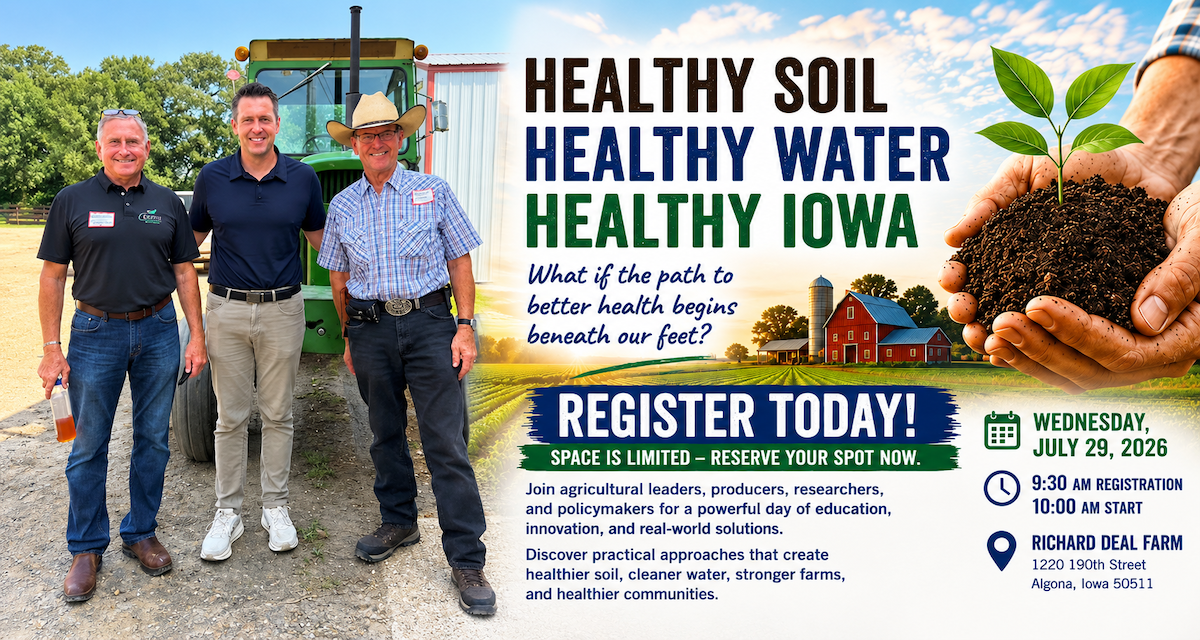
A strong indicator of the popular revolution brewing among Iowa’s farming community was an event in July 2026 called “Healthy Soil, Healthy Water, Healthy Iowa”, where Lahn was a speaker. The meeting, billed as a day of “education, innovation, and real-world solutions”, took place on the Richard Deal Farm near Algona, Iowa and was hosted by Evan Deal and Wyatt Streit of the soil health consultancy company Natural Heartland Solutions. The primary attendees were elected officials and/or candidates for public office at both the state and federal level.
Among the participants was Howard Vlieger, Iowa farmer and “student of the soil” since 1989. He reports that the meeting “brought together a very experienced group of individuals with a broad array of knowledge, focused on health, beginning with the soil and progressing all the way up the food chain. The concepts of implementing successful alternative farming practices were the focus of the day. Whether it is called alternative, biological, regenerative*, or organic, all these concepts were discussed at this meeting.” The following summary of the events of the day is based on Howard’s report.
Verlyn Sneller, president of the soil health products company Terra Transitional Solutions (TTS), with over 45 years’ experience, was the first speaker. He explained how improving soil health is the basis for the financial and environmental well-being for all types (conventional and organic) of farming operations. The TTS crop production programme is built around a biological product called Biomentum, made up of naturally occurring microorganisms. Verlyn shared numerous examples of how farmers from multiple states in the Midwest, on land now totalling over 250,000 acres, are successfully reducing the use of commercial fertiliser and pesticides, while maintaining or increasing yields –improving the bottom line in their cropping operations. Farmers implementing the full TTS program are seeing ongoing improvements in soil health and soil function, which are reducing the compaction issues in their fields – improving water infiltration and crop performance. Biomentum is also being used to improve the nutrient quality and content of liquid manure by digesting the solids, reducing odor and fly problems and saving money on fuel and equipment requirements. Another version of Biomentum is also being used to improve water quality in bodies of water.
Dr Michael McNeil, Ph.D., of Algona, Iowa, with over 40 years of experience, told how he has directly and indirectly assisted farmers to transition approximately 120,000 acres to organic crop production. Improving soil health is the number one focus in these farmers’ operations. Dr McNeil shared examples of how proper soil function happens and emphasised the importance of nutrient balance in reducing the need for pesticides. Learning about, and working with, the soil’s natural capabilities with the least amount of tillage is key to a successful transition to organic.
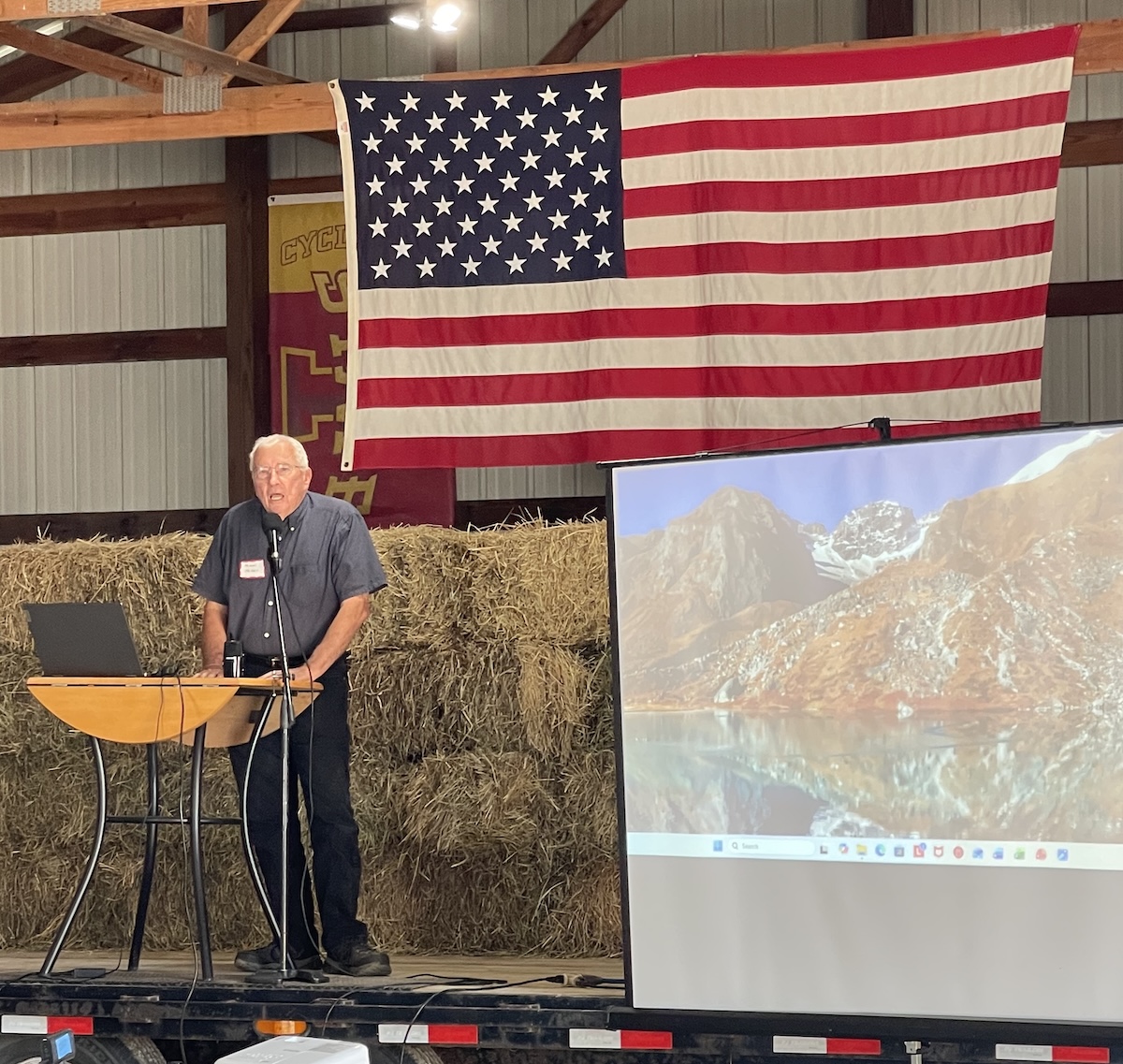 Dr Michael McNeil
Dr McNeil also shared how one large hog producer did a comparison of non-GMO grain to GMO grain feed. With non-GMO feed he found a significantly better outcome of fewer deaths and improved rate of gain and feed conversion, as well as fewer days on pre-market ‘finishing’ feed, with the animals going to market sooner. The producer was able to make more money, despite paying a premium for the non-GMO grain.
Dr Art Dunham, DVM, from Ryan, Iowa, with over 50 years’ experience as a practising veterinarian, shared information about the challenges his livestock farming clients are experiencing as a result of GMO feedstuffs, including nutrient deficiencies that are causing a variety of health issues and deaths in the livestock in their operations. Dr Dunham has had numerous lab tests performed that document the nutrient deficiencies that are directly contributing to these issues. Dr Dunham said all of the clients that switched back to using non-GMO crops and eliminated the use of the nutrient-chelating chemicals (notably glyphosate, which is sprayed on GMO herbicide-tolerant crops) were back to their normal production levels and much more profitable.
Ryland Engelhart is co-founder of Kiss The Ground, a nonprofit championing regeneration and healthy soil as a solution for human and planetary health; he’s also the producer of the documentary film of that name. He co-founded American Regeneration, an organisation that advances regenerative agriculture initiatives to restore soil health and enhance human wellbeing. His presentation explained his journey of learning about the benefits of regenerative farming. It focused on the importance of healing the soil and the environment, which in turn leads to benefits all the way up the food chain. He showed that regenerative agriculture is not just a solution for our land – it’s a path to healing the nation.
Howard Vlieger presented on how healthy soil vastly decreases the potential for flooding. He shared the numbers on rainfall infiltration tests conducted in Sioux County by Natural Resources Conservation Service personnel on regeneratively versus conventionally farmed land in 2024. A total of 5.39 inches per hour infiltrated on ‘regen’ land, versus .97 inches per hour on conventionally farmed land. By extrapolating these numbers to the acres in the Rock River water basin, he demonstrated the reason for the severe flooding that Rock Valley, Iowa has experienced in recent years – soils depleted in organic matter by intensive conventional farming methods.
Howard also shared the results of a scientific study documenting the ill effects of GMO corn and soy on the health of pigs. Attendees received a handout describing the positive results from Dale Hansen’s customers at Luxemburg Feed that have switched to feeding non-GMO feed. Howard emphasised that we know how to solve Iowa’s problems, and “by working together with both sides of the political aisle we can make our state and hopefully the entire Midwest healthier than ever”.
Zach Lahn was the closing speaker. His main campaign topics have been fixing the state’s problems and not succumbing to the pressures of the establishment. He called for changes in the education system, creating opportunities for young people when they graduate from college. He aims to save family farms from the oppression of the monopolistic control of a handful of crop input and commodity companies and thereby solve the water quality and cancer crisis in Iowa.
Zach offered common sense ways of dealing with these issues, as well as describing his meeting with HHS Secretary Robert F. Kennedy Jr. and Secretary of Agriculture Brooke Rollins.
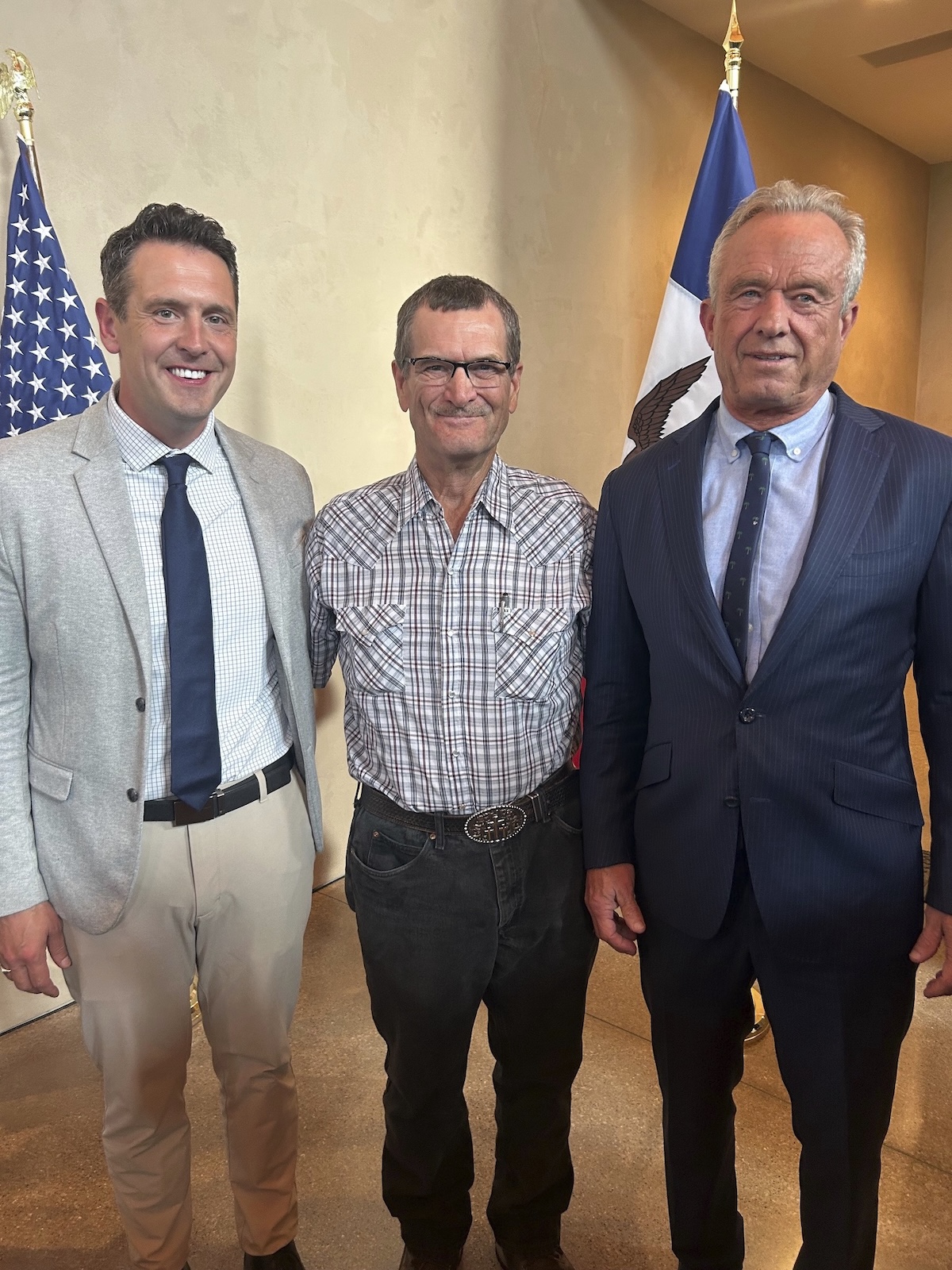
Zach Lahn, Howard Vlieger, and Robert F. Kennedy Jr
Zach plans to help the state to utilise healthy Iowa-grown food in schools, to benefit farmers and schoolchildren alike. He said: “We need to help all children and people in Iowa. This is not a partisan issue.”
There was much positive feedback about the event. Iowa Senator Lynn Evans posted on his Facebook page: “The field day in Algona was a day spent learning about regenerative farming practices and the benefits of improving soil health on water quality, flood control, and our own health. The many in attendance included several candidates and 15 members of the Iowa legislature as well as Zach Lahn for Governor. Thank you to all of those that made this a successful event!”
*GMWatch is aware that some farmers who call themselves regenerative use herbicides such as glyphosate to kill weeds and cover crops, and/or to ‘dry down’ grain before harvest. We believe that herbicides have no place in truly regenerative farming. The event described in this article didn’t go into this topic and there is no suggestion that the speakers and attendees either do or do not use herbicides in this way.
Banner image: Verlyn Sneller, Zach Lahn, and Howard Vlieger at the Healthy Iowa event, and the promotional ad for the event. Images courtesy of Howard Vlieger.