


An absence of regulatory approval hasn’t stopped Norfolk Healthy Produce’s GM tomatoes from spreading among EU countries. Report: Jonathan Matthews and Claire Robinson
Europe hasn’t approved GMO purple tomato seeds, but despite their sale and cultivation being strictly prohibited, Latvian authorities recently found GMO tomato seedlings being sold at a leading gardening fair. And Latvia seems not to be the only European country where these unauthorised GMO seeds or seedlings have been offered for sale.
Ultimately, that’s because even though the US company which produces the seeds – Norfolk Healthy Produce – denies supplying, licensing, or authorising their distribution in Europe, its marketing specifically targets home gardeners as its primary market, bypassing larger-scale commercial agriculture. This appears to be a deliberate strategy to break down public resistance to GMOs by packaging the GMO trait in a crop that is heavily associated with home gardening, organic lifestyles, and seed-saving culture, and so leveraging a highly personal hobby to normalise this technology.
But bypassing traditional commercial farm restrictions in this way also makes containment and non-GMO choices much harder to protect. And putting the GMO technology into a visually striking, consumer-facing crop and appealing directly to the curiosity of home growers, also creates a product that naturally exploits the often border-free and informal nature of global amateur gardening networks. This inevitably increases the risk of illegal spread and, as a result, of supposedly conventional tomatoes in private gardens or small market gardens becoming genetically contaminated.
Spreading across Europe
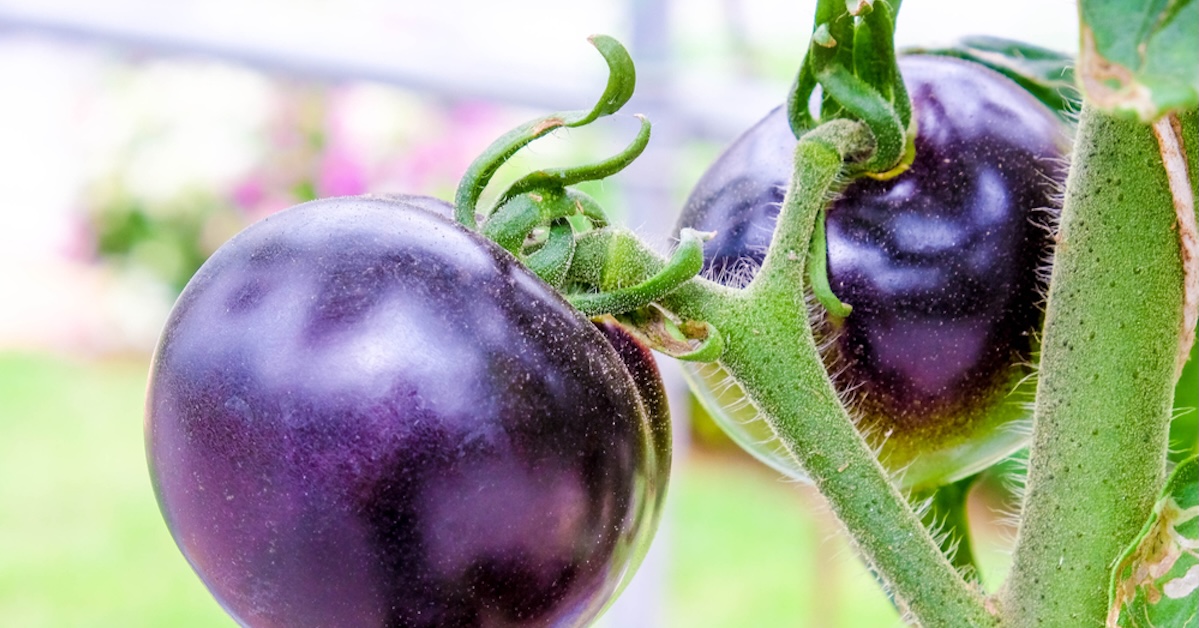
According to the biotech news website Informationsdienst Gentechnik, the authorities in Latvia seized the GMO tomato seedlings at Latvia’s largest consumer fair for horticulture, ‘Dārzs un Dzīvesstils’ (Garden and Lifestyle), held in May 2026, after visitors’ attention was drawn to a stall run by tomato enthusiasts selling seedlings of a tomato variety in which not only the skin but also the flesh was purple. To those in the know, this was clear evidence of genetic modification, because although there are non-GMO tomatoes with purple skin and even some with darkish flesh, there are none where the skin, flesh, and seeds are all ink-purple throughout. So they alerted the authorities, who subsequently questioned the trader. According to the Latvian media portal LSM, the trader claimed he had sourced the seeds from the USA.
LSM reported that the remaining seedlings had been destroyed and that the authorities urged people who had already purchased them not to pass them on or grow them, but to dispose of them. However, the authorities have no way of checking whether this is being complied with. Moreover, the magazine Baltic Focus reported that the same GMO seeds had already popped up in Latvia and Lithuania in 2025. And they weren’t the first Nordic states to sound the alarm.
Even though these seeds were only launched on the US market in February 2024, by September the Finnish authorities were warning that they were on sale to amateur gardeners, including those in the European Union, via an online shop for amateur gardeners on Facebook. The Finnish authorities asked buyers to return or burn the seeds, as well as any plants that had already been grown, warning, “Under no circumstances should the fruit be composted or left in the ground, as the seeds may germinate the following year.”
Just three months later, in December 2024, Kleverhof, a German Demeter-certified tomato-growing farm, mentioned in a YouTube video that the Norfolk GMO tomato had been offered for sale in a closed Facebook group for tomato enthusiasts with 38,000 members.
Patents, trade marks and a boutique biotechnology business
This illicitly spreading GMO tomato was originally developed by Cathie Martin at the John Innes Centre in Norfolk, UK, and was grown in greenhouse trials in Canada in 2014. The tomato’s genome was engineered to contain two genes from the snapdragon plant, which cause the tomato to accumulate purple pigments throughout the fruit – something that doesn’t occur naturally inside a tomato.
In 2022, the US Department of Agriculture authorised the marketing of the GMO tomato by Norfolk Plant Sciences (NPS), the boutique biotech company co-founded by Martin with Jonathan Jones – a scientist known for his close, but not always disclosed, links to Monsanto. NPS then set up a US subsidiary – Norfolk Healthy Produce, based in Davis, California – to sell the seeds to amateur gardeners. It also offers licences to small-scale professional growers who wish to cultivate the GMO tomatoes and market the seeds or fruit themselves.
Apart from the USA, the tomato – which is protected by the ‘Purple Tomato’ trade mark and patent – has been authorised for cultivation in Canada since August 2025 and in Australia since early 2026. Because Australia operates a joint food safety regulation system with New Zealand, New Zealand permits its consumption but bans its cultivation, as well as the import of whole tomatoes – to prevent any viable GMO seeds from entering the country’s ecosystem.
According to the Canadian Biotechnology Action Network, which is working to help Canadian seed savers understand the issues and to try to help seed swaps remain free from GMO contamination, small packets of seeds have been on sale in Canada to amateur gardeners since early 2026. From April onwards, the first GMO tomatoes – grown by Red Sun Farms – were available in some supermarkets under the Empress brand name, but without being clearly labelled as GMOs.
There are numerous GMO-free tomato varieties with purple or even black skins that are hugely popular with amateur gardeners, such as ‘Indigo Rose’, ‘Black Beauty’, ‘Cherokee Purple’ and ‘Black Eagle’. However, in all of them, while the skin is black or purple, the flesh is at best a dark maroon. Norfolk Healthy Produce is capitalising on the growing popularity of such distinctive varieties by marketing its seeds to amateur and allotment gardeners. For the same reason, it has also developed other novelty varieties, including a larger ‘cocktail’ size version of its cherry purple tomato – marketed to gardeners as the ‘Dark Holo’, and another similarly sized version with yellow and hazel striped skin over its purple flesh, branded as ‘The 11’.
The marketing strategy is clearly to capitalise on the lucrative, trend-driven novelty market for specialist home gardeners who love growing rare or unusually coloured crops (like white strawberries or blue corn) that they can showcase on social media platforms. And because gardening communities on Reddit, TikTok, and Facebook cross international lines, this viral marketing campaign, combined with Norfolk Healthy Produce’s ‘sharealike’ model, which “permits not-for-profit community sharing and personal-use breeding of their seeds by home gardeners”, provides a perfect recipe for generating the grey and black markets that have led to the repeated cases of these GMO seeds finding their way illegally into Europe.
The magazine Baltic Focus points out that such cases carry a high risk of the seeds – and thus the modified genetic material – finding their way into private gardens, hobby groups, swap meets or via online retailers, even without the GMO tomatoes being approved or ever reaching shop shelves. The cases that have come to public attention could thus be just the visible tip of the iceberg, pointing to widespread GMO contamination in private greenhouses.
Norfolk Healthy Produce can’t control its GMO seeds
Norfolk Healthy Produce has long failed to keep its much hyped GMO seeds under control. In 2024, the company sent Baker Creek Heirloom Seed Company in the US a letter alleging that Baker Creek might have infringed its patent on the GM purple tomato. Baker Creek’s ‘crime’ had been to offer its customers what it believed to be a non-GMO purple tomato, grown from seed sourced from a breeder in Europe, where the GMO version had not been approved – hence Baker Creek’s conviction that the tomato was non-GMO. On receiving the warning letter, Baker Creek immediately withdrew the purple tomato from sale. Since then, GMWatch has been alerted to cases of the GMO purple tomato (with purple flesh right the way through) allegedly being sold and given away by breeders and growers at seed and gardening fairs across Europe.
‘Approval via contamination’?
We hope that this is not yet another case of ‘approval via contamination’, a timeworn strategy used by the GMO industry and its allies to force GMOs into countries that didn’t want them. The pattern has been that GMO seeds have been illegally smuggled into the relevant country and grown by farmers; then governments, faced with the incendiary prospect of having to order large acreages of crops to be destroyed, have simply approved them retrospectively. This happened, for instance, with GMO soy in Brazil and GMO Bt cotton in India.
In the case of the GMO tomato, Norfolk Healthy Produce consistently expresses its strong disapproval of any grey market entrepreneurs selling on its seeds to Europe, or black-marketeers multiplying its seeds in their back yards. But for all their tut-tutting, the driving force behind what’s happening is Norfolk’s own marketing strategy, as is all too apparent from the fact that when regulatory agencies have intercepted illegal operations, the sellers are explicitly using the viral imagery and branding – that Norfolk make freely available – to market their illicit seeds.
The professional GMO promoter Mark Lynas has called Norfolk’s marketing to gardeners a “stroke of genius”. But the viral spread of an open-pollinated GMO into our gardens and community seed supply erodes regulatory controls and undermines efforts to protect people’s non-GMO choices.
The German-language article by Informationsdienst Gentechnik is here.
Sources used by Informationsdienst Gentechnik
Latvian Public Service Media: Unauthorised GMO tomatoes found in Latvia (11 June 2026)
Baltic Focus: The Purple Tomato Case: why Latvia’s GMO seedling case matters (12 June 2026)
Finnish Food Authority: Warning: Illegal genetically modified tomato seeds for sale (4 September 2024, automatically translated)
Kleverhof: Illegaler Anbau in Europa! Grüne Gentechnik kommt mit der Lila Tomate (Youtube video 08.12.2024)
Website of Norfolk Healthy Produce
Canadian Biotechnology Action Network: Genetically Engineered Fruits and Vegetables in Your Produce Section (24.04.2026)
The Guardian: Genetically modified purple tomatoes get green light to be sold in Australia (03.02.2026)
Image: Shutterstock (licensed purchase)