









 Memo reveals how GMO deregulation will trap plant breeding and innovation in a patent thicket controlled by a few multinationals and institutions – and won't solve food and farming problems. Report: Eric MEUNIER of Inf'OGM
In late April 2026, the French government supported the deregulation of GMOs produced using new techniques of genetic modification (GMO/NGT). A month earlier, however, the French Embassy in the United States had sent the government a memo detailing the situation in that country. Despite more than 140 marketing authorisations, only a few GMO/NGT are actually on the market there… but with significant patent-related issues. The situation described bears no resemblance to the promises made by multinational corporations or the European Commission.
---
On April 21, 2026, the Council of the European Union adopted a position in favour of deregulating the release and marketing of numerous GMO/NGT. This vote took place while numerous stakeholders were warning various governments about the risks of the appropriation of life associated with patents covering these techniques and/or the (plant) products obtained through them[i]. Agricultural unions, environmental protection groups, consumer associations (both French[ii] and foreign[iii]), citizen collectives that have long opposed GMOs, small and medium-sized seed producers, retailers[iv], processors, restaurant owners… many have voiced their opposition to a European Union lacking regulatory oversight of these GMOs. By endorsing the compromise text negotiated in early December 2025 with the European Parliament and the European Commission, the French government chose to place its trust in measures – or promises of measures – that would reduce the risks of a few multinationals appropriating living organisms, while remaining fully aware that these measures are highly fragile[v].
This position of the French government becomes even more surprising in light of an internal memo it received from its embassy in the United States in late March 2026. This memo, intended for the French administration but which Inf’OGM was able to read, depicts a national situation very similar to what opponents of deregulation are predicting in Europe.
20 years for “fewer than ten varieties”
In the United States, NGTs “were incorporated into plant breeding programs in the 2010s”[vi]. That was nearly twenty years ago. This is a long enough period to expect that GMO plant products developed using these NGTs would be widely available on the market. Especially since the country has long had an approval system that the note describes as “fairly facilitative”. This system has led the U.S. administration to issue a favourable opinion for “nearly 140 varieties currently in development”. As noted, the United States applies a system similar to that proposed by the European Commission in the context of GMO/NGT deregulation. The U.S. system implies that “most NGT plant varieties, provided they do not incorporate exogenous genetic material (particularly from pests), are exempt from the cumbersome authorisation procedures required for GMOs ahead of marketing”.
Despite these 140 approvals resulting from this very light regulatory framework, the French Embassy notes that “fewer than ten NGT varieties should be on the market in the United States”. A surprisingly low figure given the promises made by multinationals, which the embassy highlights: their ability, with these new genetic modification techniques, “to meet productivity requirements (hardier and healthier crops), adapt to climate change (drought resilience), but also ensure environmental sustainability (reduction in chemical inputs)”, in theory more quickly than with traditional breeding methods.
“the patent and licensing ecosystem […] concentrated in the hands of a few major players”
In addition to the fact that “scientists currently lack clarity on the true benefits of NGTs in terms of plant health (resistance to pests) or environmental resilience”, the note clearly identifies the key factor preventing the commercialisation of varieties modified by new techniques in a country that facilitates their market entry: patents.
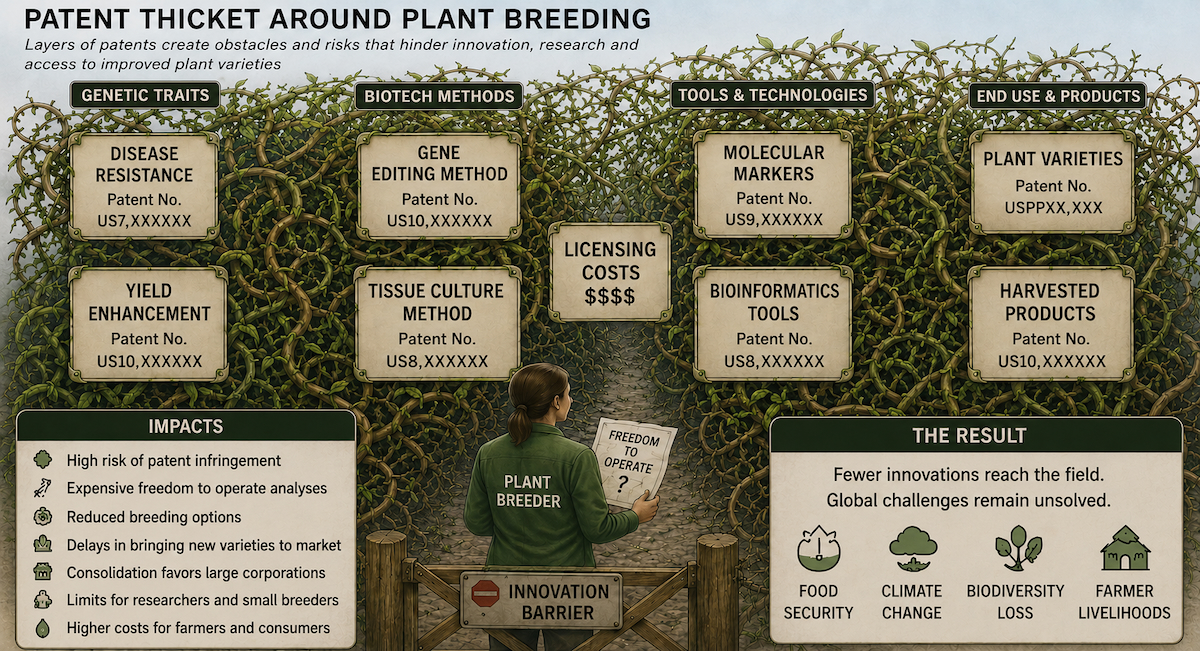
As the note points out, “patents are thus at the heart of these technological innovations, coupled with licensing agreements – whether exclusive or not – that ensure incentives for innovation through market regulation”. Thus, over the past twenty years, while fewer than ten varieties have been brought to market, the number of patents has skyrocketed: “by December 2024, more than 1,000 patents and patent applications had been granted or were pending approval [by the U.S. Patent and Trademark Office] for the use of CRISPR technology in agriculture. Sixty-nine had been granted in the field of field crops”.
While, in the case of the CRISPR/Cas9 tool, the foundational patents are held not by multinationals but by research institutes (“the Broad Institute […] on one side and UC Berkeley and the University of Vienna”), multinationals have got into the game by signing licensing agreements with them, and then in turn developing processes “to create new plant varieties, processes that will in turn be patented and commercialised through licensing”. Corteva has thus acquired several exclusive and non-exclusive licenses from various rights holders regarding the use of CRISPR/Cas9 for plant products, giving it a dominant position in controlling this technology and thereby requiring its competitors who wish to use this process to pay royalties.
According to the embassy’s memo to the French government, “ultimately, the ecosystem of patents and licenses protecting i) the CRISPR-Cas9 technology, ii) the processes for creating new plant varieties incorporating CRISPR-Cas9, and iii) the characteristics of plant varieties resulting from these processes is, in fact, concentrated in the hands of a few major players”. This concentration is being criticised by several stakeholders in Europe at the attention of national and European lawmakers. However, according to the embassy, “in fact, abuse of a dominant position could be invoked”.
What would the situation be in Europe if deregulation was adopted?
The memo from the French Embassy explains that in the United States, the “platform” model – which aims to consolidate patents to serve as a one-stop shop for negotiations between holders of rights and licensees under “fair, reasonable, and non-discriminatory” terms – could be a solution. However, it notes that, despite the existence of such a platform for CRISPR/Cas9, “some American breeders prefer to turn to other CRISPR techniques, using alternative enzymes such as Cas12a, Cas13a, or Cas14a” to avoid a near-monopoly situation resulting from the use of patent rights.
In short, “the absence of strict regulatory constraints governing the commercialisation of NGT plant varieties might suggest a form of ‘democratisation’ of gene-editing technology in the United States”. However, in reality, this is not the case, since the patent system “strongly protects both the research institutes that discovered the CRISPR technique and the multinationals that have filed numerous patents protecting their plant breeding processes”. Consequently, innovation in the field of plant variety creation by companies “ultimately remains the preserve of large firms. SMEs wishing to develop innovative varieties are thus forced to enter into licensing agreements with these multinationals, at high costs”.
In conclusion, the embassy wrote to the French government in late March 2026 – one month before the European Council vote – that “as the intellectual property system is designed in the EU Regulation on NGTs, based on patents, nothing would seem to prevent the U.S. model from being replicated in the EU”. It adds, however, that it is “to be hoped that the ‘regulatory’ mechanisms provided for in the regulation (information platform, internal market surveillance, etc.) will fully fulfil their role and enable European SMEs to gain genuine access to innovation”. These mechanisms depend entirely on the goodwill of the patent holders, as the measures referred to by the French Embassy are not mandatory under the text adopted by the Council of the EU in April and which MEPs are expected to consider in June 2026.
Upon reading the memo, one might therefore wonder why the French government chose not to take it into account on April 21, 2026, when it approved the proposal for a new regulation on GMO/NGT.
Notes
i. Antoine Vépierre, A wide range of stakeholders opposed to the deregulation of GMOs/NGTs, Inf’OGM, 20 April 2026. https://infogm.org/en/a-wide-range-of-stakeholders-opposed-to-the-deregulation-of-gmos-ngts/
ii. Collective opt-out, Il faut des étiquettes sur les organismes génétiquement modifiés et les nouvelles techniques génomiques pour les consommateurs, mais aussi pour le commerce international, Le Monde, 6 March 2025. https://www.lemonde.fr/idees/article/2025/03/06/il-faut-des-etiquettes-sur-les-organismes-genetiquement-modifies-et-les-nouvelles-techniques-genomiques-pour-les-consommateurs-mais-aussi-pour-le-commerce-international_6576724_3232.html
iii. Suzy Sumner, Modified food, modified rights? Why genetically modify organisms labelling must stay, The Brussels Times, 14 October 2025. https://www.brusselstimes.com/1793393/modified-food-modified-rights-why-gmo-labelling-must-stay
iv. Collective opt-out, Avec cette nouvelle loi, les Français auront d’immenses difficultés à accéder à une alimentation sans OGM, Le Monde, 6 December 2023. https://www.lemonde.fr/idees/article/2023/12/06/avec-cette-nouvelle-loi-les-francais-auront-d-immenses-difficultes-a-acceder-a-une-alimentation-sans-ogm_6203859_3233.html
v. Denis Meshaka, The French Ministry of Agriculture concedes a compromise on patents in the GMO/NGT regulations, Inf’OGM, 23 April 2026. https://infogm.org/en/the-french-ministry-of-agriculture-concedes-a-compromise-on-patents-in-the-gmo-ngt-regulations/
vi. All the translations are from Inf’OGM.
This article was first published by Inf'OGM and is republished by GMWatch with their kind permission.