


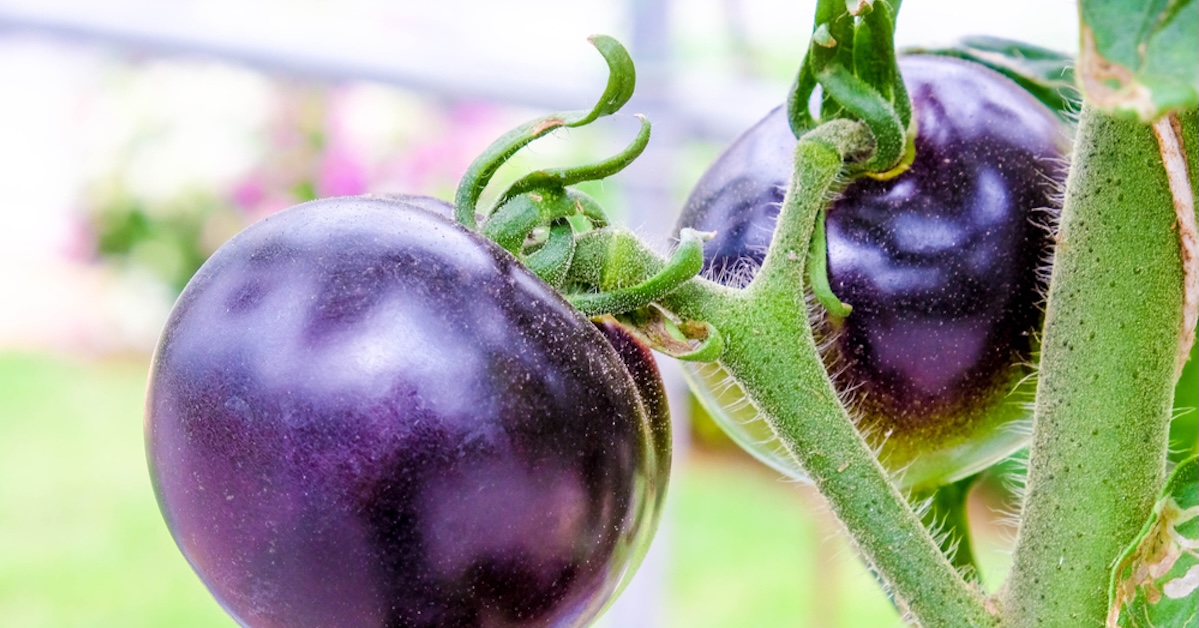
 Norfolk Plant Science’s “healthy” GM tomato was said to have anti-cancer properties – but food safety questions remain`
Summary
Extraordinary claims have been made for the GM Purple Tomato’s supposed anti-cancer properties since its development was first announced in 2008. However, these claims have been criticised by health authorities on the grounds that they are not based on evidence. More recently the health claims have been toned down in renewed publicity around the tomato. There are unanswered food safety questions around the tomato, both from the point of view of its high levels of antioxidants – levels that scientists say can harm health – and any unintended changes from the GM process used to develop it. Even at this early stage of the GM Purple Tomato’s commercialisation, the developer company Norfolk Plant Sciences has used its patents on the GM-obtained enhanced anthocyanin trait to force an avowedly non-GM seed company to stop selling seeds with the same trait, which the seed company said was obtained by conventional breeding.
Facts at-a-glance
The GM Purple Tomato was genetically engineered with genes from the snapdragon plant to contain high levels of the antioxidant anthocyanin, a type of polyphenol. The GM tomato was developed by Prof Cathie Martin at the John Innes Centre (JIC) in the UK.[1]
Claims
- The GM Purple Tomato was promoted in the media as a supposedly cancer-fighting food. For example, the UK’s Daily Express headlined its 2008 article, “Purple tomato can beat cancer”. The article added that it “could also keep you slim, ward off diabetes and help to safeguard your eyesight”.[2]
- The “cancer fighting purple tomato”[3] claims were not made up by the press, but originated with the JIC, which headed its press release, “Purple tomatoes may keep cancer at bay”.[4]
- The claims were based on a small “pilot” study in cancer-prone mice that found the mice eating the GM tomato lived longer than those eating non-GM tomatoes.[5]
Results
- The UK’s National Health Service (NHS) and Cancer Research UK (CRUK) objected to the JIC and media claims on the grounds that they are unsupported by evidence. The NHS Knowledge Service said: “Until the tomato is tested in humans we cannot be sure that it will offer the same benefits, or that there will not be any unexpected harms.”[6] Cancer Research UK said it was wrong to assume that “antioxidants = good… that's not what the science says”.[7]
- Evidence indicates that high levels of anthocyanin, such as those in the GM tomato, as well as high levels of polyphenols in general, may present health risks.[8]
- In a 2023 press release, Norfolk Plant Sciences toned down previous health claims and did not mention cancer.[9] However, it used the word “healthy” to describe the GM tomato and named its US subsidiary Norfolk Healthy Produce.[10]
Companies
- The GM Purple Tomato is marketed by Norfolk Plant Sciences and its US subsidiary, Norfolk Healthy Produce. Norfolk Plant Sciences is a spinout company from the JIC and the Sainsbury Laboratory and was established by Cathie Martin and her JIC colleague Jonathan Jones.[11]
Patents
- Norfolk Healthy Produce/Norfolk Plant Sciences has used its patents on the GM enhanced anthocyanin trait to prevent an avowedly non-GM seed company selling seeds with the same trait that the seed company said was obtained by conventional breeding.[12]
Claims
The GM Purple Tomato was genetically engineered with genes from the snapdragon plant to contain high levels of the antioxidant anthocyanin, a type of polyphenol. The GM tomato was developed by Prof Cathie Martin at the John Innes Centre (JIC) in the UK.[13]
From the start, the GM tomato was promoted in the media as a supposedly cancer-fighting food. For example, on 27 October 2008, the UK’s Daily Express headlined its story about the GM tomato's development, “Purple tomato can beat cancer”. The article added that it “could also keep you slim, ward off diabetes and help to safeguard your eyesight”.[14]
Reuters headlined its article, “Scientists develop cancer fighting purple tomato”.[15] Like the Express article, the Reuters piece mentioned a small "pilot" feeding study on cancer-prone mice conducted by Cathie Martin and colleagues, which found that the mice fed the GM tomato lived longer than those fed non-GM red tomatoes.[16]
The “cancer fighting purple tomato” claims were not made up by the press, but originated with the media work of the John Innes Centre. The JIC had headed its 26 October 2008 press release, “Purple tomatoes may keep cancer at bay”.[17]
In a 2023 press release Norfolk Plant Sciences toned down the previous health claims for the product and did not mention cancer.[18] This suggests that some legal caution had entered the marketing strategy for the tomato.
Yet Norfolk Plant Sciences repeatedly uses the word “healthy” to describe the GMO tomato. Indeed, the company has named its US subsidiary, which announced the favourable outcome of the FDA review of the GM Purple Tomato, Norfolk Healthy Produce. Norfolk Plant Sciences states that Norfolk Healthy Produce “is actively developing and marketing the next generation of innovative vegetables and fruits”.[19]
Moreover, some people within the GMO industry lobby are still repeating the “cancer fighting purple tomato” claims. Maddie Hall,[20] CEO of Living Carbon, which aims to market GM trees engineered “to soak up more carbon and cool the climate”,[21] greeted the USDA's deregulation in the US of the GM purple tomato on X with the post: “Yesterday was a historic day in plant biotech: A purple tomato engineered with high antioxidants was approved by USDA. BigPurpleTomato helps prevent cardiovascular disease and fight cancer in humans. This approval under new regulation ushers in a new era for plant synbio!”[22]
Results
Pushback on claims
The Daily Express and other media following the anti-cancer line were quickly slapped down by the UK's National Health Service (NHS) and Cancer Research UK (CRUK). According to an article in NHS Choices, reporting the views of the NHS Knowledge Service: “These claims are not actually based on benefits seen in humans, but rather from a small-scale study of mice that were given an extract of genetically modified tomatoes.” The NHS Knowledge Service also noted: “The small sample sizes used mean the results may have occurred by chance. Also until the tomato is tested in humans we cannot be sure that it will offer the same benefits, or that there will not be any unexpected harms.” It concluded that without further research, the claims that these GM tomatoes "can beat cancer" cannot be supported.[23]
Cancer Research UK wrote on its Science Update blog that “cancer is a complex disease that has lots of ‘causes’... The problem with a lot of the coverage of the super-tomato story is that it misses out on this complexity... There’s also a big – and in our opinion unwarranted – assumption in some of the coverage. And that’s the simple equation that antioxidants = good. There's a fair amount of evidence that some antioxidants in our foods can help prevent some kinds of cancer in some people. But the complexity of this evidence often gets translated in the media and in advertising to ‘antioxidants prevent disease’. And that's not what the science says.”[24]
Antioxidants: The science
In its pushback against the “anti-cancer” claims for the GM tomato, Cancer Research UK points to a New Scientist article on the health effects of antioxidant supplements. The article cites differing and contradictory findings from various studies and concludes that “at best, antioxidant supplements do little or nothing to benefit our health. At worst, they may even have the opposite effect, promoting the very problems they are supposed to stamp out.”[25]
This view is reflected by the findings of a mini-review of the human health effects of a class of antioxidants called polyphenols (which include anthocyanin), as ingested from both food and supplement sources. Authored by scientists from Harvard University and the University of Melbourne, the mini-review emphasises “the need for increased regulation and guidelines for polyphenol consumption and supplementation in order to ensure consumers remain safe and informed about polyphenols”. The scientists point out that supplements taken in pill form may make it easily possible to exceed safe levels, potentially causing serious ailments, such as stroke or increased risk of death.[26]
Venket Rao, professor emeritus at the University of Toronto’s Dept of Nutritional Sciences, warned of the dangers of overdosing on antioxidants. He said: “We have evidence that antioxidants are good for you, but we also have well-controlled clinical studies showing that at megadoses they could be harmful to you.”[27] Another caution against taking high doses of antioxidants came from Prof Jim Kehrer of the University of Alberta in Edmonton. As an example, he said high levels of the antioxidant vitamin A can cause liver damage. He suggested that people should not overdo selected chemicals.[28]
The GM Purple Tomato is a food and not a pill supplement. Nonetheless, the high anthocyanin levels in the tomato may present similar risks as those from supplements, as explained below.
Too much of a good thing?
Former US EPA scientist Dr Ray Seidler said:[29] “When consumed in moderation, anti-inflammatory compounds like anthocyanins can have health benefits. But too much of a good thing may not be good. It has been demonstrated that over-consumption of anthocyanins (e.g. when taken as pill supplements) may cause kidney, liver, and thyroid hormone health effects.[30] Anthocyanins are part of a group of compounds called polyphenols, which may also limit or interfere with iron absorption.”[31]
Drawing attention to the GM Purple Tomato’s extremely high anthocyanin levels, Dr Seidler said, “The average American consumes around 12.5 milligrams of anthocyanins per day.[32] The anthocyanin content from the GM tomato averages about 500mg per 100g of fresh fruit,[33] some 40 times more than the daily average consumption. One hundred grams of tomato is less than half a cup. Other naturally purple and red coloured fruits (sweet cherries, blackberries, strawberries, red raspberries, black grapes) contain anthocyanins in the range of 3-143mg/100g,[34] up to 160-fold less than the GM Purple Tomato.”
Michael Antoniou, a London-based professor of molecular genetics and toxicology, explained the double-edged role of antioxidants, which can benefit or impair health, depending on the individual and the circumstances.
“The health claims around ingesting high levels of antioxidants such as anthocyanins are based on their ability to neutralise reactive oxygen species (ROS). ROS perform vital health-promoting functions.
“However, ROS can also damage molecules (including DNA) and cells, leading to diseases such as cardiovascular disease and cancer. The key to good cell and organ function is maintaining a balance between producing enough ROS to appropriately modulate vital functions but not so much as to bring about damage and disease.
“Ingesting megadoses of antioxidants, such as anthocyanins from even a modest portion of the GM Purple Tomatoes, could interfere with the delicate balance between too much and too little ROS, leading to negative health outcomes.”
Supporting these views, a systematic review of randomised trials on antioxidants by the Cochrane Library found no evidence that they can reduce risk of mortality in healthy or sick people and concluded that some antioxidants can increase the risk of mortality. The authors concluded, “Antioxidant supplements need to be considered medicinal products and should undergo sufficient evaluation before marketing.”[35]
This type of in-depth evaluation has not happened with the GM Purple Tomato, even though it contains higher levels of antioxidants than the levels in the pill supplements that some scientists warn against ingesting.
No evidence of food safety
Prof Antoniou warned that, as the GM tomato has been genetically engineered to change biochemical pathways to produce high amounts of anthocyanin, this could also lead to unintended alterations in the tomato's composition: “Biochemical pathways are interlinked, so introducing a new core pathway could lead to biochemical changes resulting in the production of novel toxins or allergens.
“And this is the risk from just the intended change. In addition, the GM transformation process (plant tissue culture and plant cell transformation) will inevitably give rise to hundreds or thousands of sites of unintended DNA damage (mutations).[36] These wide scale mutations can change patterns of gene function and altered biochemistry and composition, with unknown health consequences.[37]
“There is no evidence that the developers of the GM Purple Tomato have carried out the kind of molecular analyses (proteomics and metabolomics) that could help establish whether they only got the change they want, with no unintended changes. As a result, we don't know if these tomatoes are safe to eat.”
Antibiotic resistance genes
The GM Purple Tomato contains an antibiotic resistance marker gene (the so-called nptII gene),[38] which confers resistance to antibiotics including kanamycin and neomycin. The purpose of these genes in this case is to enable the genetic engineer to check which cells have successfully incorporated the snapdragon genes into their genome.
Controversy has simmered over antibiotic resistance marker genes in GMOs for many years but has never been resolved. The concern is that such genes could transfer to disease-causing bacteria and add to the already serious problem of antibiotic resistance in humans and other animals.
The World Health Organization says, “Although the probability of transfer is low, the use of gene transfer technology that does not involve antibiotic resistance genes is encouraged.”[39]
Norway has banned the use of GM varieties containing antibiotic resistance marker genes.[40]
In the EU, Directive 2001/18 states, “The issue of antibiotic-resistance genes should be taken into particular consideration when conducting the risk assessment of GMOs containing such genes” and recommends that they are phased out from commercialised GMOs by 2008.[41] However, the GMO industry failed to do so.
There appears to be no independent assessment of risks posed by the presence of an antibiotic marker gene in the GM Purple Tomato.
Regulatory status
In the US in 2022 the US Dept of Agriculture (USDA) deregulated the GM Purple Tomato,[42] effectively removing it from the agency's regulatory framework. In 2023 the US Food and Drug Administration (FDA) sent the developers a “no questions” letter.[43] This letter confirms that based on the data supplied by the applicant, the GM tomato “does not raise issues that would require premarket review or approval by FDA”.[44]
In Canada in August 2025 the GM Purple Tomato was approved for food use.[45] In the same month the Canadian Food Inspection Agency (CFIA) authorised planting of the seeds.[46] Seeds can be purchased online by growers.[47]
In Australia in 2026, the Office of the Gene Technology Regulator and Food Standards Australia New Zealand (FSANZ) approved the GM Purple Tomato. It can be sold commercially, grown, and eaten there. Prior to importing GM Purple Tomato as seeds, plants or fruit, an import permit from the Department of Agriculture, Fisheries and Forestry (Biosecurity) would also be needed. Separate approval would be required in the Australian state of Tasmania, which maintains a strict state-wide ban on the commercial release of GM crops.[48]
Commercial launch in the US
Following favourable reviews by the US FDA and USDA, the GM tomato was commercially launched in the US in 2024[49] by Norfolk Plant Sciences and its US subsidiary Norfolk Healthy Produce, under the name “Purple Tomato”.[50] Seeds were being sold to home gardeners[51] at $20 per pack.[52] In 2024 the company got its tomatoes into some supermarkets on the East Coast and was targeting high-end restaurants.[53]
GM Purple Tomatoes sold and grown illegally in the EU
In June 2026 Latvian authorities found GM Purple Tomato seedlings being sold at a leading gardening fair, in spite of the fact that the EU has not approved their sale or cultivation. The State Plant Protection Service discovered these seedlings at a collector’s home after receiving complaints in May from visitors to the “Garden and Lifestyle 2026” exhibition regarding the sale of this variety. The Plant Service conducted an inspection of the grower, who admitted that they had obtained the seedlings from another collector in the US but said they had now destroyed the material.[54]
Latvia seems not to be the only EU country where unauthorised GM Purple Tomato seeds or seedlings have been offered for sale; nor was the 2026 discovery in that country the first one. The magazine Baltic Focus reported that the same GM seeds had already appeared in Latvia and Lithuania in 2025.[55] And they were not the first Nordic states to sound the alarm.
Even though these seeds were only launched on the US market in February 2024, by September the Finnish authorities were warning that they were on sale to amateur gardeners, including those in the EU, via an online shop for amateur gardeners on Facebook. The Finnish authorities asked buyers to return or burn the seeds, as well as any plants that had already been grown, warning, “Under no circumstances should the fruit be composted or left in the ground, as the seeds may germinate the following year.”[56]
Just three months later, in December 2024, Kleverhof, a German Demeter-certified tomato-growing farm, mentioned in a YouTube video that the GM Purple Tomato had been offered for sale in a closed Facebook group for tomato enthusiasts with 38,000 members.[58]
Norfolk Healthy Produce denies supplying, licensing, or authorising their distribution in the EU.[59] Nevertheless, its marketing specifically targets home gardeners[60] as its primary market, bypassing larger-scale commercial agriculture. According to the civil society organisation GMWatch: “This appears to be a deliberate strategy to break down public resistance to GMOs by packaging the GMO trait in a crop that is heavily associated with home gardening, organic lifestyles, and seed-saving culture, and so leveraging a highly personal hobby to normalise this technology.
“But bypassing traditional commercial farm restrictions in this way also makes containment and non-GMO choices much harder to protect. And putting the GMO technology into a visually striking, consumer-facing crop and appealing directly to the curiosity of home growers also creates a product that naturally exploits the often border-free and informal nature of global amateur gardening networks. This inevitably increases the risk of illegal spread and, as a result, of supposedly conventional tomatoes in private gardens or small market gardens becoming genetically contaminated.”
GMWatch questioned whether the broad spread of the illegal seed dissemination might be another case of “approval by contamination”, following the precedents of GM soy in Brazil and GM Bt cotton in India.[61]
Conventionally bred purple tomatoes
Heirloom non-GM anthocyanin-rich tomatoes (albeit with lower anthocyanin levels than the GM version[62]) have long been marketed. Heirloom varieties of purple tomato, such as Black Zebra[63] and Black Krim,[64] are available to growers.
In addition to heirloom varieties, the “Indigo” family of conventionally bred purple tomatoes were developed by Jim Myers, a plant breeder and professor at Oregon State University, by crossing genes from wild tomatoes with modern varieties.[65]
It took Martin and her colleagues at Norfolk Plant Sciences 20 years to successfully genetically engineer the GM tomato.[66] In contrast, Myers’s non-GM Indigo Rose purple tomato took just 10 years to develop and was released in 2011.[67] There are currently more than 50 cultivars of the Indigos being grown and bred throughout the world. Myers said, “There's just all this diversity in the Indigo market class that has come about through conventional breeding. With the GMO tomato, it's taken them all this time and more to get one variety out there.”[68]
Laws on health and nutrient claims
In the EU, nutrition and health claims made for products are tightly regulated and must be “clear, accurate and based on scientific evidence”.[69] The EU regulation has been retained in the post-Brexit UK.[70]
In the US, under the Federal Food, Drug, and Cosmetic Act, health claims on foods or dietary supplements must be authorised by the FDA.[71] False or unsubstantiated health claims are in violation of the Federal Food, Drug & Cosmetics Act (FDCA).[72] In order for foods to carry an FDA-authorised health claim, “there must be significant scientific agreement (SSA) among qualified experts that the claim is supported by the totality of publicly available scientific evidence for a substance/disease relationship”.[73]
Claims about nutrient content can only be made for nutrients for which there is a Recommended Daily Intake (RDI) in the Code of Federal Regulations (CFR) Title 21[74] – but there is no RDI for anthocyanin in the Code.[75]
There is no indication that Norfolk Plant Sciences has attempted to validate any health or nutrient claims for the GM tomato, either with the FDA or any other official body.
Companies
The GM Purple Tomato was developed and is marketed by Norfolk Plant Sciences and its US subsidiary, Norfolk Healthy Produce. Norfolk Plant Sciences is a spinout company from the John Innes Centre and the Sainsbury Laboratory and was established by Cathie Martin and her John Innes Centre colleague Jonathan Jones.[76]
Patents
Cathie Martin and her Norfolk Plant Sciences colleague Jonathan Jones hold active and pending patents on methods to genetically engineer plants with higher antioxidant compounds, as well as on the plants made with those methods.[77]
Norfolk Plant Sciences targets seed company over alleged patent infringement
In its 2024 catalogue, Baker Creek Heirloom Seed Company in the US offered a “non-GMO purple tomato”, the Purple Galaxy. It even featured on their catalogue’s cover.

On 19 February 2024, Baker Creek said it was contacted by Norfolk Healthy Produce, which “expressed concern that the Purple Galaxy might have been derived from its patented genetically engineered tomato”.[78] Baker Creek immediately withdrew the Purple Galaxy seeds, saying, “Subsequent laboratory testing conducted in conjunction with Norfolk did not conclusively establish a relationship between the Purple Galaxy and Norfolk’s GM purple tomato. Indeed, such contamination should be unlikely in Europe, given its approach to GM crops. But the testing also did not conclusively establish that the Purple Galaxy is truly free of any genetically modified material.”[79]
Baker Creek also stated that it “remains steadfast in its commitment to selling only heirloom and open-pollinated, non-Genetically Modified (‘non-GM’) varieties”.[80]
Baker Creek insists that it did its due diligence: “We sourced the seed for the Purple Galaxy from a plant breeder in Europe – where GM tomatoes are not approved – who has collected rare tomato seeds for decades and grows more than 1,000 varieties of tomatoes annually. We actively followed his attempts to breed a purple flesh tomato over the course of three years. In the beginning, using two varieties, he had a fruit that was definitely not purple; it was a purplish red with a few purple streaks. Cultivating five generations over three years, he ultimately had a beautiful tomato with purple skin and flesh. We then travelled to Europe to see the plants for ourselves.”[81]
However, C.S. Prakash, who runs the pro-GMO AgBioWorld website,[82] accused Baker Creek of lying and deliberately stealing Norfolk Plant Sciences’ patented germplasm. He posted on X: “Liar, liar… your pants on fire! How Bakers Seeds simply swiped some GMO purple tomato seeds from Norfolk Plant Sciences, gave it a fancy name and marketed it as heirloom tomato to its gullible customers!”[83]

Norfolk Healthy Produce unambiguously said the Purple Galaxy was GMO: “Given its remarkable similarity to our purple tomato, we prompted Baker Creek to investigate their claim that Purple Galaxy was non-GMO. We are told that laboratory testing determined that it is, in fact, bioengineered (GMO). This result supports the fact that the only reported way to produce a purple-fleshed tomato rich in anthocyanin antioxidants is with Norfolk’s patented technology. We appreciate that Baker Creek tested their material, and after discovering it was a GMO, removed it from their website.”[84]
In the absence of either Baker Creek or Norfolk Healthy Produce posting the lab results publicly, it is impossible to know whether they showed the Purple Galaxy was GMO or not.
All we know is that apparently, the testing company didn’t find the obviously GM transgenes (artificially introduced GM genes) they looked for in their first testing – probably the snapdragon genes – but then Norfolk “suggested additional genes to test for”. According to Baker Creek’s post, these results were inconclusive.[85]
So did the testing company find the snapdragon genes, which are responsible for the increased anthocyanin levels? Or did it find genes that may be found in the GM purple tomato but which are naturally occurring? If the latter, they are not patent-protected.[86] European law, correctly interpreted, does not allow patents on naturally occurring genes.[87]
Breeders’ patent fears
Plant breeders are becoming increasingly fearful of inadvertently infringing the patents of seed companies, in particular those of the large multinationals, which have taken to sending threatening letters to the breeders, warning them of the consequences of using their intellectual property.
An article called “Laying claim to nature’s work: Plant patents sow fear among small growers” describes the experience of Adaptive Seeds, an organic seed company. The company was contacted by BASF, the owner of Nunhems, the fourth-largest vegetable breeding company in the world, with a list of varieties of seeds and traits Nunhems had patented.
According to the article, “It was an ominous reminder of just how many traits and varieties BASF has control over.”
Adaptive Seeds founder Andrew Still said, “There’s always a general concern that one day they’re going to decide we’re selling something that they think is theirs and they’re going to sue us over that.”
The article explains that the consolidation of the seed industry that has occurred since the early 2000s has concentrated the patented ownership of valuable plant germplasm in the hands of a few multinationals: “Today, just four companies – Bayer, DowDupont/Corteva, ChemChina-Syngenta and BASF – control over 60% of the seed market worldwide.[88] Bayer alone owns over 20 different varieties of lettuce, some of which the company has owned for over a decade. Each patent has an extensive list of the variety’s traits and characteristics.
“The system rewards powerful firms with the resources to develop and enforce patents, explained Phil Howard, a professor in the department of community sustainability at Michigan State University. As patent law is complicated and ambiguous, many small-scale breeders don’t know if the seeds they want to work with are patented or not. He said this stifles their freedom to experiment.
“’Some of these big firms will intimidate seed breeders into believing that there are broad patent claims on many seeds, when in fact there aren’t. So the current lack of transparency and the complexity really gives massive advantages to these big firms and really hinders the smaller firms.’”[89]
Another article, “We’re losing our seed breeders”, reported, “Because private sector breeding often results in patents, public breeders are unable to experiment with most seeds a private breeder produces — leaving some wary. ‘The privatization of actual genetic traits is really troubling,” said [Chris Smith, executive director of the Utopian Project, a nonprofit that focuses on crop diversity in the food and farm system]. I should be allowed to work with purple carrot genetics without worrying about being sued. And that’s not our current reality, which is really scary to me.’”[90]
Author: Claire Robinson. Historical original research and review: Jonathan Matthews. Review and editing: Franziska Achterberg. Scientific review: Dr Ray Seidler; Dr Michael Hansen; Prof Michael Antoniou. Last updated: 29 Oct 2026. This article was first published (in more concise form) on the GMO Promises website.
References
1. John Innes Centre (2022). Norfolk Plant Sciences welcomes major milestone decision on purple GM tomatoes. 8 Sept. https://www.jic.ac.uk/press-release/norfolk-plant-sciences-welcomes-major-milestone-decision-on-purple-gm-tomatoes/
2. Fletcher V (2008). Purple tomato can beat cancer. Daily Express, 27 Oct. https://www.express.co.uk/news/uk/68047/Purple-tomato-can-beat-cancer
3. Kahn M (2008). Scientists develop cancer fighting purple tomato. Reuters, 26 Oct. https://www.reuters.com/article/idUSTRE49P2KF/
4. John Innes Centre (2008). Purple tomatoes may keep cancer at bay. 26 Oct. Version archived in Wayback Machine 30 Apr 2009. https://web.archive.org/web/20090430135628/http://www.jic.ac.uk/corporate/media-and-public/current-releases/081026martin.htm
5. Butelli E et al (2008). Enrichment of tomato fruit with health-promoting anthocyanins by expression of select transcription factors. Nature Biotechnology 26: 1301–1308. https://www.nature.com/articles/nbt.1506
6. NHS Choices (2008). Purple tomatoes “beat cancer”. 27 Oct. Version archived by Wayback Machine 2 May 2009. https://web.archive.org/web/20090502045505/http://www.nhs.uk/news/2008/10October/Pages/Purpletomatoes.aspx
7. Cancer Research UK (2008). Purple tomatoes won’t beat cancer. 27 Oct. Version archived by Wayback Machine 17 Jul 2009. https://web.archive.org/web/20090717012343/http://scienceblog.cancerresearchuk.org/2008/10/27/purple-tomatoes-wont-beat-cancer/
8. Melton L (2006). The antioxidant myth: A medical fairy tale. New Scientist, 2 Aug. https://www.newscientist.com/article/mg19125631-500-the-antioxidant-myth-a-medical-fairy-tale/ An archived version of this article is here: https://archive.ph/MxDUJ ; Cory H et al (2018). The role of polyphenols in human health and food systems: A mini-review. Front Nutr 5: 87. Sep 21. doi: 10.3389/fnut.2018.00087 https://www.ncbi.nlm.nih.gov/pmc/articles/PMC6160559/ ; Cory H et al (2018). The role of polyphenols in human health and food systems: A mini-review. Front Nutr 5:87. doi: 10.3389/fnut.2018.00087. https://www.ncbi.nlm.nih.gov/pmc/articles/PMC6160559/ ; Mennen LI et al (2005). Risks and safety of polyphenol consumption. Am J Clin Nutr 81(1 Suppl):326S-329S. doi: 10.1093/ajcn/81.1.326S. https://pubmed.ncbi.nlm.nih.gov/15640498/ ; CBC News (2013). Antioxidant supplement overload can be 'hazardous'. 28 Aug. https://www.cbc.ca/news/health/antioxidant-supplement-overload-can-be-hazardous-1.1412993 ; Bjelakovic G et al (2012). Antioxidant supplements for prevention of mortality in healthy participants and patients with various diseases. Cochrane Database of Systematic Reviews. 14 Mar. https://doi.org/10.1002/14651858.CD007176.pub2
9. Norfolk Healthy Produce (2023). Norfolk Plant Sciences' high antioxidant purple tomato completes FDA consultation. 10 Jul. https://www.norfolkhealthyproduce.com/fda-announcement
10. Norfolk Healthy Produce (2023). Norfolk Plant Sciences' high antioxidant purple tomato completes FDA consultation. 10 Jul. https://www.norfolkhealthyproduce.com/fda-announcement
11. John Innes Centre (2024). Norfolk Plant Sciences. https://www.jic.ac.uk/research-impact/commercial-and-societal-impact/collaboration-translation/norfolk-plant-sciences/ Accessed 27 Aug 2024.
12. Baker Creek Heirloom Seed Company Facebook post (2024). 19 Feb. https://www.facebook.com/rareseeds/posts/pfbid0k3R5xH5359hqPaP3Vmx6sF8gK3a4Xu4rSCsUw6Cz6J5gE4mqSXoe1bdR29uHsEa2l ; Rare Seeds (2024). FAQ: Baker Creek discontinues Purple Galaxy tomato seeds. https://www.rareseeds.com/faq ; AgDaily (2024). Seed catalog throws tantrum after listing GMO tomato by accident. 20 Feb 2024. https://www.agdaily.com/news/seed-catalog-throws-tantrum-after-listing-gmo-tomato-by-accident/ ; Pavia W (2024). Why a British purple tomato is causing a scandal. The Times, 3 May. https://www.thetimes.co.uk/article/the-scandal-of-the-purple-heirloom-tomato-developed-in-a-lab-nwlnnt2nf
13. John Innes Centre (2022). Norfolk Plant Sciences welcomes major milestone decision on purple GM tomatoes. 8 Sept. https://www.jic.ac.uk/press-release/norfolk-plant-sciences-welcomes-major-milestone-decision-on-purple-gm-tomatoes/
14. Fletcher V (2008). Purple tomato can beat cancer. Daily Express, 27 Oct. https://www.express.co.uk/news/uk/68047/Purple-tomato-can-beat-cancer
15. Kahn M (2008). Scientists develop cancer fighting purple tomato. Reuters, 26 Oct. https://www.reuters.com/article/idUSTRE49P2KF/
16. Butelli E et al (2008). Enrichment of tomato fruit with health-promoting anthocyanins by expression of select transcription factors. Nature Biotechnology 26: 1301–1308. https://www.nature.com/articles/nbt.1506
17. John Innes Centre (2008). Purple tomatoes may keep cancer at bay. 26 Oct. Version archived in Wayback Machine 30 Apr 2009. https://web.archive.org/web/20090430135628/http://www.jic.ac.uk/corporate/media-and-public/current-releases/081026martin.htm
18. Norfolk Healthy Produce (2023). Norfolk Plant Sciences' high antioxidant purple tomato completes FDA consultation. 10 Jul. https://www.norfolkhealthyproduce.com/fda-announcement
19. Norfolk Healthy Produce (2023). Norfolk Plant Sciences' high antioxidant purple tomato completes FDA consultation. 10 Jul. https://www.norfolkhealthyproduce.com/fda-announcement
20. Maddie Hall’s LinkedIn page (March 2024). https://www.linkedin.com/in/maddie-hall-76293135/
21. Upholt B (2023). Inside the quest to engineer climate-saving “super trees”. MIT Technology Review, 8 Jun. https://www.technologyreview.com/2023/06/08/1074287/inside-the-quest-to-engineer-climate-saving-super-trees/
22. Maddie Hall @maddiehalla on X, 9 Sept 2022; Wayne Riekhof @wayneriekhof on X https://twitter.com/GMWatch/status/1757075107560722584/photo/1
23. NHS Choices (2008). Purple tomatoes “beat cancer”. 27 Oct. Version archived by Wayback Machine 2 May 2009. https://web.archive.org/web/20090502045505/http://www.nhs.uk/news/2008/10October/Pages/Purpletomatoes.aspx
24. Cancer Research UK (2008). Purple tomatoes won’t beat cancer. 27 Oct. Version archived by Wayback Machine 17 Jul 2009. https://web.archive.org/web/20090717012343/http://scienceblog.cancerresearchuk.org/2008/10/27/purple-tomatoes-wont-beat-cancer/
25. Melton L (2006). The antioxidant myth: A medical fairy tale. New Scientist, 2 Aug. https://www.newscientist.com/article/mg19125631-500-the-antioxidant-myth-a-medical-fairy-tale/ An archived version of this article is here: https://archive.ph/MxDUJ
26. Cory H et al (2018). The role of polyphenols in human health and food systems: A mini-review. Front Nutr 5: 87. Sep 21. doi: 10.3389/fnut.2018.00087 https://www.ncbi.nlm.nih.gov/pmc/articles/PMC6160559/
27. CBC News (2013). Antioxidant supplement overload can be 'hazardous'. 28 Aug. https://www.cbc.ca/news/health/antioxidant-supplement-overload-can-be-hazardous-1.1412993
28. CBC News (2013). Antioxidant supplement overload can be 'hazardous'. 28 Aug. https://www.cbc.ca/news/health/antioxidant-supplement-overload-can-be-hazardous-1.1412993
29. All quotes from Dr Seidler are from: Robinson C (2024). As GM purple tomato goes on sale to home gardeners in US, dubious cancer claims reappear. GMWatch, 19 Feb. https://www.gmwatch.org/en/106-news/latest-news/20381
30. Cory H et al (2018). The role of polyphenols in human health and food systems: A mini-review. Front Nutr 5:87. doi: 10.3389/fnut.2018.00087. https://www.ncbi.nlm.nih.gov/pmc/articles/PMC6160559/
31. Mennen LI et al (2005). Risks and safety of polyphenol consumption. Am J Clin Nutr 81(1 Suppl):326S-329S. doi: 10.1093/ajcn/81.1.326S. https://pubmed.ncbi.nlm.nih.gov/15640498/
32. Wu X et al (2006). Concentrations of anthocyanins in common foods in the United States and estimation of normal consumption. J Agric Food Chem 54(11):4069-75. doi: 10.1021/jf060300l. https://pubmed.ncbi.nlm.nih.gov/16719536/
33. The Silicon Review (2022). USDA approves the genetically modified purple tomatoes. 13 Sept. https://thesiliconreview.com/2022/09/us-regulators-approve-gm-tomatoes ; Norfolk Plant Sciences (2021). Information supporting a regulatory status review of tomato genetically engineered to produce increased levels of anthocyanins. 31 Jul. https://www.aphis.usda.gov/brs/pdf/rsr/21-166-01rsr-review-submission.pdf
34. Healthline (2023). What is anthocyanin? Foods list, benefits, and more. Updated 6 Oct. https://www.healthline.com/nutrition/anthocyanin Summary is based on data from: Manolescu BN et al (2019). Dietary anthocyanins and stroke: A review of pharmacokinetic and pharmacodynamic studies. Nutrients 11(7):1479. doi: 10.3390/nu11071479. https://pubmed.ncbi.nlm.nih.gov/31261786/
35. Bjelakovic G et al (2012). Antioxidant supplements for prevention of mortality in healthy participants and patients with various diseases. Cochrane Database of Systematic Reviews. 14 Mar. https://doi.org/10.1002/14651858.CD007176.pub2
36. Latham JR et al (2006). The mutational consequences of plant transformation. J Biomed Biotechnol. DOI: 10.1155/JBB/2006/25376. http://www.ncbi.nlm.nih.gov/pubmed/16883050 ; Wilson AK et al (2006). Transformation-induced mutations in transgenic plants: Analysis and biosafety implications. Biotechnol Genet Eng Rev 23: 209–238. http://www.ncbi.nlm.nih.gov/pubmed/22530509
37. Wilson AK et al (2006). Transformation-induced mutations in transgenic plants: Analysis and biosafety implications. Biotechnol Genet Eng Rev 23: 209–238. http://www.ncbi.nlm.nih.gov/pubmed/22530509
38. Butelli E et al (2008). Enrichment of tomato fruit with health-promoting anthocyanins by expression of select transcription factors. Nature Biotechnology 26: 1301–1308. https://www.nature.com/articles/nbt.1506
39. World Health Organization (2014). Food, genetically modified. 1 May. https://www.who.int/news-room/questions-and-answers/item/food-genetically-modified
40. Myskja BK, Myhr AI (2020). Non-safety assessments of genome-edited organisms: should they be included in regulation? Sci Eng Ethics 26(5):2601–2627. doi: 10.1007/s11948-020-00222-4. https://www.ncbi.nlm.nih.gov/pmc/articles/PMC7550366/
41. European Parliament and Council (2001). Directive 2001/18/EC of the European Parliament and of the Council of 12 March 2001 on the deliberate release into the environment of genetically modified organisms and repealing Council Directive 90/220/EEC. http://eur-lex.europa.eu/legal-content/en/TXT/?uri=CELEX%3A32001L0018 See Article 4, para 2.
42. USDA (2022). APHIS issues first regulatory status review response: Norfolk Plant Sciences’ Purple Tomato. 6 Sept. https://www.aphis.usda.gov/aphis/newsroom/stakeholder-info/sa_by_date/sa-2022/purple-tomato
43. US FDA (2023). Letter to Cathie Martin and Nathan Pumplin, “Re: Biotechnology Notification File No. BNF 00o178”. 20 Jun 2023. https://www.fda.gov/media/170056/download ; see also: ISAAA (2023). GE high antioxidant purple tomato completes FDA consultation. 19 Jul. https://www.isaaa.org/kc/cropbiotechupdate/article/default.asp?ID=20311
44. US FDA (2023). Letter to Cathie Martin and Nathan Pumplin, “Re: Biotechnology Notification File No. BNF 00o178”. 20 Jun 2023. https://www.fda.gov/media/170056/download
45. Health Canada (2025). Novel food information: Purple Tomato – Del/Ros1-N event. https://www.canada.ca/en/health-canada/services/food-nutrition/genetically-modified-foods-other-novel-foods/approved-products/purple-tomato-del-ros1-n-event/document.html
46. CFIA (2026). Decision Document DD2025-156: Determination of the safety of Norfolk Healthy Produce, Inc.'s tomato Del/Ros1-N. https://inspection.canada.ca/en/plant-health/plant-varieties/novel-traits/approved-under-review/decision-documents/dd2025-156
47. CBAN (2026). Tomatoes. https://cban.ca/wp-content/uploads/Alert-Genetically-Modified-Purple-Tomato.pdf
48. Australian Government Office of the Gene Technology Regulator (2026). DIR 218: Commercial release of tomato genetically modified for purple fruit colour. https://www.ogtr.gov.au/gmo-dealings/dealings-involving-intentional-release/dir-218
49. The Sainsbury Laboratory (2024). US gardeners rush to snap up purple tomatoes pioneered in Norfolk. 22 Feb. https://www.tsl.ac.uk/news/us-gardeners-rush-to-snap-up-purple-tomatoes-pioneered-in-norfolk
50. John Innes Centre (2024). Norfolk Plant Sciences. https://www.jic.ac.uk/research-impact/commercial-and-societal-impact/collaboration-translation/norfolk-plant-sciences/ Accessed 27 Aug 2024 ; Woodruff S (2024). Gardeners can now grow a genetically modified purple tomato made with snapdragon DNA. NPR, 6 Feb. https://www.npr.org/sections/health-shots/2024/02/06/1228868005/purple-tomato-gmo-gardeners
51. The Sainsbury Laboratory (2024). US gardeners rush to snap up purple tomatoes pioneered in Norfolk. 22 Feb. https://www.tsl.ac.uk/news/us-gardeners-rush-to-snap-up-purple-tomatoes-pioneered-in-norfolk
52. Cupriak A (2024). GM purple tomatoes developed in Norfolk hit US shelves. Farmers Guide, 9 Mar. https://www.farmersguide.co.uk/rural/food-drink/gm-purple-tomatoes-developed-in-norfolk-hit-us-shelves/
53. Anderson M (2025). Norfolk Healthy Produce's purple tomatoes coming to Northern California restaurants. Sacramento Business Journal, 10 Jun. https://www.bizjournals.com/sacramento/news/2025/06/10/norfolk-healthy-produce-purple-tomato-restaurants.html
54. Ambote S, LSM English (2026). Unauthorised GMO tomatoes found in Latvia. Latvian Public Service Media, 11 Jun. https://eng.lsm.lv/article/society/environment/11.06.2026-unauthorised-gmo-tomatoes-found-in-latvia.a651022/
55. Baltic Focus (2026). The Purple Tomato case: why Latvia’s GMO seedling case matters. 12 Jun. https://balticfocus.org/the-purple-tomato-latvias-gmo-12-06-2026/
56. Ruokavirasto (Finnish Food Authority) (2024). Varoitus: Laittomia muuntogeenisen tomaatin siemeniä myynnissä. 4 Sept. https://www.ruokavirasto.fi/kasvit/uutiset/kasviuutiset/varoitus-laittomia-muuntogeenisen-tomaatin-siemenia-myynnissa/
57. Kleverhof (2024). Illegaler Anbau in Europa! Grüne Gentechnik kommt mit der Lila Tomate. Youtube. https://www.youtube.com/watch?v=W92y3IDwB-A
58. Verrückt nach Tomaten. Facebook group. https://www.facebook.com/groups/734072183614275 Accessed 29 Oct 2026.
59. Norfolk Healthy Produce (2026). LinkedIn post, 18 Jun. https://www.linkedin.com/posts/unauthorised-gmo-tomatoes-found-in-latvia-share-7473462090872131584-lAoE/
60. Woodruff S (2024). Gardeners can now grow a genetically modified purple tomato made with snapdragon DNA. NPR, 6 Feb. https://www.npr.org/sections/health-shots/2024/02/06/1228868005/purple-tomato-gmo-gardeners
61. Matthews M, Robinson C (2026). Genetically modified purple tomatoes grown illegally in the EU. GMWatch, 9 Sept. https://www.gmwatch.org/en/latest-news/20699 . For GM soy in Brazil, see: New Scientist (2005). Illegal soybeans go legit in Brazil. 9 Mar. https://www.newscientist.com/article/1876361-illegal-gm-soybeans-go-legit-in-brazil/ . For GM Bt cotton in India, see: Shrivastav S (2017). GM soyabean being cultivated illegally in Guj: Farmer group. Times of India, 8 Nov. https://timesofindia.indiatimes.com/city/nagpur/gm-soyabean-being-cultivated-illegally-in-guj-farmer-group/articleshow/61552614.cms
62. Wilson C (2022). Why I am keen to get my hands on genetically modified purple tomatoes. New Scientist, 12 Oct. https://www.newscientist.com/article/mg25634080-900-why-i-am-keen-to-get-my-hands-on-genetically-modified-purple-tomatoes/
63. Primerasemillas (2025). Tomato seeds Black Zebra. https://www.amazon.co.uk/Tomato-Seeds-Black-Zebra-Indeterminate/dp/B0CQP97P7V
64. Hensita (2025). Black Krim Russian heritage heirloom meaty beefsteak tomato seeds. Certified French organic grower. https://tinyurl.com/24ec3trr
65. Woodruff S (2024). Gardeners can now grow a genetically modified purple tomato made with snapdragon DNA. NPR, 6 Feb. https://www.npr.org/sections/health-shots/2024/02/06/1228868005/purple-tomato-gmo-gardeners
66. Woodruff S (2024). Gardeners can now grow a genetically modified purple tomato made with snapdragon DNA. NPR, 6 Feb. https://www.npr.org/sections/health-shots/2024/02/06/1228868005/purple-tomato-gmo-gardeners
67. Pokorny K (2023). OSU breeding program produced series of purple tomatoes with healthy antioxidants. Oregon State University, 21 Apr. https://news.oregonstate.edu/news/osu-breeding-program-produced-series-purple-tomatoes-healthy-antioxidants
68. Woodruff S (2024). Gardeners can now grow a genetically modified purple tomato made with snapdragon DNA. NPR, 6 Feb. https://www.npr.org/sections/health-shots/2024/02/06/1228868005/purple-tomato-gmo-gardeners
69. EU Commission (undated). Nutrition and health claims. https://food.ec.europa.eu/safety/labelling-and-nutrition/nutrition-and-health-claims_en
70. UK Government (2021). Guidance: Nutrition and health claims: guidance to compliance with Regulation (EC) 1924/2006. Updated 10 November 2021. https://www.gov.uk/government/publications/nutrition-and-health-claims-guidance-to-compliance-with-regulation-ec-1924-2006-on-nutrition-and-health-claims-made-on-foods/nutrition-and-health-claims-guidance-to-compliance-with-regulation-ec-19242006#section-5
71. Schneeman B (2007). FDA's review of scientific evidence for health claims. J Nutr. 137(2):493-4. doi: 10.1093/jn/137.2.493. https://pubmed.ncbi.nlm.nih.gov/17237334/
72. Practical Law Commercial Transactions (2019). FDA and FTC warn companies making unsubstantiated health claims about CBD products. https://uk.practicallaw.thomsonreuters.com/w-019-8745?transitionType=Default&contextData=(sc.Default)&firstPage=true
73. US FDA (2022). Authorized health claims that meet the Significant Scientific Agreement (SSA) standard. https://www.fda.gov/food/food-labeling-nutrition/authorized-health-claims-meet-significant-scientific-agreement-ssa-standard
74. FDA (2008). Small entity compliance guide: Nutrient content claims definition for “high potency” and definition for “antioxidant” for use in nutrient content claims for dietary supplements and conventional foods. Jul. https://www.fda.gov/regulatory-information/search-fda-guidance-documents/small-entity-compliance-guide-nutrient-content-claims-definition-high-potency-and-definition ; FDA (2013). A food labelling guide: Guidance for industry. https://www.fda.gov/media/81606/download
75. FDA (updated 2023). CFR - Code of Federal Regulations Title 21. Updated 22 Dec. https://www.accessdata.fda.gov/scripts/cdrh/cfdocs/cfcfr/cfrsearch.cfm
76. John Innes Centre (2024). Norfolk Plant Sciences. https://www.jic.ac.uk/research-impact/commercial-and-societal-impact/collaboration-translation/norfolk-plant-sciences/ Accessed 27 Aug 2024.
77. Lens.org patent search results, as of 30 Sept 2024: https://www.lens.org/lens/patent/142-512-246-788-300/frontpage?l=en ; https://www.lens.org/lens/patent/172-128-558-724-105/frontpage?l=en ; https://www.lens.org/lens/patent/158-626-006-481-71X/frontpage?l=en ; https://www.lens.org/lens/patent/155-881-460-075-34X/frontpage?l=en ; https://www.lens.org/lens/patent/088-201-907-785-074/frontpage?l=en
78. Baker Creek Heirloom Seed Company Facebook post (2024). 19 Feb. https://www.facebook.com/rareseeds/posts/pfbid0k3R5xH5359hqPaP3Vmx6sF8gK3a4Xu4rSCsUw6Cz6J5gE4mqSXoe1bdR29uHsEa2l
79. Baker Creek Heirloom Seed Company Facebook post (2024). 19 Feb. https://www.facebook.com/rareseeds/posts/pfbid0k3R5xH5359hqPaP3Vmx6sF8gK3a4Xu4rSCsUw6Cz6J5gE4mqSXoe1bdR29uHsEa2l
80. Rare Seeds (2024). FAQ: Baker Creek discontinues Purple Galaxy tomato seeds. https://www.rareseeds.com/faq
81. Baker Creek Heirloom Seed Company Facebook post (2024). 19 Feb. https://www.facebook.com/rareseeds/posts/pfbid0k3R5xH5359hqPaP3Vmx6sF8gK3a4Xu4rSCsUw6Cz6J5gE4mqSXoe1bdR29uHsEa2l
82. AgBioWorld (2011). About AgBioWorld. Accessed 8 Mar 2024. https://twitter.com/i/lists/1561751668819099648
83. C. S. Prakash X page (2024). https://twitter.com/i/lists/1561751668819099648
84. AgDaily (2024). Seed catalog throws tantrum after listing GMO tomato by accident. 20 Feb 2024. https://www.agdaily.com/news/seed-catalog-throws-tantrum-after-listing-gmo-tomato-by-accident/
85. Baker Creek Heirloom Seed Company Facebook post (2024). 19 Feb. https://www.facebook.com/rareseeds/posts/pfbid0k3R5xH5359hqPaP3Vmx6sF8gK3a4Xu4rSCsUw6Cz6J5gE4mqSXoe1bdR29uHsEa2l
86. See, for example, two patents covering the GM purple tomato on Lens.org, which cover genes inserted by transgenesis and/or cisgenesis but not genes from conventional breeding; https://www.lens.org/lens/patent/142-512-246-788-300/frontpage?l=en ; https://www.lens.org/lens/patent/172-128-558-724-105/frontpage?l=en
87. No Patents on Seeds! (undated). What is the problem? Accessed 11 Mar 2024. https://www.no-patents-on-seeds.org/en/background/problem
88. Prof Phil Howard and his colleague Amos Strömberg have made visual graphics of seed industry consolidation from 2003–2022. They note, “Colossal changes have placed the majority of agrochemical and seed sales globally under the control of six firms by the early 2000s… and subsequent “megamergers” reduced this to just four firms by 2018.” See: Strömberg A, Howard PH (2023). Recent changes in the global seed industry and digital agriculture industries. 4 Jan. https://philhoward.net/2023/01/04/seed-digital/
89. Scotten M (2024). ‘Laying claim to nature’s work’: plant patents sow fear among small growers. The Guardian, 25 Jan. https://www.theguardian.com/environment/2024/jan/25/plant-patents-large-companies-intellectual-property-small-breeders
90. Swenson S (2023). We’re losing our seed breeders. Ambrook Research, 19 May. https://ambrook.com/research/crops/public-seed-breeders-land-grant-universities-agribusiness?emci=54d8b662-1895-ee11-8925-002248223f36&emdi=709f856c-fd95-ee11-8925-002248223f36&ceid=2017884
Banner image: Shutterstock (licensed purchase)